Germany has now openly declared its intention to become the dominant conventional military power in Europe by 2039. What Berlin is doing is a structural shift that has been building quietly for years, and now it is being formalized in plain sight. The plan calls for expanding the Bundeswehr to roughly 460,000 personnel, including reserves, with about 260,000 active troops, effectively doubling the scale of its usable force compared to today.
What stands out is that this is taking place at the same time Germany’s economy is stagnating, with growth forecasts collapsing toward just 0.5% while inflation rises due to energy pressures and geopolitical tensions. You are witnessing the classic historical pattern where governments shift resources toward military buildup as economic conditions weaken. This is precisely how capital is redirected during periods of rising geopolitical risk.
Germany’s military budget tells the real story. The Bundeswehr is now operating with roughly €108.2 billion in 2026, making it one of the largest defense budgets in the world, and a dramatic departure from the decades when Germany refused to even meet NATO’s 2% threshold. Just a few years ago, Germany was spending closer to €80–90 billion annually, and now projections show spending rising toward €150–160 billion by 2029, or roughly 3.5% of GDP.

This is a staggering transformation. For decades, Germany deliberately maintained a weak military posture as part of the post–World War II settlement. Now they are not only rearming, but they are also explicitly stating they intend to be the strongest conventional force in Europe. That would have been unthinkable twenty years ago.
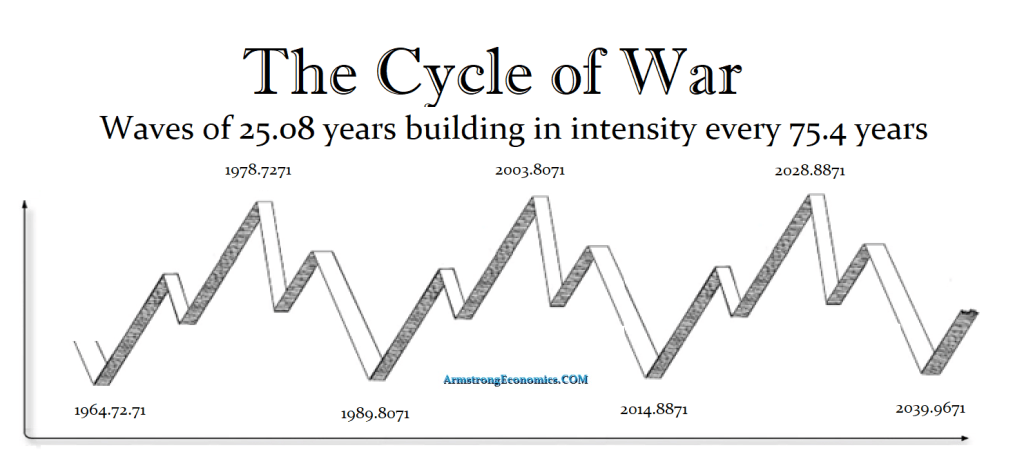
From the perspective of the Economic Confidence Model and the war cycle, this fits perfectly into the timing window we have been warning about. The arrays have been showing a convergence of civil unrest and international war cycles into 2026–2027. What we are seeing in Germany is not isolated. It is part of a broader shift across Europe, where governments are preparing for sustained conflict risk, not a temporary crisis.
Germany has also moved beyond simply increasing spending. They are restructuring the entire military system, including technology integration, AI-driven warfare, and logistics infrastructure that can support rapid deployment across Europe. This is preparation for long-term engagement capability, not defensive posturing. Once governments begin investing at this scale, they are not planning for peace. They are preparing for confrontation.
I have said repeatedly that Europe would move toward militarization as internal political cohesion breaks down and external threats rise. Germany, historically constrained by its past, is now being repositioned as the military anchor of Europe. That changes the balance of power entirely. It also raises serious questions about the future of NATO, particularly as the United States begins to pull back and Europe is forced to stand on its own.
This is why capital flows continue to favor the United States for now, even with its own fiscal issues. Europe is moving into a period of instability, and Germany’s military expansion is confirming that shift. The cycle is turning, and once it does, it does not reverse overnight.