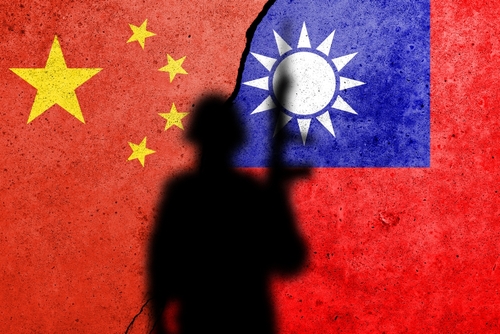
Taiwan’s Ministry of National Defense reported that 32 Chinese military aircraft, 10 naval vessels, and five additional official Chinese ships were operating around the island. More importantly, 25 of those aircraft crossed the median line of the Taiwan Strait and entered Taiwan’s air defense identification zone. That median line was once viewed as an unofficial buffer. Today, it is crossed so frequently that Beijing appears determined to normalize military operations in areas that would have been considered highly provocative only a few years ago.
The mistake many analysts continue to make is assuming that China must launch a massive sea invasion for the situation to become dangerous. Modern warfare is changing rapidly. A blockade, economic strangulation, cyberattacks, drone saturation, and missile pressure can accomplish many of the same objectives without immediately triggering a traditional war. Taiwan clearly understands this. The government is now accelerating plans to build an arsenal of more than 1,800 anti-ship missiles by 2029, including American Harpoons and domestically produced Hsiung Feng missiles. Officials openly describe creating a “kill zone” in the Taiwan Strait capable of inflicting severe losses on any attacking force.
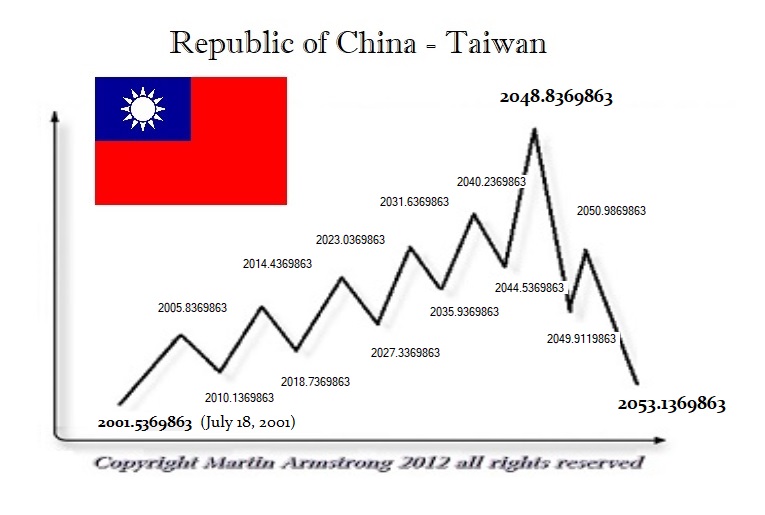
What interests me is not the daily military count. It is the timeline. China has increased military pressure around Taiwan for years, yet at the same time we see military planners throughout Asia discussing preparation windows extending into 2028 and 2029. Taiwan’s missile expansion is specifically designed to reach full strength around 2029. Military officials in Europe are discussing vulnerabilities that exist until roughly the same period. We are seeing governments independently focus on the same time horizon. That is difficult to ignore.
The larger issue is confidence. Governments always believe they can manage tensions indefinitely until suddenly they cannot. China is conducting larger exercises. Taiwan is rapidly arming. Japan is expanding defense spending. The Philippines is strengthening military cooperation with the United States. The entire region is preparing for a future that policymakers increasingly believe may be unavoidable.
Our models have been warning that 2026 would be a panic-cycle year marked by rising volatility and escalating geopolitical tensions. The risks continue building into 2027, which remains a major war-risk year. By 2028, recessionary pressures, sovereign debt concerns, and civil unrest begin colliding with these geopolitical tensions. Then we arrive at the major ECM turning point in 2029. Whether Taiwan becomes the spark is impossible to know in advance. What we can observe is that governments, militaries, and markets are all increasingly behaving as if they see a storm forming on the horizon.