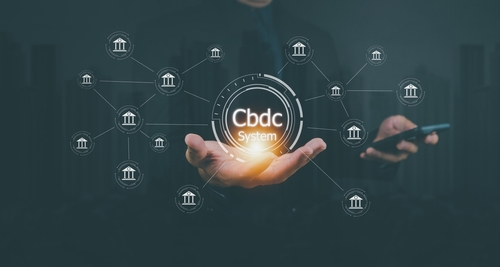
The push toward digital currency is being framed as innovation and efficiency, but when you strip away the marketing language, what is unfolding is a structural transformation of the financial system that shifts control away from individuals and concentrates it within governments and central banks. The Bank for International Settlements has confirmed that more than 90% of central banks are now actively researching, developing, or piloting central bank digital currencies, which is not coincidence or experimentation but a coordinated global direction. This aligns directly with what I have been warning, that when governments face a sovereign debt crisis they will turn to mechanisms that allow them to monitor and control capital flows because they cannot solve the debt problem through traditional means.
In the United States, more than 95% of transactions are already digital in some form, whether through credit cards, debit systems, ACH transfers, or mobile payment platforms, which means the infrastructure for surveillance is already largely in place. Cash has not been eliminated yet, but it has been marginalized, and that is the first step because once transactions become digital, every movement of money creates a permanent record. Governments already have the ability to access financial data through banks, but a central bank digital currency removes the intermediary entirely and places that visibility directly within a centralized system controlled by the state.
This is where the real shift takes place because a CBDC is not simply a digital version of existing currency, it is a programmable financial instrument. That means money itself can be controlled, restricted, or directed according to policy decisions. Transactions could be approved or denied in real time, spending could be limited to certain categories, and funds could even be given expiration dates to force consumption. These are not theoretical concerns as these capabilities have already been discussed openly in central bank reports and demonstrated in pilot programs around the world, including China’s digital yuan, which integrates payment systems with state oversight.
The connection to the sovereign debt crisis is critical because governments are reaching a point where they cannot sustain spending without either raising taxes, inflating the currency, or imposing controls on capital. Digital currency provides a mechanism to do all three simultaneously. Real-time taxation becomes possible because transactions can be monitored instantly, eliminating the lag between earning and reporting income. Capital controls can be enforced automatically by restricting transfers, preventing withdrawals, or limiting how funds are used. Inflation can be managed politically by directing spending into specific sectors or suppressing activity in others. This is the level of control that governments have never had before, and it changes the entire structure of the financial system.
The transition is being rolled out gradually because it cannot be imposed overnight without resistance. Digital systems will continue to coexist with cash and traditional banking for a period of time, but the direction is clear. As digital adoption increases, incentives will be introduced to encourage usage while restrictions on cash will slowly expand. Limits on cash transactions, reporting requirements, and regulatory pressure on banks are all part of this process. Eventually, participation in the digital system becomes not a choice but a necessity because alternatives are either restricted or eliminated.
There is also a geopolitical dimension to this shift because digital currencies can be used to bypass existing financial networks such as SWIFT, allowing countries to conduct transactions outside the traditional Western-dominated system. At the same time, within domestic economies, these systems give governments the ability to enforce policy at the individual level. This creates a dual structure where digital currencies are used externally to avoid sanctions and internally to impose control, and that combination is what makes this development so significant.
What is rarely discussed openly is how this ties into the broader expansion of surveillance. Financial transactions do not exist in isolation, they are connected to identity, location, and behavior. Once money is fully digital and centrally managed, it becomes possible to integrate financial data with other forms of monitoring, creating a comprehensive view of individual activity. This is where the line between financial regulation and social control begins to blur, because the same system that tracks spending can also be used to enforce compliance with policies that extend beyond economics.
The issue ultimately comes down to control rather than convenience because while digital systems offer efficiency, they also eliminate anonymity. Cash has always provided a degree of financial privacy because transactions could occur without leaving a trace. Once that disappears, every economic action becomes visible and potentially subject to oversight. That fundamentally alters the relationship between individuals and the state because financial independence is replaced with conditional access to money.
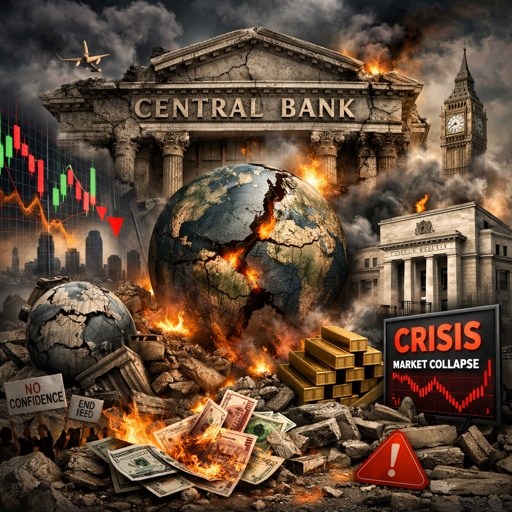
When you look at this within the context of the sovereign debt crisis, the direction becomes clear. Governments cannot allow capital to move freely when confidence begins to decline, and digital currency provides the mechanism to manage that risk. The ability to track, restrict, and direct financial activity ensures that capital remains within the system and under control. This is not about modernization, it is about maintaining authority in a system that is under increasing strain.
The transition is already underway, and once it reaches a critical mass, reversing it will not be simple because the infrastructure will be embedded in everyday life. The real question is not whether digital currency will be adopted, but how it will be used once it becomes the dominant form of money, because that will determine whether it serves as a tool of efficiency or a mechanism of control.