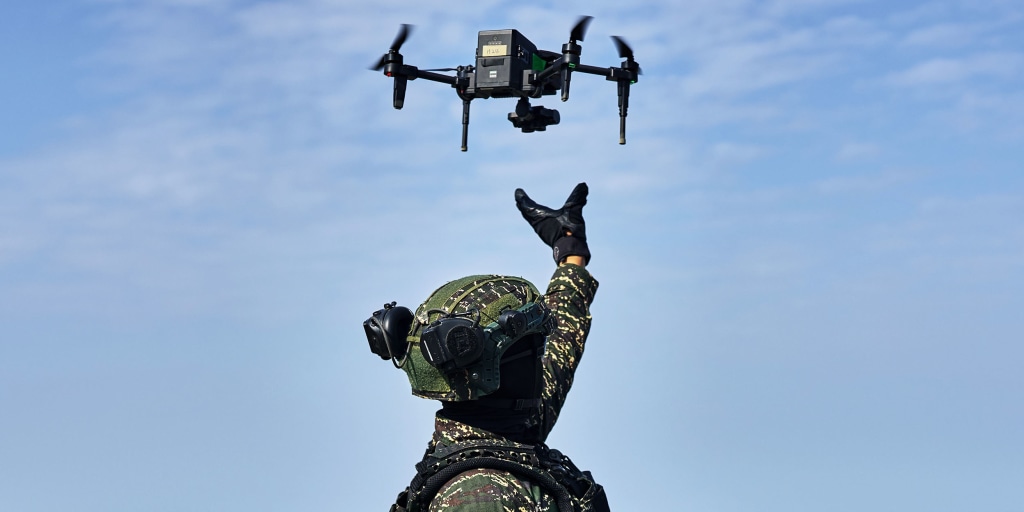
Taiwan has proposed another $4.6 billion in defense spending, and what is particularly interesting is where a substantial portion of that money is going. Taipei wants more than 600 coastal surveillance and reconnaissance drones, over 40,000 coastal attack drones, and an initial fleet of more than 100 unmanned suicide boats. This comes only days after Taiwan’s parliament approved a six-year drone program capped at NT$240 billion, roughly $7.6 billion. Taiwan is not buying drones as some technological experiment. It is preparing for what it believes a future war with China would actually look like.
Ukraine changed warfare because it demonstrated that a relatively inexpensive drone can destroy equipment costing millions of dollars. The Middle East has reinforced the same lesson. Taiwan has obviously been watching. President Lai Ching-te’s government originally sought roughly NT$210 billion to purchase about 210,000 military drones over six years, arguing that modern warfare has made unmanned systems essential to Taiwan’s asymmetric defense. Parliament ultimately approved its own larger NT$240 billion framework, and Taiwan is now moving aggressively to build the industry domestically rather than remain dependent on foreign suppliers.
This is precisely the type of weapon Taiwan would need if there were ever a conflict with mainland China. Taiwan cannot match China ship for ship, aircraft for aircraft, or soldier for soldier. China’s advantage in conventional military power is simply too great. Taiwan’s strategy therefore has to make the cost of crossing the Taiwan Strait and attempting an amphibious invasion so high that Beijing concludes the operation is not worth undertaking.
That is where drones become extremely important. Thousands of inexpensive unmanned weapons can be dispersed around the island, hidden far more easily than conventional aircraft, and launched against ships approaching the coastline. Surveillance drones can identify targets while attack drones strike landing craft, vehicles, supply lines, and troops. Unmanned boats add another dimension by threatening vessels offshore without placing Taiwanese sailors directly in harm’s way. This is asymmetric warfare, and Taiwan clearly believes quantity matters.
Taiwan is also fortifying the Penghu Islands in the Taiwan Strait, which would become strategically important in any invasion scenario. The military established its first drone force there in July and deployed UAVs during the annual Han Kuang exercises. Penghu sits roughly 50 kilometers from Taiwan’s main island and could provide Taiwan with positions from which missiles and drones could threaten Chinese forces attempting to cross the Strait. Beijing understands the importance of these islands just as well as Taipei does.

The government is not hiding its intentions. Taiwanese officials have openly discussed creating what American strategists have called a “hellscape” in the Strait, where enormous numbers of drones, missiles, mines, and unmanned vessels could overwhelm an invading force. Whether such a strategy would actually stop China is another question entirely, but this is clearly the direction military planning has taken.
What concerns me is the timing because Taiwan is not acting as if war is some impossible event decades into the future. Defense spending for 2027 is proposed to exceed NT$1 trillion for the first time, with the broader defense budget projected at roughly $35 billion. President Lai has said Taiwan intends to raise defense spending toward 5% of GDP by 2030. Governments do not make investments of this magnitude unless they believe the geopolitical environment has fundamentally changed.
This does not mean China invades Taiwan tomorrow, nor should every military procurement announcement be portrayed as proof that war is inevitable. Nevertheless, the entire region is preparing for a confrontation that politicians continue telling the public they supposedly want to prevent. China is expanding its military capabilities, Taiwan is rapidly increasing defense expenditures, Japan is rearming, and the United States continues restructuring its forces throughout the Pacific. Every participant says these preparations are intended to preserve peace while simultaneously preparing for war.
China itself dominates the global commercial drone industry and much of the supply chain required to manufacture them. Taiwan obviously cannot prepare for a conflict with China using critical components that would disappear the moment hostilities began. Taipei is therefore attempting to establish what it calls a “non-red” supply chain that excludes Chinese components while building domestic production capacity. This is as much an industrial policy as a military one.
This is where the world is moving as globalization continues to fracture. Defense is no longer simply about possessing weapons. Governments are realizing that they must control the factories, semiconductors, communications equipment, raw materials, energy, and supply chains necessary to replace those weapons during an extended conflict. Taiwan happens to possess one of the world’s most important semiconductor industries, but even that becomes a vulnerability when the island depends upon imported energy and materials.
Modern warfare is rapidly moving away from the assumption that victory belongs exclusively to whoever owns the most expensive weapons platform. A $100 million aircraft or multimillion-dollar armored vehicle can now be threatened by technology costing a fraction of that amount. The battlefield is becoming increasingly automated, decentralized, and dependent upon enormous quantities of relatively inexpensive systems.
Taiwan has clearly absorbed that lesson. The proposed supplementary budget alone includes more than 40,000 coastal attack drones, and the broader six-year program could ultimately produce a drone force numbering in the hundreds of thousands. Taiwan is preparing to saturate the battlefield rather than merely purchase a handful of extraordinarily expensive weapons and hope they survive the opening days of a conflict.
The political danger is that every military buildup creates another buildup on the opposite side. Taiwan says it needs drones because China threatens invasion. Beijing points to Taiwan’s expanding military cooperation with Washington as evidence that separatist forces are preparing for confrontation. Washington then cites China’s military expansion to justify additional weapons for Taiwan. This is how an arms race develops even when every government insists it is acting defensively.
Taiwan is therefore becoming one of the places to watch closely as we move toward the end of this decade. The investment in drones is not simply another defense contract. It reflects a fundamental change in how Taipei believes a war with China would be fought and demonstrates that Taiwan is preparing seriously for the possibility that deterrence could eventually fail.