The Federal Reserve’s preferred inflation gauge just delivered another reminder that inflation has not been defeated. The Personal Consumption Expenditures (PCE) Price Index rose 4.1% year-over-year in May, the highest annual reading in three years, after climbing 0.4% during the month alone. Even stripping out food and energy, the so-called “core” PCE increased another 0.3% in May and now stands at 3.4% annually, still nearly double the Fed’s mythical 2% target. This is now the third consecutive month that inflation has accelerated rather than cooled. Meanwhile, consumer spending increased another 0.7% during May despite prices continuing to rise. People are still spending, but they are increasingly financing that spending by drawing down savings rather than enjoying genuine increases in purchasing power.
This is precisely why I have said repeatedly that simply replacing the Fed chairman changes nothing. Kevin Warsh inherits the same Keynesian institution that has governed monetary policy for decades. The politicians want lower interest rates because governments are drowning in debt and every percentage point increase dramatically raises interest costs. But central bankers cannot simply ignore inflation when it is moving back above 4%. Markets continue to fantasize that a new chairman somehow has a magic wand. That is political wishful thinking, not economics.
If inflation continues to reaccelerate, the pressure to raise rates will become overwhelming regardless of who occupies the chairman’s office. The Fed follows its mandate, and inflation above 4% leaves very little room for political fantasies.
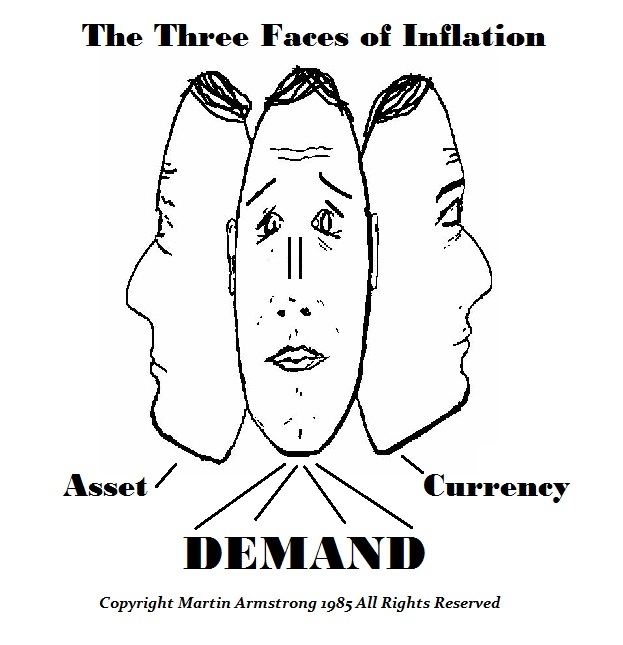
Many commentators immediately blamed the increase entirely on higher oil prices during the recent Middle East conflict. Energy certainly contributed, but that explanation is far too simplistic. Core inflation excludes food and energy, yet it also accelerated to its highest level since late 2023. That tells us inflationary pressures have spread throughout the broader economy. Housing, services, transportation, insurance, labor costs, tariffs, and supply-chain disruptions all continue feeding higher prices. This is exactly why I have argued that reducing inflation to a single commodity price misses the broader cyclical forces driving the economy. Once inflation becomes embedded throughout the system, it becomes far more difficult to eliminate than politicians care to admit.
The markets continue to misunderstand another important point. Rising interest rates are not automatically bearish. Historically, rates tend to rise alongside strong capital concentration and expanding markets because money competes for returns. Rates generally collapse during bear markets and recessions when capital desperately seeks safety. We are entering a period where geopolitical instability, sovereign debt problems across Europe, and international capital flight continue funneling money into the United States. That capital flow can support both the U.S. dollar and financial markets even while interest rates remain elevated. The old Keynesian assumption that higher rates automatically destroy markets has repeatedly failed during previous international crises.
The broader issue extends far beyond one inflation report. Governments worldwide have accumulated debt levels that cannot realistically be serviced under permanently elevated interest rates. Every central bank now finds itself trapped between inflation and sovereign debt. Lower rates encourage inflation and currency instability. Higher rates increase government financing costs and expose the insolvency of highly indebted nations. That is why sovereign debt remains the defining issue of this decade. Inflation is not simply about gasoline or groceries. It is the symptom of governments that borrowed far beyond any sustainable level and now face the consequences.
Our models continue to point toward rising volatility into 2026 as the Panic Cycle unfolds. War, capital migration, sovereign debt stress, and declining confidence in government institutions are converging simultaneously. The latest PCE report is simply another confirmation that inflation has not disappeared. It merely paused before beginning its next advance. Those expecting a smooth return to the low-inflation world of the last decade are preparing for a future that no longer exists.