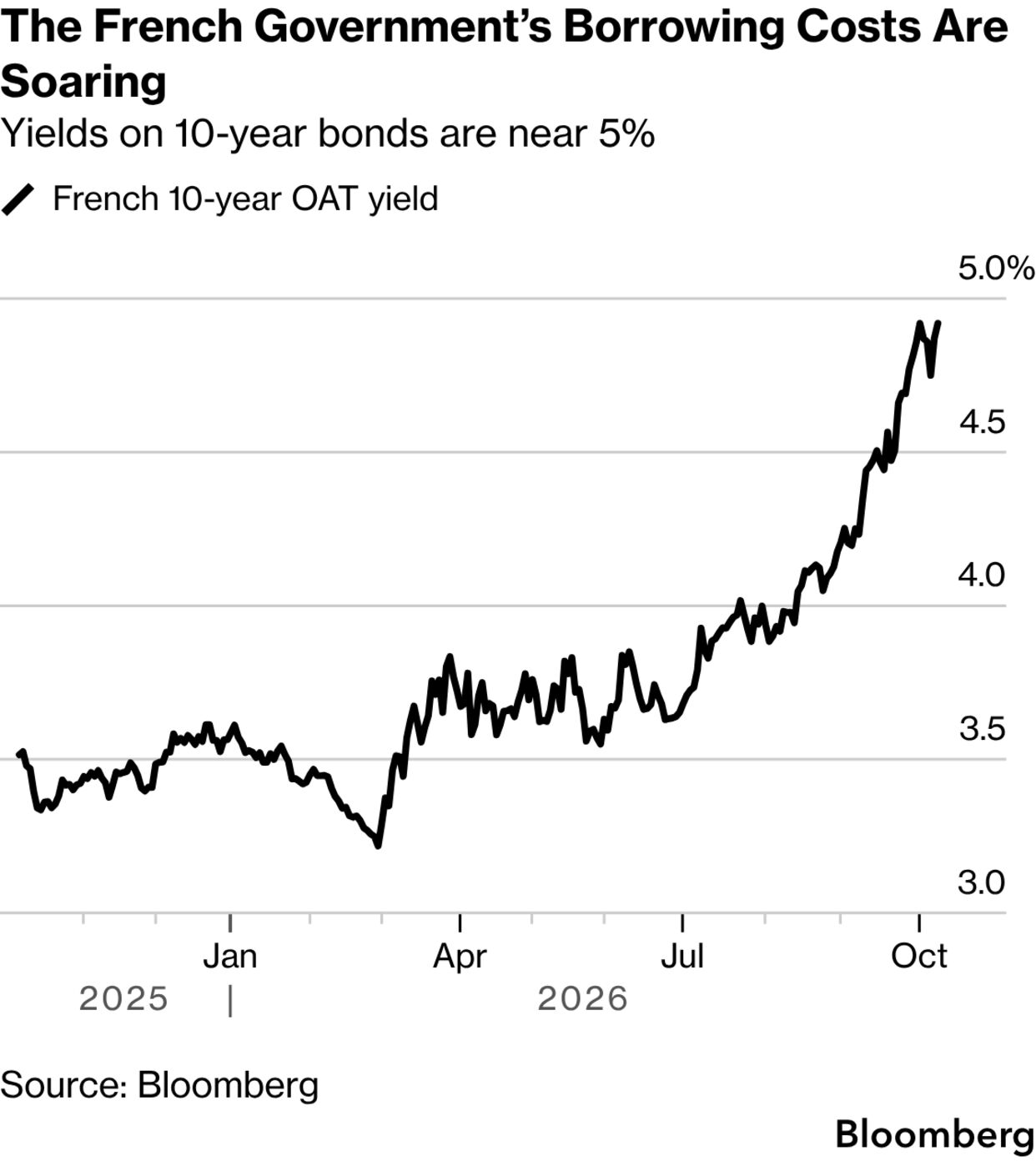
Spain’s 10-year borrowing cost is now approximately 75 basis points below France’s. During the 2012 European debt crisis, it was around 500 basis points above. French yields jumped 70 basis points in September, while the premium over Germany reached nearly 160 basis points. France also plans €340 billion in bond issuance for 2027, and its deficit is expected to exceed the government’s 5% target. These figures describe a government needing substantial financing just as investors become less comfortable providing it.
The politicians assume that because France has always been treated as a major European power, its debt will always receive favorable treatment. Why? A creditor is buying a claim on future payments, not a monument to the borrower’s prestige. Spain was once regarded as a threat to the monetary union. Now investors accept less interest to hold its debt than France’s. The reputation changes when the financial position and confidence in its management change. No government is entitled to remain a preferred borrower forever.
Look at the arithmetic behind that €340 billion. An additional percentage point of interest on that amount would mean €3.4 billion in annual financing costs if applied across the issuance. That is an illustration, since bonds are issued at different maturities and yields, but it shows the scale. There is no new hospital, road, or productive investment attached to that extra expense. The government is paying more to obtain the money it already needs. Existing fixed-rate debt does not reprice overnight; the pressure accumulates as old obligations mature and new borrowing is added.
This is the problem with governments that never intend to retire their debt. They assume another buyer will always finance the next rollover. When borrowing is cheap, they congratulate themselves on how manageable the obligation has become. When creditors demand more, the interest bill eats into the budget and the public is presented with another choice between taxes and cuts. The promises were made years ago. The people now paying for them may have had no part in the decision.
Sharing a currency does not make every government an equally attractive borrower. Investors can sell one member’s bonds and buy another’s without abandoning the euro. That distinction matters because pressure can build inside the monetary union while officials insist that its existence proves confidence remains intact. Confidence in the currency, confidence in a government, and confidence in that government’s debt are separate judgments.
France’s public debt reached €3.5955 trillion at the end of June, according to INSEE, equivalent to 119% of GDP. It increased by €75.8 billion in the first quarter and another €59.6 billion in the second, adding €135.4 billion in six months. At the end of 2019, the debt ratio was 98.2%. Paris has spent years making commitments financed by tomorrow’s borrowing, and now that borrowing is becoming more expensive. Existing fixed-rate obligations do not suddenly reprice, but every maturity brings another financing decision. The government must find money to repay the old creditor while financing whatever spending still exceeds revenue. That is how a country can keep paying its debts while digging itself deeper into the hole.
The euro’s fundamental weakness is exposed in these borrowing costs. Europe combined the currencies without consolidating national debts into one jointly guaranteed obligation. Greece, Italy, Spain, and Portugal surrendered their independent exchange-rate policies while remaining responsible for their own finances. When confidence broke, adjustment fell heavily on domestic wages, employment, budgets, and taxpayers. It would be simplistic to blame every southern European problem on that design, but monetary union removed an important means of adjustment without creating a full fiscal union to replace it. France is now borrowing more expensively than Italy and Greece, while Spain’s 10-year yield sits about 75 basis points below France’s. The ECB’s policy rate cannot erase those differences because investors are lending to separate governments. A French bond is not a German guarantee merely because both are denominated in euros.
France’s political class should remember how readily Europe demanded sacrifices from the south when those countries could no longer finance themselves on acceptable terms. What happens when the promises cease to attract the money? The burden moves onto taxpayers and public services, or the government seeks assistance that comes with conditions. The people who spent the proceeds may have retired by then. The people working today are left financing the interest on decisions they cannot undo.