QUESTION: Martin,
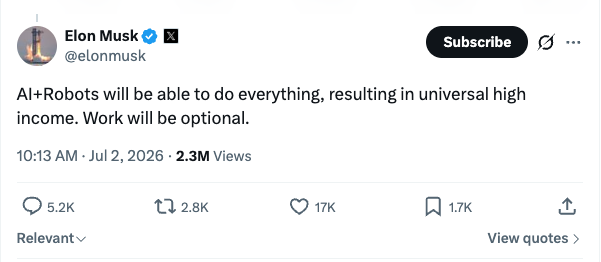
How does the richest man in the world not understand basic economics?
Blog post?
BT
ANSWER: For the life of me, I believe this sort of thinking all stems from Karl Marx and this distorted idea that the object is to be taken care of by government and just lay around and watch TV that is intended to indoctrinate people. This sort of reasoning is against every basic foundation of civilization. AI and robots are incapable of original discovery for they cannot possess that human characteristic of curiosity.
Elon Musk’s reasoning that AI and robots will make work optional is based on a core economic absurd argument: AI and robotics will create such an abundance of goods and services that the very concepts of work and money become largely obsolete. However, this vision also faces significant challenges and raises complex questions about the human desire for purpose. I was doing research in the Firestone Library at Princeton University. I became friends with one professor who had known Einstein.
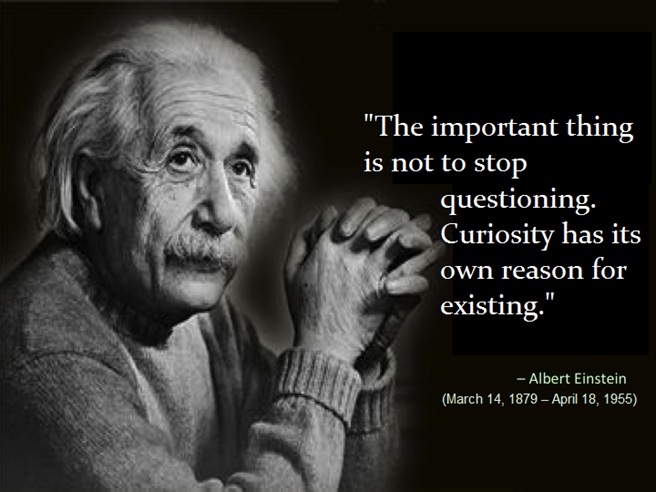
He asked me what I was so intensely researching. I explained that I was trying to ascertain why all governments rise and then crash and burn throughout the centuries. He then said to me that I reminded him of Einstein. I was taken back. I said I was no Einstein. He then explained to me to me that the subject matter did not matter. It was curiosity that was the mother of all discovery. Without someone being curious, human society would stagnate.

During the late 1970s, I went through Check-Point-Charlie into East Germany. I wanted to see what Communism was all about and why they needed a wall to prevent people from fleeing. Those words from that professor suddenly rang true. The government feared individualism and curiosity. Because of that, the Russian economy could never compete with Capitalism because it suppressed the very essence of how human society advances. It requires that curiosity to make innovations that expands the economy and raises the standard of living.
Musk’s argument is rooted in what he sees as the logic of productivity and deflation. His reasoning can be broken down as follows.
- The core idea is that AI and robots will be capable of performing nearly all physical and cognitive labor at near-zero marginal cost . This would lead to a massive surge in the production of goods and services. However, it would be like Communism lacking that curiosity and this would suppress any advancement.
- The resulting supply would vastly outpace the available money supply, causing the prices of everything from food and housing to healthcare and education to plummet towards zero . For example, current productivity might see one worker produce 100 units per day, while one AI could produce 10,000, fundamentally breaking the link between work and survival.
In this state of “post-scarcity,” money, which Musk describes as an “information system for labor allocation,” would lose its purpose. If you can have anything you want without needing to direct someone else’s labor, he assumes that the currency system collapses. He has stated, “I think money will stop being relevant at some point in the future.”
To manage this transition, Musk proposes a “universal high income” (UHI), which goes beyond a basic safety net to ensure a comfortable life for everyone, funded by the massive surplus generated by AI and robots.
In this future, work would transition from a necessity for survival to an optional pursuit for personal satisfaction—a hobby, much like gardening for pleasure rather than out of necessity .
While Musk sees a future of shared prosperity, the classic communist goal, this vision is childish and lacks any reference historically. There is one historical precedent that needs to be addressed. There is a well-known historical paradox. Spain did import vast amounts of silver and gold from its New World colonies, but this wealth did NOT lead to broad economic expansion and instead contributed to a long-term decline.
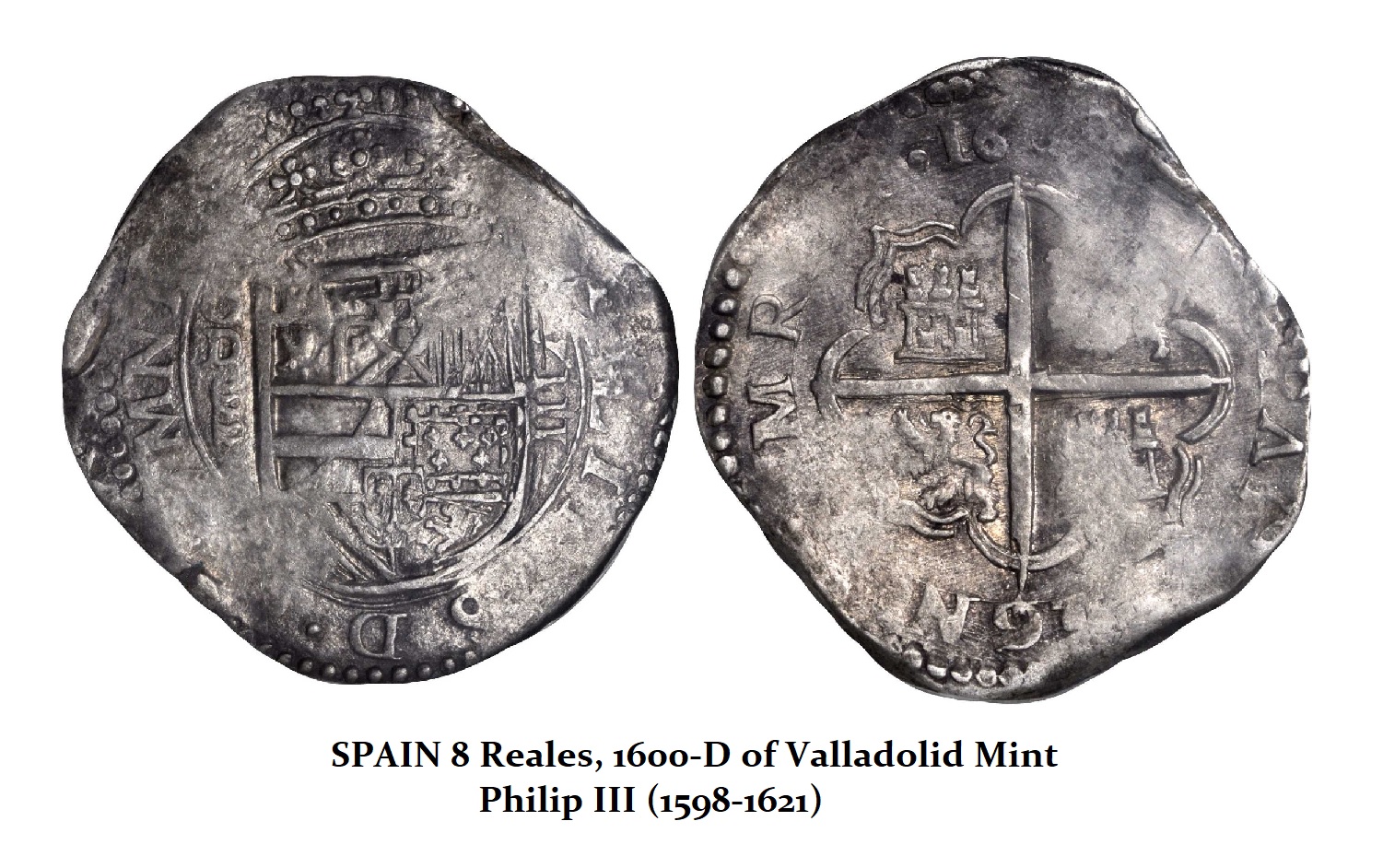
The “Resource Curse” and Economic Distortion:
The massive influx of precious metals, especially silver, created a “resource curse” effect on the Spanish economy. The primary impact was severe inflation, which made Spanish goods expensive and uncompetitive internationally.
The “Dutch Disease” Effect:
Economists have identified this as an early case of “Dutch disease,” where a boom in one sector (in this case, raw materials from the colonies) harms other sectors like manufacturing. The inflow of silver inflated prices and led to a rise in the relative price of non-tradable goods (like services and housing) compared to tradable goods (like manufactured products).
This meant Spain’s domestic industries could NOT compete with cheaper goods from other European nations. As a result, the bullion largely “passed through” Spain to pay for imports, fueling the economies of countries like England and the Netherlands rather than fostering domestic economic expansion. A close analysis reveals that by 1750, Spain’s GDP per capita was over 40% lower than it would have been without the silver influx.
The massive mining and agricultural work in the Americas was not performed by a disgruntled Spanish populace. It was carried out through the brutal exploitation of Indigenous peoples under systems like the encomienda and later through the forced labor of enslaved Africans.
While there is evidence of French migration to parts of Spain, such as the Bishopric of Girona in the 16th and 17th centuries, this was a regional phenomenon. These French immigrants were noted to be heavily represented in the treballador (worker) category. Under Musk’s fictional economic system, migrants from poor regions will be attracted to fill jobs with actual human labor that Mush assumes can be eliminated with AI and robots.
Musk is making the same mistake as the Marxists and does not comprehend that “lack of economic expansion” in this economic utopia as we saw in Spain that was caused by the distorting effect of vast, sudden wealth on the national economy, which discouraged domestic industry. AI and Robots lack that human element of curiosity and that is the cornerstone of civilization. Those nation states that embraced capitalism and free financial markets, encouraged investment and that does not take place without the CONCENTRATION of wealth the socialists hate so much. But there is a disparity of wealth also among nations, which they seem to ignore.

In January 2014, IBM committed $1 billion to create a new Watson business division. This was a significant move to commercialize Watson’s cognitive computing abilities and make them available via the cloud. This investment included a $100 million venture fund to support startups developing apps powered by Watson.
A large portion of IBM’s investment went into Watson Health, which aimed to revolutionize medical treatment. The company spent more than $4 billion to acquire health-related data and analytics companies. This endeavor, however, faced major challenges and is widely considered a failure, with IBM eventually selling off parts of Watson Health for over $1 billion in 2022. The told the world that Watson would discover the cure for cancer. That requires curiosity, which Watson lacked.
Musk’s reasoning presents a logical endpoint of technological progress—a world of immense abundance. However, the economic “math” of this future is only half the equation. The “human nature” part, how society navigates the transition and how people find meaning beyond work, remains the central, unresolved challenge of his vision. Without that human trait of curiosity, the economy will stagnate and eventually collapse. Just compare the economic growth of even Germany at 0.8% compared to the United States at 2.16%. The distinguishing factor is the highly socialistic policy of Germany and the EU seeking to control every aspect of society.
Musk’s world would be another version of communism for even without money, then the state would own everything and you will NOT be happy. Investment would NOT exist and that individual who comes up with an idea would have no means to develop that into a successful industry. In Communism, children were taught that the state was their real parent. There was no God, that was just the controlling mechanism of Capitalism. Ambition was evil as was curiosity. All progress would come to a halt, which was why communism failed.