COMMENT #1: Marty, I tried to get my brother to read your blog and he said it was depressing. I tried to explain that you always say that there is a light at the end of this tunnel and it will be our opportunity to redesign the system for the better. We cannot accomplish that goal if we do not understand what needs to be fixed. I can see the problem. He will be swept up in the rhetoric of the left and this is how society is dividing. It’s hard to imagine we came from the same parents. At the core, they do not want to admit that their ideas are wrong and to achieve their perfect Marxist Utopia, we must surrender all personal freedom. I understand you have tried to warn the world in hoping to reduce the amplitude of the event. The self interests of the left and the neocons attack you because you have the track record to support your warnings while others have only opinions.
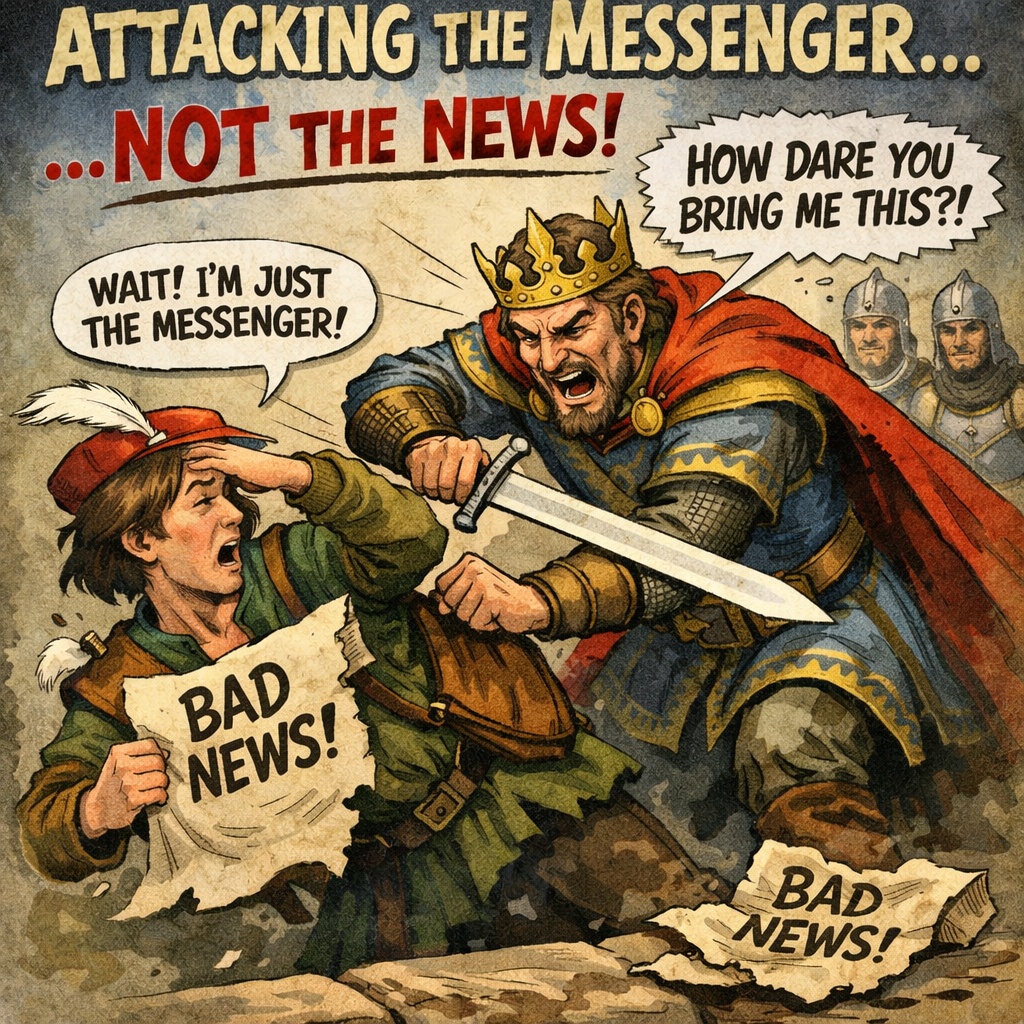
History will remember you. Not the muckrakers with only opinion. As always, they attack the messenger rather than confront the news.
Paul
COMMENT #2: The biggest criticism I have heard about you is not that cyclical analysis works, but you are the largest advisor that ever was and as such you have too much influence. Would you address that criticism?
Remi
QUESTION #1: I always have hope Marty, if we have no hope, we lose everything. I think people are more aware of what’s happening and who is pulling the strings and forcing us into these wars. The question is, how do we remove the neocons, how do we stop the madness, does it require an uprising, for those in power will not stop until they succeed. We need people to pull in the same direction, and also to ensure that our freedom of speech is not eroded. You can already see they are trying to shut down these channels. How can we, the great unwashed fight back if we dont fight together in an organised and legal manner ?
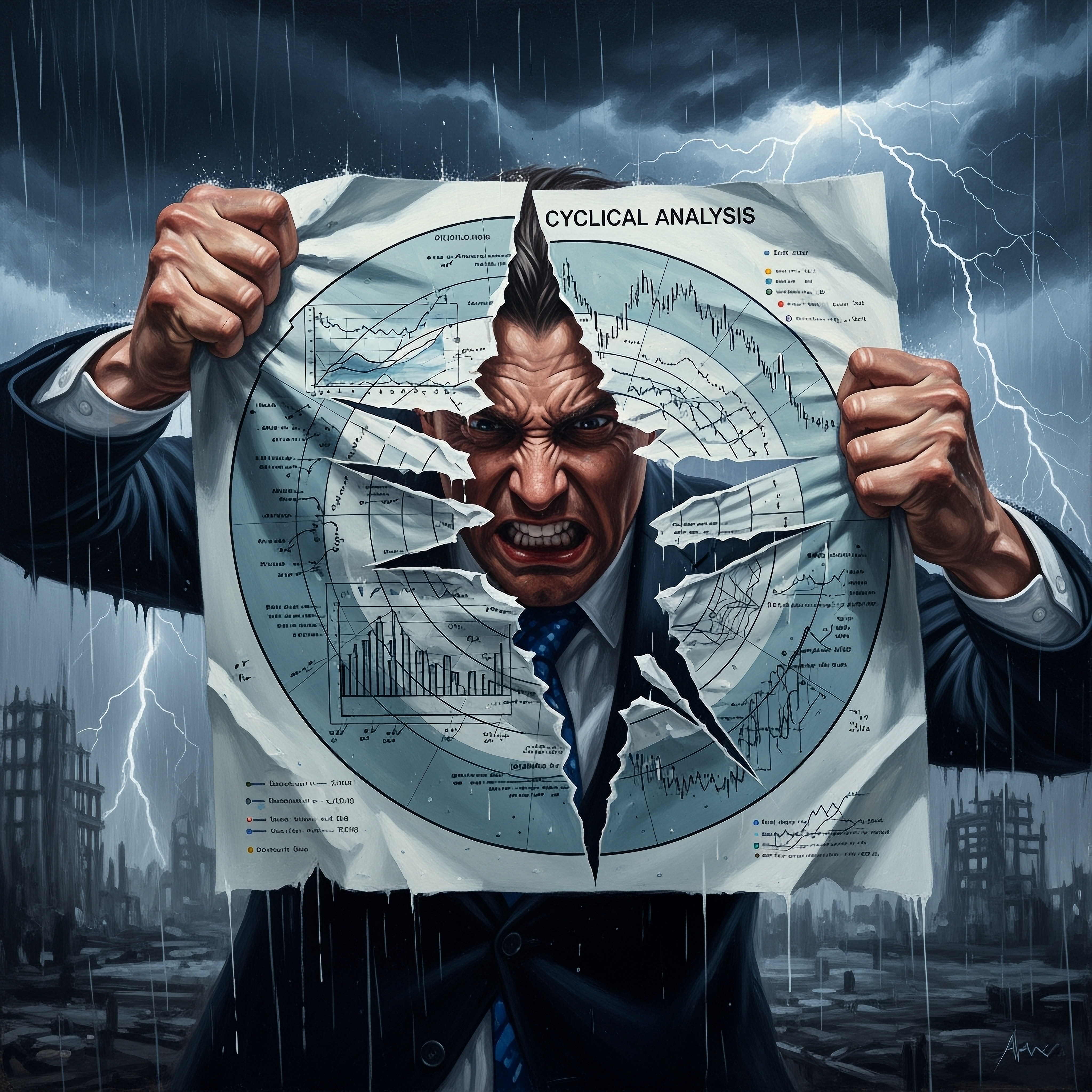
REPLY: You’ve pinpointed a core tension in economic thought. There has been this animosity that dominates economics stemming from different sources and targets different aspects of “cyclical analysis” and the hatred of those of us who have dared to even use cyclical analysis. The fear is not simply that “humans cannot alter the business cycle,” but rather a deeper philosophical and methodological rejection of the inevitability and predictability implied by some cyclical theories, especially when they challenge the efficacy of policy or the fundamental stability of the current economic system. Without socialism, government cannot promise the moon and when the cycles conflict with their agenda, it is always time to kill the messenger.
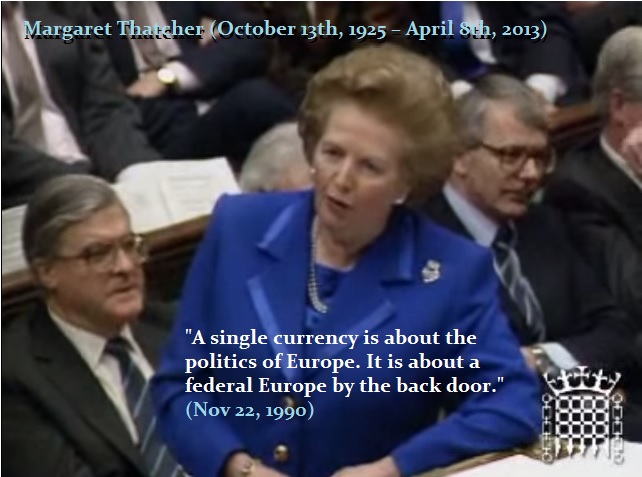
I have dealt with heads of state when there was a time when intelligent people held such offices. Both Margaret Thatcher kept Britain out of the Euro for she instinctively understood it was the backdoor way to federalize Europe. It was her own cabinet that staged a coup to try to surrender British sovereignty for a dream of the euro that was absurd. They actually believed that combining with a single currency, their GDP would be larger than the USA and Europe would rise again to lead the world. I warned them it would require (1) debt consolidation, which they rejected because they did not trust each other, and (2) they would have to abandon Marxism which their heads would turn around and spit out green fluid as in the Omen at just the thought of a free economy.
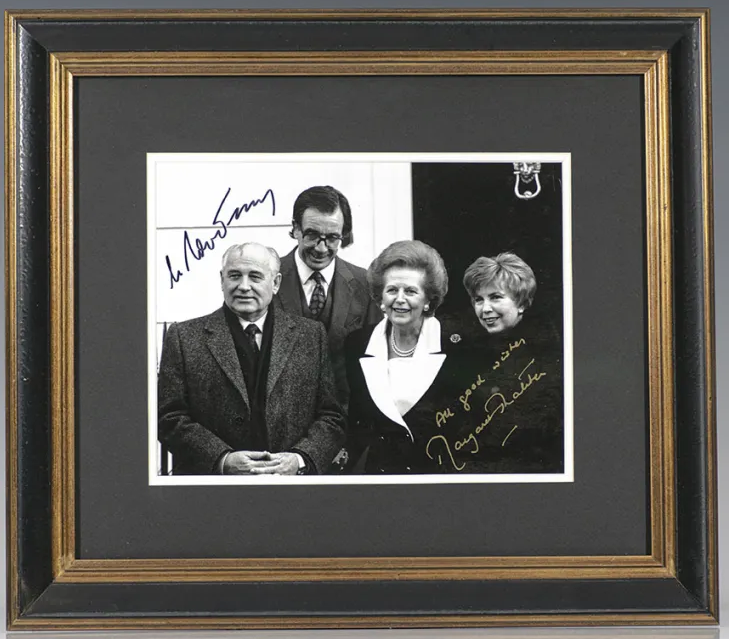
Even my dealings with Mikhail Gorbachev were also impressive insofar as he too understood cycles instinctively. Gorbachev resurrected Kondratieff who Stalin executed because he too did not like his message that capitalism would not die. He grasped that the USSR was collapsing and it was precisely on time. He choose to go with the cycle rather then try to fight it.
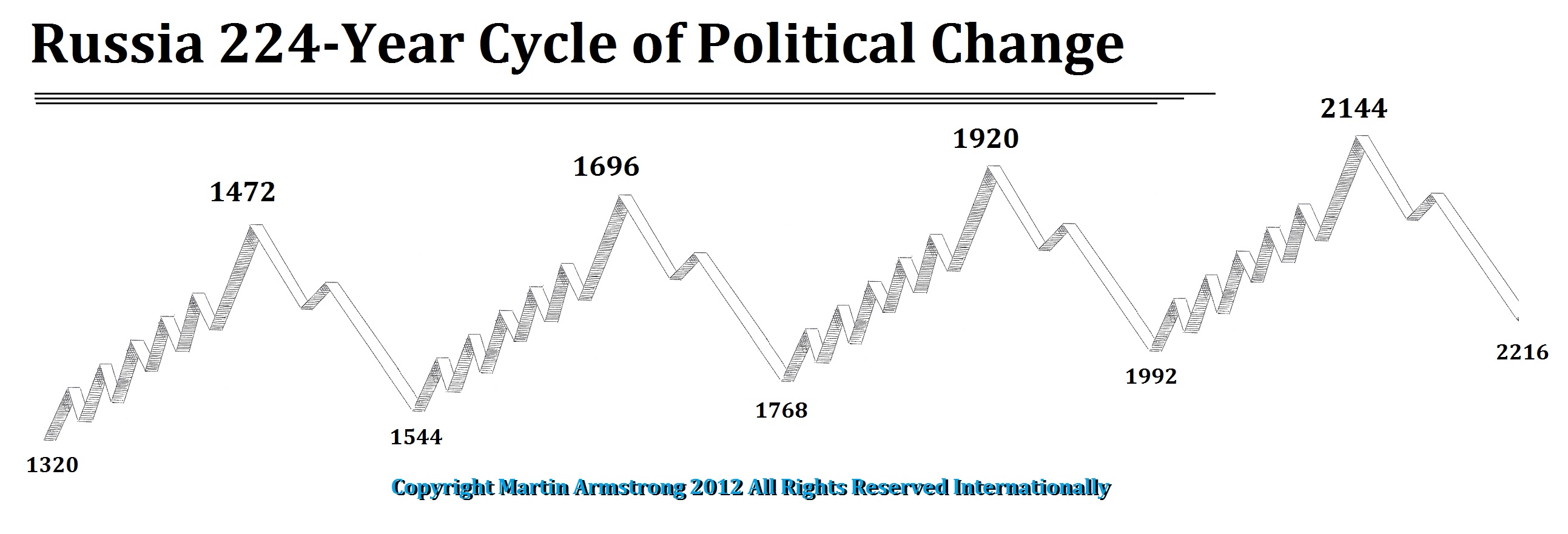
Mikhail Gorbachev understood our forecast that Communism would collapse in 1989. He embraced the cyclical reality and was the correct man at the correct time to help with the transition without bloodshed. The Economic Confidence Model gave us 1989 for the collapse of Communism, but it was the 224 Year Cycle of Political Change that gave us 1992 and the breakup of the USSR.
As far as having too uch influence, that is the typical view from people who utterly fail to understand that cycles exist, and their inability to see the world or to dynamically think connecting the dots from all fields of science rather than the typical linear thinking process. They try to reduce everything to a single cause and effect like global warming is entirely due to CO2. It was the massive droughts in Asia that sent Attila the Hun to invade Europe. It was the eruption of Thera that wiped out the Minoan society. It was the climate change to cold that sent the sea people to wipe out Bronze Age city states.
They cannot connect the dots. Here is Larry Summers who thinks that if you simply forecast, you then influence the outcome. Sorry, it does not work that way. Yes, we are probably the biggest ever. But we have clients with even trillion dollar portfolios. That does NOT mean they simply do as I say. They take the forecasts and run it through their own due diligence. They understand that everything is connected and there are so many variables, it does take a computer to keep track of everything.

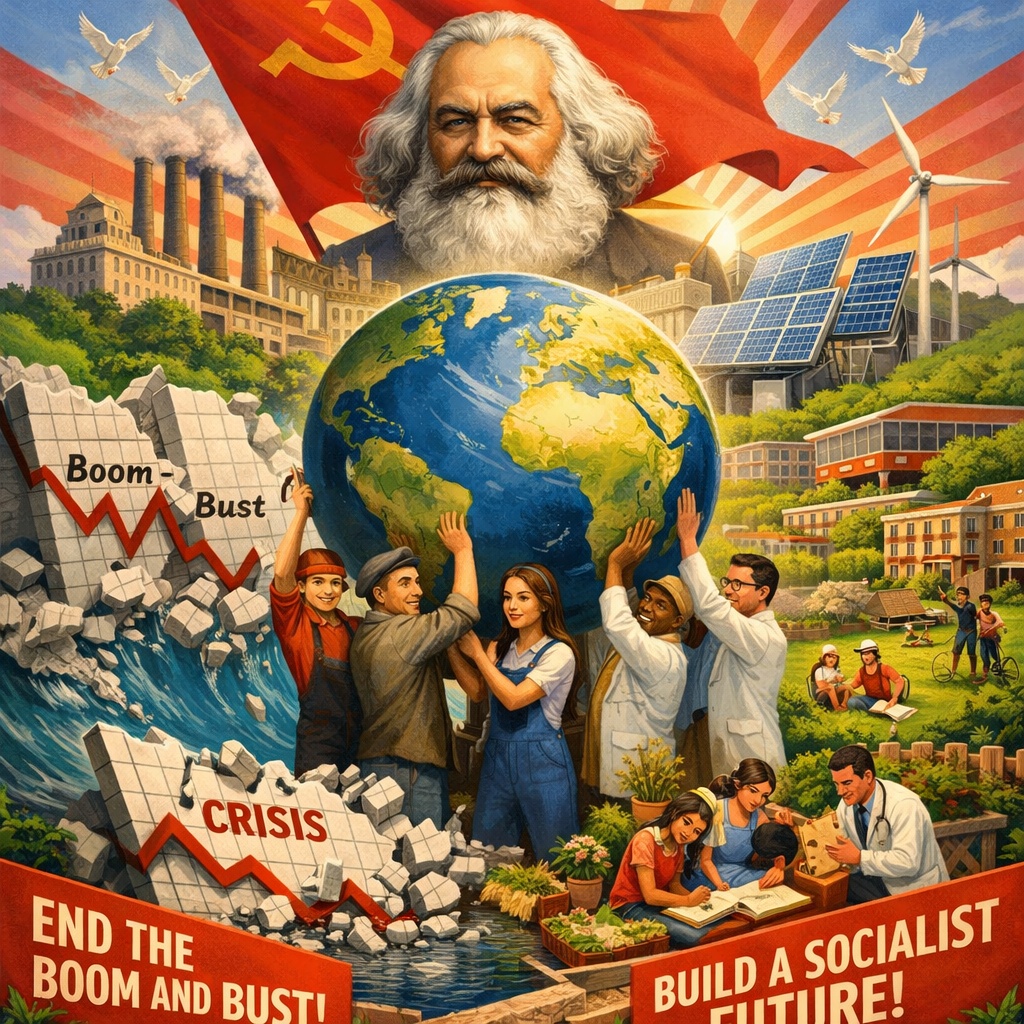
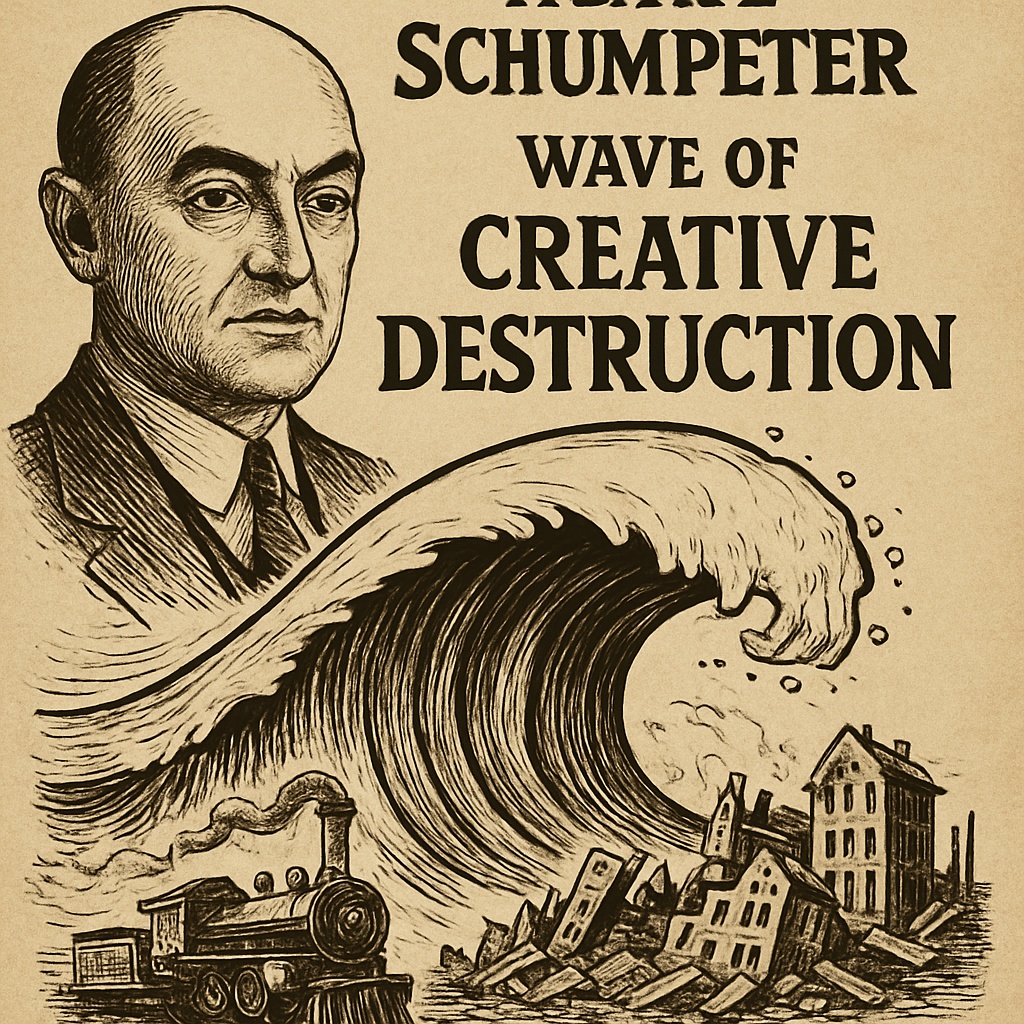
Karl Marx saw the Cycle as a Symptom of Doom. Marx didn’t just describe a business cycle; he described a crisis cycle inherent to capitalism. For Marx, these cyclical crises were not accidental flaws but necessary features of a system built on internal contradictions (e.g., the tendency of the rate of profit to fall). They would grow progressively worse until the system collapsed. Stalin has Kondratieff executed because he saw that the decline in the business cycle was how it rejuvenated the system and it would not die but be reborn each time. Joseph Schumpeter described this as waves of creative destruction. The invention of the automobile put the horse and buggy people out of business. The Internet put a lot of local businesses out of the economy as they could not compete just as AI is starting to also change aspects within the economy.
Mainstream (neoclassical) economics has always been profoundly hostile to this view of cyclical analysis. Why? This threatens the System Legitimacy that government has the power to manage the economy. If crises are inevitable, then the entire system is delegitimized. How can a politician run for office promising change if the business cycle cannot be altered? This is an existential threat, not just a technical disagreement.
Marx’s cycle theory suggests that policy tweaks (like those later proposed by Keynes) are merely band-aids on a mortal wound. The animosity, therefore, comes from a political and ideological fear that accepting a Marxist cyclical analysis means accepting the inevitability of revolution and the futility of reform. The fear is that if people believe the cycle is an inescapable death spiral, they will seek to overthrow the system. This appears to be a desperate assessment and they love to blame the disparity of wealth as the culprit. However, the disparity of wealth is by no means confined to the individual.
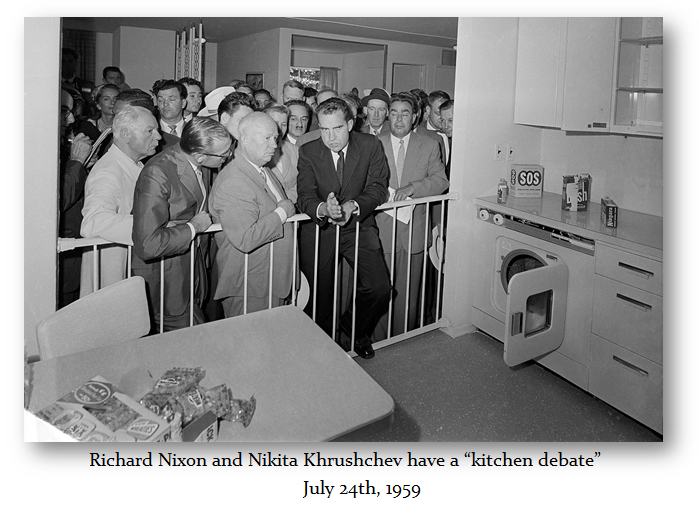
A nation can be the richest in natural resources like Russia, but this suppression of individual freedom ensured the economic stagnation of communism for innovation always comes from the individual – not government. That was well illustrated in the famous Kitchen debate of 1959 between Khrushchev and VP Richard Nixon where he demonstrated all of the innovations from the private sector.
John Maynard Keynes: The Cycle as a Failure of Aggregate Demand
Keynes shifted the focus. For him, the business cycle was driven by fluctuations in aggregate demand, primarily investment, influenced by volatile “animal spirits.” The cycle was a persistent malfunction of a market economy, not its inevitable death knell.
Keynes’s Goal was ALTERATION of the cycle and his whole project was to demonstrate that humans could and should alter the business cycle through government intervention (fiscal and monetary policy) to smooth out booms and busts.
The Source of Animosity (toward Keynes): This came later, from two powerful schools:
Monetarists (Milton Friedman):
Friedman argued that the cycle could be managed through steady, rules-based monetary policy, but that Keynesian fine-tuning was dangerous and destabilizing. Their animosity was toward the activist, discretionary aspect of Keynesian alteration, not the idea of some control.
New Classical Rejection of Cyclical Analysis:
The classical academics launched a methodological and ideological attack on the very foundation of cyclical analysis as a policy guide. They argued that what look like cycles are actually optimal responses to exogenous shocks (like technology changes). The economy is always in equilibrium. There is no inherent “cycle” to alter—only efficient adjustments to surprises.
However, the the conflict emerges from the realization that government attempts to “alter the cycle” are not just futile but actively harmful, creating distortions and inflation. The fear is of hubristic policy making based on a flawed model. They argued that if people are rational, they will anticipate government policy, rendering systematic Keynesian stabilization policies ineffective. We see this in market activity when the interest rate is changes and the market moves opposite of expectations and the response is that it was already factored into the market price.
The Modern Dominance goes out of its way to insist that this is all random “Fluctuations,” not regular “Cycles.” The classical academics have gone as far as to discard the term “business cycle” attempting to drive this out of favor in mainstream macroeconomics, replacing it with “economic fluctuations” or “boom and bust” cycles.
Why? “Cycle” implies a predictable, endogenous, wave-like pattern with regularity (like the Kondratieff wave or Juglar cycle). This suggests inevitability and, perhaps, a theory like Marx’s. The Preferred Model is emerging as the dominant framework (Dynamic Stochastic General Equilibrium – DSGE) models the economy as being hit by random shocks. The resulting “fluctuations” are not predestined cycles but the complex outcome of these shocks propagating through the system. They cannot grasp the complexity that the business cycle cannot be reduced to a single isolated cause and effect.
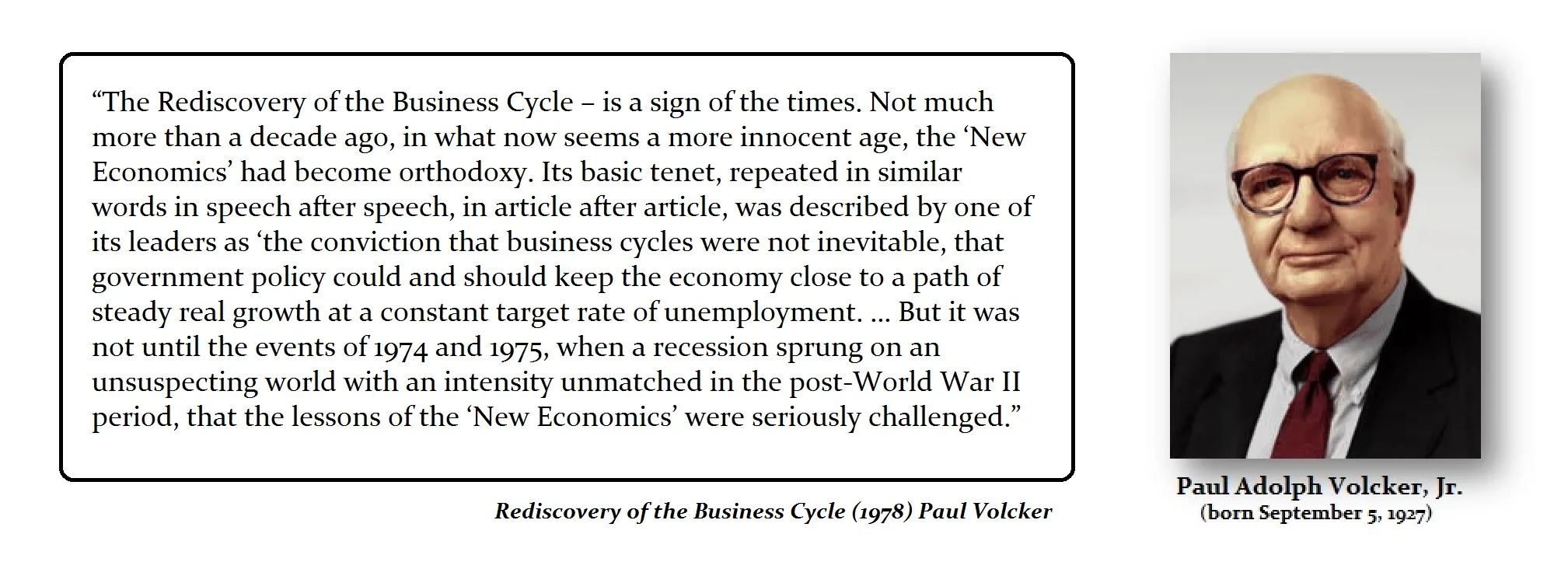
The implication is serious. If there is no predictable cycle, the goal is not to “alter a cycle” but to improve the economy’s resilience to shocks (through flexible markets, credible central banks, and sound institutions) and to use monetary policy to stabilize prices and, to a lesser extent, output. Yet this has proven to be futile. Even Paul Volcker, the renown former Chairman of the Federal Reserve in his Rediscovery of the Business Cycle published in 1978, admitted that Keynesian Economics failed in 1974/1975.
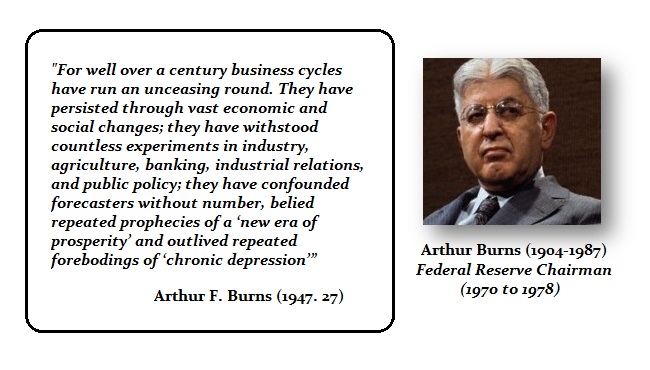
Arthur Burns, who was the Fed Chairman in 1971 when the gold standard collapsed under Bretton Woods, also concluded that the business cycle always wins. The academic economists refuse to even investigate the business cycle because if there is a cycle of regularity, then their theories are worthless.
The Austrian School Exception
It’s worth noting the Austrian School (Hayek, Mises), which embraces a cyclical theory (the boom-bust cycle caused by central bank-induced credit expansion) but is also profoundly hostile to Keynesian alteration. Their argument is that intervention prolongs and deepens the necessary correction. Their animosity is toward the alterer, not the analysis.
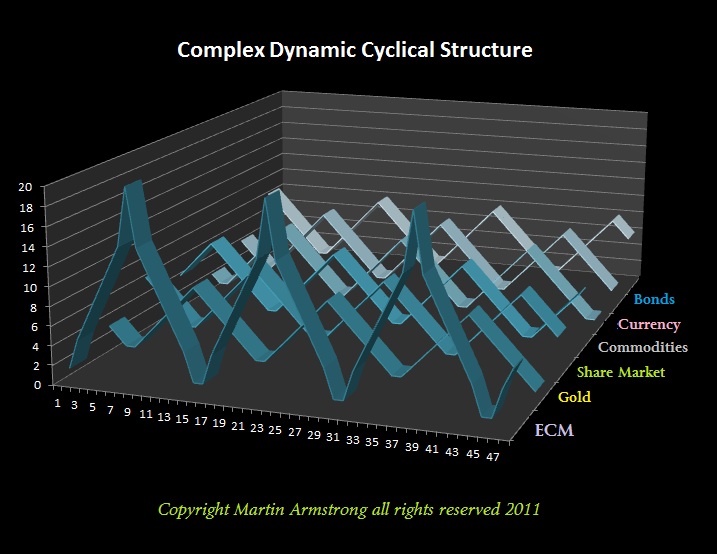
COMPLEXITY
The animosity toward cyclical analysis is multifaceted where with linear analysis, the goal is always to reduce the blame to a single cause and effect. The main rejection is that they perceive cyclical analysis predicts systemic collapse and they at least respect is tied to revolution, which is why they are waging economic war against Russia currently attempting to cause its collapse and/or revolution.
Against the idea of a predictable cycle that can be fine-tuned by discretionary policy, we must comprehend that humans cannot successfully alter the business cycle without making things worse, simply because they lack the understanding of the complexity behind it. The academic economists would be discredited as their preference for rules-based policy or a belief that most fluctuations are efficient responses. This is like looking at a woman in child birth and ignoring that a child is being born trying to deal with the contractions without knowing their cause.
Linguistic Retreat: The mainstream has abandoned the term “cycle” itself to distance itself from theories of endogenous inevitability and to focus on models of stochastic shocks.
In essence, the animosity toward certain types of cyclical analysis reflects a deeper battle between visions of the economy: Is it a system plagued by inherent, predictable crises? Or is it a fundamentally stable system perturbed by unpredictable shocks? The fear of human inability to alter the cycle is a powerful argument they prefer to dismiss.
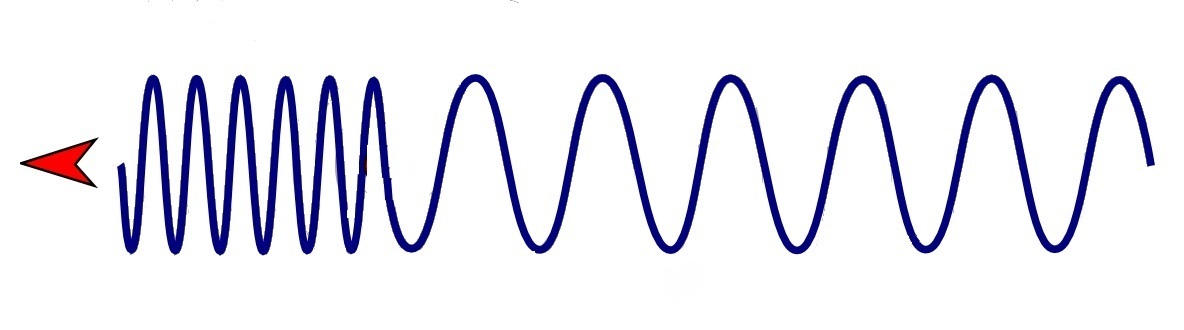
All I can say is the foundation of EVERYTHING is a cycle. Here is how sound travels known as the Doppler effect. Stand on the corner and close your eyes. If the sound of a bus grows louder, it is coming toward you. If the sound is fading, the bus is moving away.
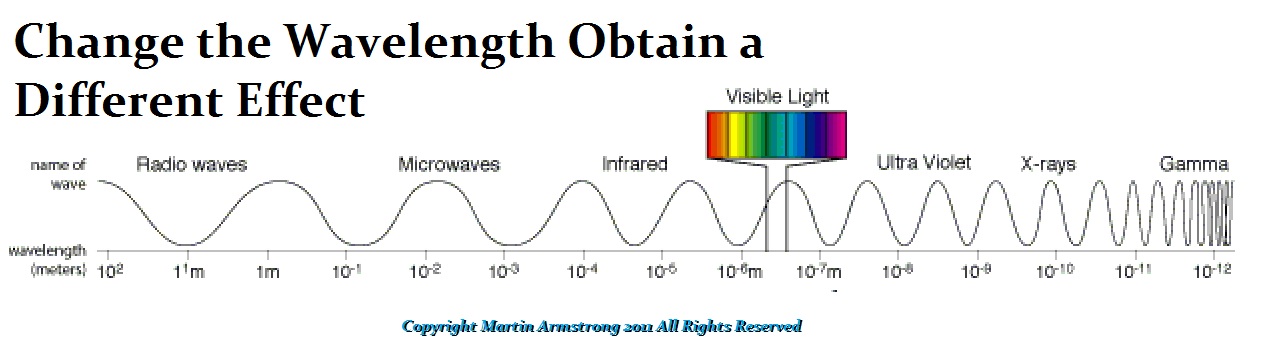
Sunlight also travels in cyclical waves. Change the frequency and you get a different effect. There is a cycle to absolutely everything around us. Our computer Arrays are composed of a correlation of 72 individual models. Then there is a global correlation to the frequencies of all other markets. So there is not a single cycle that you can reverse-engineer from an array. It just does not work that way. We simply do cycles differently than most people in the cyclical analysis arena.
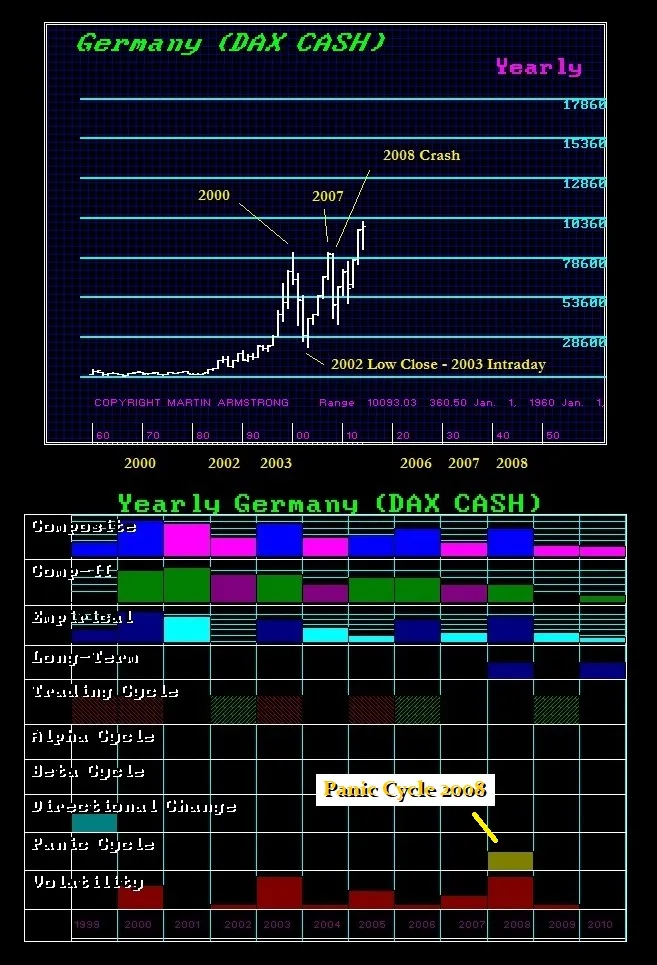
Here is the array published in 1999 that nearly 10 years in advance forecast a Panic Cycle in 2008, which became the Great Recession. This is NOT my opinion. This is allowing the computer to analyze TIME. The track record of these forecasts are far beyond what anyone can do from a gut feeling, “I think,” or opinion basis.

I stood up at our 2011 World Economic Conference in Philadelphia and warned that the War Cycle would turn up in 2014. In 2013, I warned that the computer was targeting Ukraine for the 2014 turn in geopolitics. This were not correct forecasts simply because they were my opinion.
A key Soviet offensive in the Kharkiv region in May 1942 ended in a catastrophic defeat for the Red Army, with over 200,000 Soviet soldiers captured. 1942 was the peak year of the “Final Solution” in Ukraine. The Nazi regime, aided by local collaborators and auxiliary police, systematically murdered the vast majority of Ukraine’s Jewish population. By the end of 1942, it is estimated that over 1 million Jews had been murdered on Ukrainian territory.
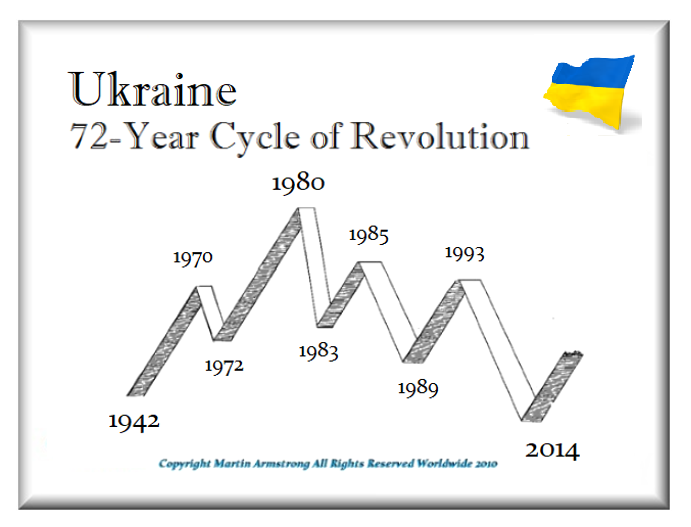
The Three Major “Revolutionary” Events (Post-Soviet Era) in Ukraine were the Revolution on Granite (October 2–17, 1990), when the government conceded to almost all demands. It was a crucial, non-violent precursor to the declaration of independence in 1991. This was followed by the Orange Revolution (2004–2005) was a definitive expression of Ukraine’s desire for a democratic, European future, though its reforms were later undermined. Then there was the Maidan Revolution of 2014, the Ukrainians renamed to the Revolution of Dignity, (November 2013 – February 2014). This was instigated by the American Neocons led by John McCain and Victoria Nuland insisting the overthrow of President Viktor Yanukovych’s sudden refusal to sign the EU–Ukraine Association Agreement.
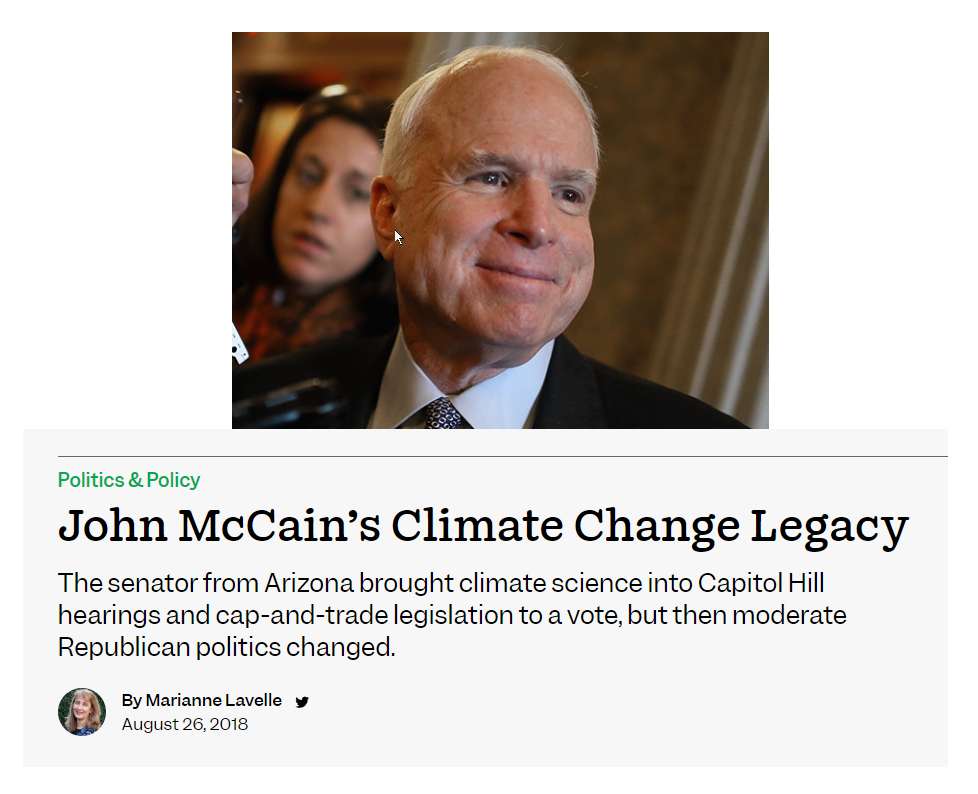
In 2013, the year before the revolution, Russia was Ukraine’s #1 trading partner in terms of total trade volume. Bilateral trade between Ukraine and Russia in 2013 was estimated to be around $40-45 billion. John McCain introduced the climate change agenda which was part of his economic war against Russia. It had nothing to do with climate. It was a push to use nuclear power in Europe to cut off the purchases of energy from Russia in hopes of causing an economic collapse.
Robert McNamara (1916 – 2009) was a leading Neocon that pushed the country into the Vietnam war. Before he died, he finally admitted that they were wrong. They thought Russia was behind the Vietnam War. McNamara admitted Russia was not involved and it was just a civil war. I believe McCain’s hatred of Russia turned on the fact that he was broken and read scripts for the communists as Tokyo Rose. Because he broke, I believe that was the source of his hatred that led him to instigate war with Russia.
The Pentagon sought to protect McCain refusing to release papers on him.
Pentagon Refuses to Release John McCain Confession
The Second Edition of FIAT will be available in a few weeks. This is part of the problem when people blame FIAT for debt and everything as if there were no debt crises before paper currencies. We have to understand what is the actual problem if we ever hope to advance as a society. Highlighting the mistakes allows us to identify them and correct them. Individually, we learn from our personal mistakes (hopefully), but as a society, governments keep changing personel and thus there is no collective ability to learn from past mistakes and as such history repeats because human nature never changes.
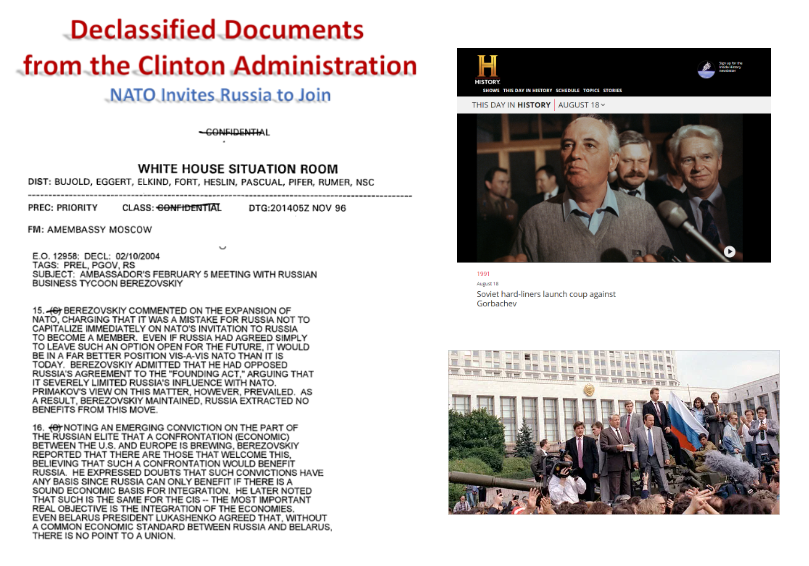
Mikhail Gorbachev understood cycles perhaps instinctively like Margaret Thatcher. He was a key figure in the democratic and reform movements during the perestroika and glasnost period. Gorbachev, like Margret Thatcher, was interested in cycles. While not a theorist himself, Gorbachev was very interested in cycles and he understood that it was time for political change in Russia. He attempted in the 1980s to break the cyclical pattern of Soviet economic stagnation and political repression (“The Period of Stagnation”) through reforms (Perestroika and Glasnost).
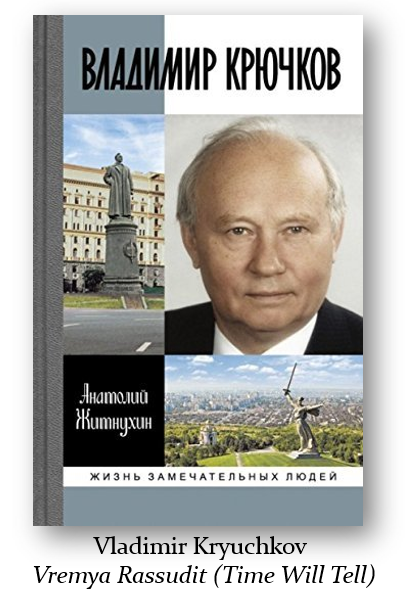
The Russian Neocons staged their coup. Gorbachev made the fatal mistake of appointing Vladimir Kryuchkov as the head of the KGB. During the first half of 1991, Kryuchkov held two secret
meetings with Robert Maxwell knowing he was an Israeli agent. He revealed a plot to overthrow Gorbachev yet wanted to buy Israel’s support from the West to make it legitimate.
The Spymaster’s Defense: A Portrait of the Man Who Nearly Saved (or Destroyed) the USSR
Anatoly Zhitnukhin’s 440-page biographical study of Vladimir Kryuchkov arrives at a peculiar moment in Russian historical memory. Published in 2016 by Molodaya Gvardiya, the book presents itself as an objective examination of the longtime head of Soviet intelligence who became the chief architect of the failed August 1991 coup. Yet beneath its scholarly veneer lies something more revealing: a rehabilitation project for one of the most controversial figures of late Soviet history.
Zhitnukhin traces Kryuchkov’s trajectory from his participation in the defense and reconstruction of Stalingrad through his diplomatic posting in Hungary (where he witnessed the 1956 uprising firsthand), to his rise within the KGB’s First Chief Directorate, and ultimately to his tenure as KGB Chairman from 1988 to 1991. The title itself—”Time Will Tell“—carries the unmistakable suggestion that history has judged Kryuchkov too harshly, that a reassessment is overdue.
The biography devotes considerable attention to Kryuchkov’s role in the Hungarian events of 1956 and the Afghan War—experiences that shaped his worldview and convinced him that Soviet power required vigilance and, when necessary, force to maintain. These formative episodes illuminate why Kryuchkov would later see Gorbachev’s reforms not as necessary evolution but as existential threat.
However, this book’s most significant contribution—and its most problematic aspect—is its treatment of the State Committee for the State of Emergency (GKChP) and the August 1991 coup attempt. Zhitnukhin portrays Kryuchkov and his co-conspirators as patriots desperately trying to prevent the collapse of a great power, not as would-be authoritarians attempting to roll back democracy.
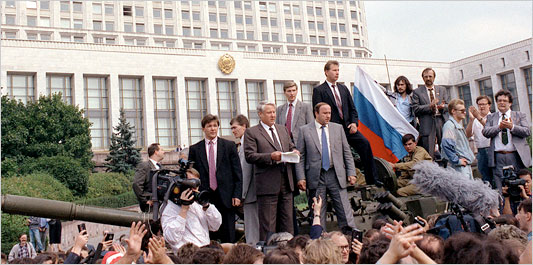
Kryuchkov was the initiator of the GKChP and led the coup attempt that placed Gorbachev under house arrest. The coup involved tanks in Moscow streets, the imprisonment of the Soviet president, and a declaration that Gorbachev had resigned due to “ill health”—a transparent lie. Kryuchkov even dispatched the KGB’s Alpha commando unit to surround Yeltsin’s residence, though he ultimately held back from giving the order to detain him.
Zhitnukhin soft-pedals this indecision, which many historians view as fatal to the coup’s success. Was Kryuchkov’s hesitation a moral boundary he wouldn’t cross, or simply the paralysis of a plotter who hadn’t fully thought through the implications of ordering special forces to arrest a democratically elected president?
The book participates in a broader Russian discourse about the Soviet collapse. After his 1994 amnesty, Kryuchkov returned to public life with writings condemning Gorbachev’s rule, and a 2007 Levada Center poll revealed that only 12% of respondents would have actively opposed his coup. This statistic is chilling—and tells us more about Russian public opinion than about the legitimacy of the coup itself. This is the real danger of Marxism. People often do not want to have to deal with life in general and a free road to nowhere seems better than having to make decisions in life that impact your future.
Zhitnukhin presents Kryuchkov as a man caught between eras, unable to accept that the world had fundamentally changed. This is partially accurate. The coup failed in part because the plotters failed to grasp that democratization had made public opinion important and that the population would no longer meekly obey orders from above. But framing this as tragic misunderstanding rather than attempted authoritarianism is a choice that reveals the book’s sympathies.
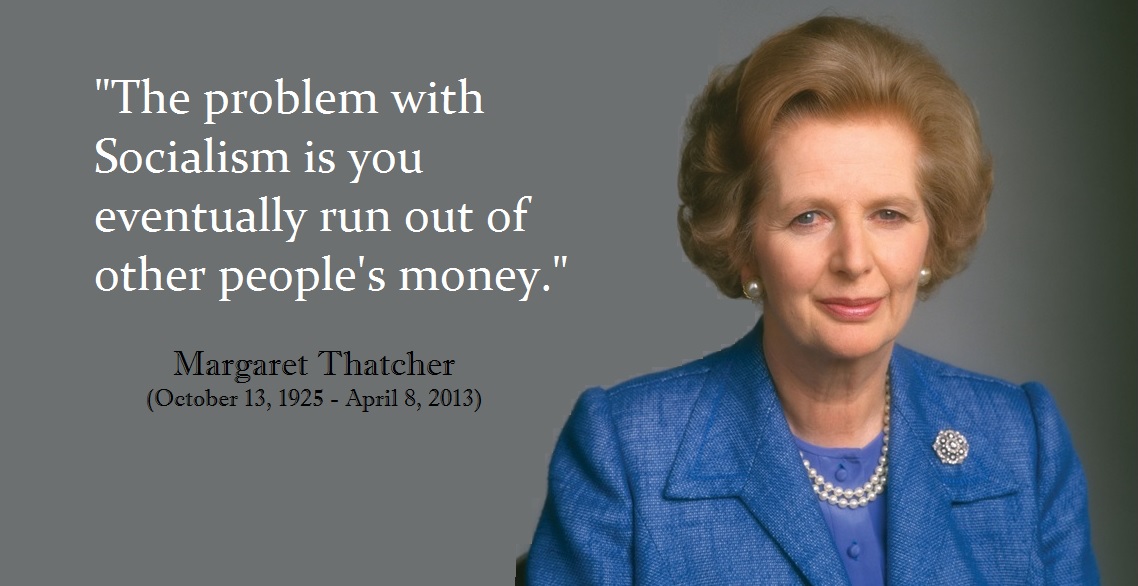
This is the major dilemma that we will also face in the West. The LEFT constantly paint themselves as the victim and therein remains the ultimate challenge to redesign the system. This is what Margaret Thatcher understood. You cannot oppress one portion of society for the benefit of another and pretend you are a free democratic state.
Zhitnukhin largely elides the most damning assessment of Kryuchkov’s legacy. Former U.S. Ambassador Jack Matlock Jr. argued that Kryuchkov was inadvertently responsible for destroying the very Soviet Union he sought to save. By staging the coup, he destroyed the Communist Party’s remaining authority and accelerated dissolution. As Matlock wrote, the Soviet Union might exist in some modified form today if someone else had been running the KGB in 1990-1991. Kryuchkov’s grab for power to retain Communism exposed the inability of Marxism to correct anything whatsoever for the economy proving that government is incapable of managing a bubblegum machine no less the nation. Stalin’s confiscation of food from Ukraine to pretend that the seizure of farmland by the state was like putting the people in the Division of Motor Vehicles in change of planting food.
The book also glosses over the moral dimension of Kryuchkov’s career. This was a man who headed Soviet foreign intelligence during the Cold War’s final decade, overseeing operations that funded communist movements worldwide, who encouraged the Soviet invasion of Afghanistan (where he served as KGB rezident in Kabul during the government overthrow), and who misinterpreted NATO’s Able Archer 83 exercise as preparation for nuclear first strike—nearly triggering catastrophic miscalculation.
Despite these critical shortcomings, Zhitnukhin’s work has value precisely because of its sympathetic lens. To understand why intelligent, experienced officials believed they needed to launch a coup, we must understand their worldview. Kryuchkov genuinely believed the Soviet Union was worth saving and that Gorbachev’s reforms were leading to national disintegration—a view that subsequent events partially vindicated, even if his chosen remedy was worse than the disease.
The Importance of Time Will Tell
The 440-page length allows Zhitnukhin to explore the full arc of Kryuchkov’s life, from Stalingrad to the bathhouse meeting in mid-August 1991 where he convinced other top officials to join the plot. These details humanize a figure often reduced to caricature as a hardline villain. The importance of this work is a glimpse into human nature. The Neocons in the West, especially NATO, act in the very same manner to retain power.
This work was published in 2016—five years into Putin’s third presidential term and two years after the annexation of Crimea. The book’s rehabilitation of Kryuchkov was in line with described the Soviet collapse as the “greatest political catastrophe of the 20th century” – the empire of the Czars, not the Soviet Union. Zhitnukhin’s sympathetic portrait of a man who tried to prevent that collapse aligns with official Russian narratives about the 1990s as a period of chaos and humiliation that strong leadership needed to overcome. Clearly, the book’s subtext: that Kryuchkov’s diagnosis was correct even if his prescription failed.
In Vremya rassudit, Zhitnukhin marshals evidence to portray Kryuchkov as a patriot who made a desperate gamble to save his country, not as an authoritarian who attempted to reverse democratization at gunpoint. The book’s wealth of detail about Kryuchkov’s career makes it a valuable resource, but readers must approach its central argument with skepticism.
The real tragedy may be that Kryuchkov was neither the monster his harshest critics describe nor the misunderstood patriot Zhitnukhin portrays. He was a capable intelligence professional who rose to leadership during a revolutionary transformation he neither understood nor accepted. This is far too often the case where people become indoctrinated by dogma. His attempt to turn back the clock didn’t just fail—it guaranteed the very outcome he feared most. This is an important point for the Neocons of the West in pushing for their endless wars to conquer the Russia of Stalin, which no longer exists. This egotistic quest of hatred from the past will ultimately lead to their destruction just as Kryuchkov ensured the collapse of Communism would become permanent.
Time has indeed told us much about Vladimir Kryuchkov. Whether it has judged him fairly, as Zhitnukhin’s title suggests, depends entirely on whether you believe attempting to overthrow a government through military force can ever be justified by claims of patriotic necessity. This book makes that case as effectively as anyone could. Whether you find it persuasive says as much about your own politics as about Kryuchkov’s legacy.
Mikhail Gorbachev’s public criticism was directed much more explicitly at Stalin than at Lenin. However, his reforms and historical reassessments during Perestroika and Glasnost ultimately undermined the Leninist system as well. Gorbachev was openly and sharply critical of Joseph Stalin, who he portrayed as the “criminal” that distorted socialism. His view of Lenin was initially he was used as the “inspiration” to fix socialism, but the process of reform unleashed forces that ultimately questioned Lenin’s entire project. Thus, Gorbachev’s public criticism focused on:
-
The Great Terror and Repressions: He supported the rehabilitation of Stalin’s victims and allowed extensive media exposure of the crimes of the Stalin era.
-
Economic and Political System: He blamed Stalin for creating the rigid, centralized command-administrative system (kommandno-administrativnaya sistema) that Gorbachev was trying to reform. He saw Stalinism as a deviation from socialism.
-
Historical Reassessment: Under Gorbachev, there was an official condemnation of the Stalinist period, reversing the muted or positive treatment common since the Brezhnev era.
The contrast with China: The key difference was philosophical. While Chinese leaders cracked down violently at Tiananmen to preserve the Communist Party’s monopoly on power, Gorbachev ultimately chose reform and openness, even though it eventually led to the dissolution of the Soviet Union in 1991. The hardline Communists saw two threats, the fall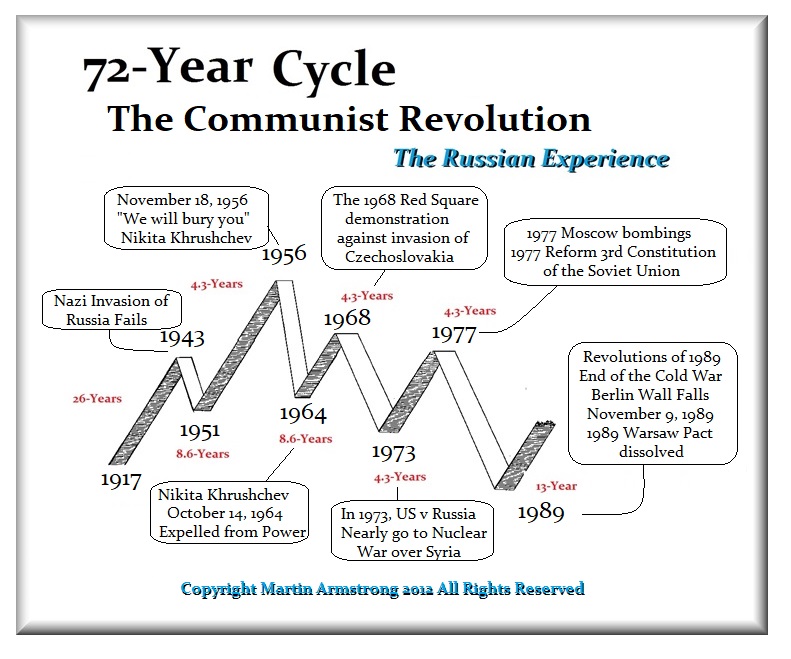
Yes, I had contact with Mikhail Gorbachev and I can say that it was his understanding of cycles that it was just time for the collapse of communism that allowed him to take the high road in allowing the collapse of the USSR. I was asked about the 72-year Revolutionary Cycle because I had warned in 1985 that Communism would fall in 1989. Mikhail Gorbachev visited Beijing in May 1989, and his visit coincided with the Tiananmen Square protests. He arrived on May 15, 1989, for a historic summit aimed at normalizing Sino-Soviet relations after decades of tension.
The timing was significant because the student protests in Tiananmen Square were already well underway. The protesters actually used Gorbachev’s visit to gain more international attention for their cause, and the Chinese government found the situation embarrassing since they couldn’t clear the square for the official welcome ceremonies. Some events had to be moved or adjusted because of the ongoing demonstrations.
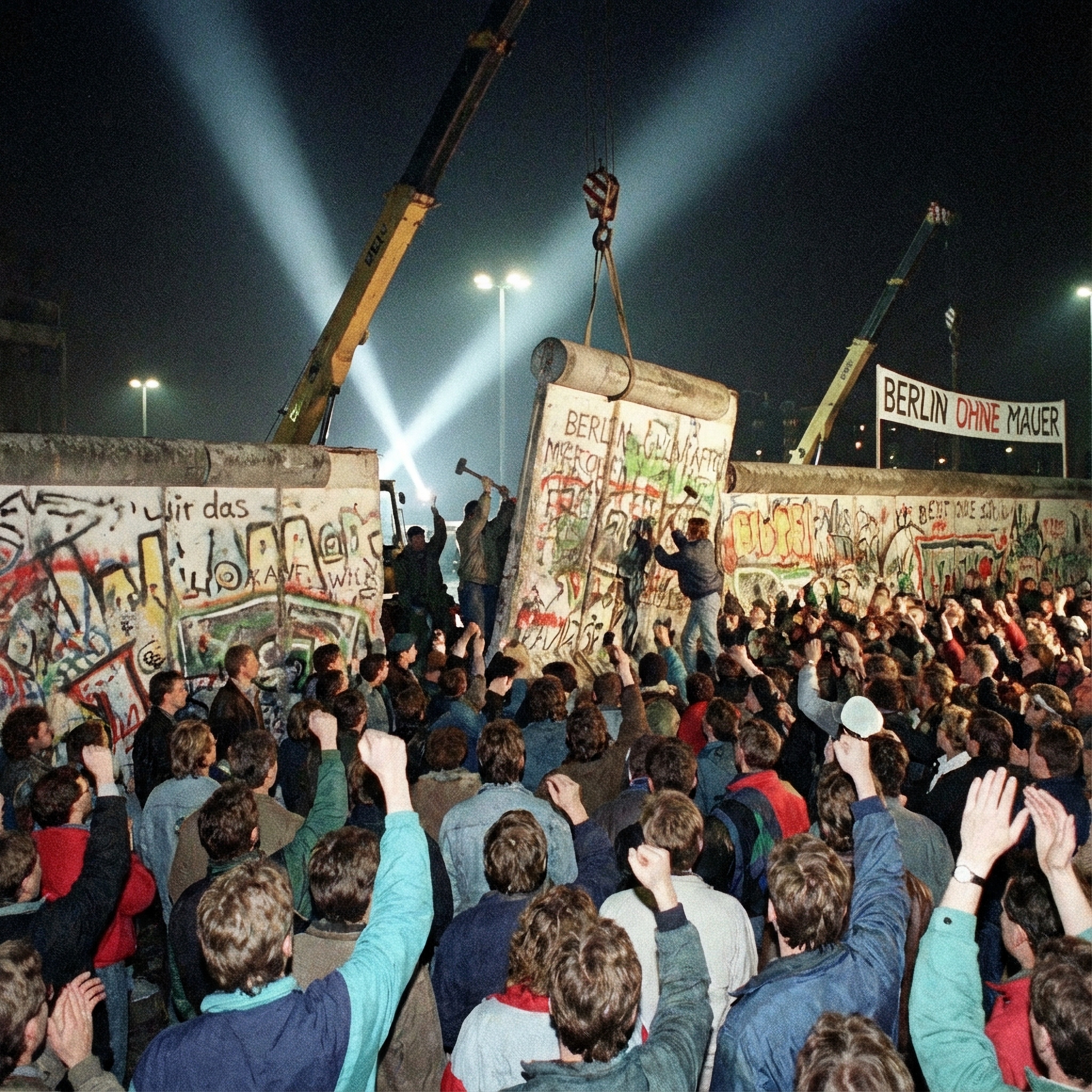
Gorbachev left Beijing on May 18, 1989. The violent crackdown on the protesters occurred later, on June 3-4, 1989, after he had already departed. Gorbachev’s approach was indeed fundamentally different from China’s, but the key examples played out somewhat differently. Gorbachev essentially refused to use Soviet force to prop up communist regimes in Eastern Europe. This was a dramatic break from past Soviet policy. When the Berlin Wall fell in November 1989 (about 5 months after Tiananmen), he didn’t intervene. Throughout 1989, as communist governments collapsed across Eastern Europe—Poland, Hungary, East Germany, Czechoslovakia—Gorbachev rejected the “Brezhnev Doctrine” that had previously justified Soviet military intervention (like in Hungary in 1956 or Czechoslovakia in 1968). He let these countries chart their own course. The American and European Neocons REFUSE to acknowledge the political change in Russia. They grew up hating communists which they merely transferred to hatred of all Russians. I believe they were just pist off that Communism fell all by itself and they did not get to shoot anybody.
In Russia itself, the situation was more complex. Gorbachev did face protests and unrest during his tenure, and his responses varied. He generally pursued reform (glasnost and perestroika) rather than violent crackdown, but there were incidents where force was used—most notably in the Baltic states in 1991 Vilnius, the capital & largest city in Lithuania, as well as Riga, the capital of Latvia and the second largest in the Baltics. which damaged his reformist reputation.
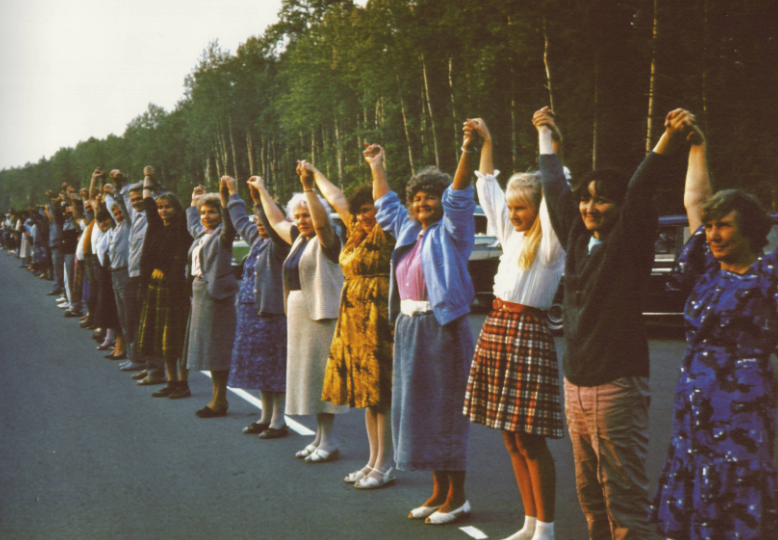
The Baltic Way (also called the Baltic Chain) happened on August 23rd, 1989—a peaceful demonstration where approximately 2 million people formed a human chain stretching about 600 kilometers across Estonia, Latvia, and Lithuania through Riga, Latvia, to Tallinn, Estonia. They were commemorating the 50th anniversary of the Molotov-Ribbentrop Pact (the secret Nazi-Soviet agreement that led to the Soviet occupation of the Baltic states).
Gorbachev’s response was relatively restrained, especially compared to what might have happened under previous Soviet leaders. He didn’t order a violent crackdown on the demonstration itself, which was peaceful and lasted only about 15 minutes. However, he and the Soviet government condemned the protest and denied the secret protocols of the Molotov-Ribbentrop Pact existed (though this denial became harder to maintain as documents emerged). The Soviet leadership issued statements criticizing Baltic “nationalists” and “separatists.”
The situation did escalate later, though. As the Baltic independence movements grew stronger in 1990-1991, tensions increased. In January 1991, Soviet forces did intervene violently in Lithuania (killing civilians in Vilnius) and Latvia (in Riga), which were among the darkest moments of Gorbachev’s tenure and contradicted his reformist image.
So while Gorbachev didn’t respond to the Baltic Way itself with force, his approach to Baltic independence was inconsistent—tolerating peaceful protest in 1989 but later there has always been a question as to who directed violent crackdowns as the independence movements threatened Soviet territorial integrity. It is widely believed that this was the Communists and not Gorbachev since that went against his character.