Taiwan began seriously examining Ukraine’s battlefield experience after Russia invaded in 2022. Taipei has since partnered with Auterion, the American-German drone software company whose systems have been tested under actual combat conditions in Ukraine. Auterion CEO Lorenz Meier stated, “What we offer has been battle-tested in Ukraine to deter aggression and destroy tanks, naval vessels, and other truly expensive equipment.” That is precisely the lesson Taiwan needs. A smaller nation does not defeat an industrial giant buying program. It survives by dispersing thousands of inexpensive weapons that can remain hidden, move quickly, operate after command systems are damaged, and continue killing an invasion force when the conventional military structure begins to break down.
Taiwan is studying Ukraine because Ukraine has become the testing ground for how the next major war will be fought. The battles are no longer determined simply by who owns the most tanks, fighter jets, or aircraft carriers. Cheap drones are destroying equipment worth millions, mobile missiles are forcing fleets away from coastlines, electronic warfare is disabling sophisticated weapons, and factories must replace losses faster than the enemy can destroy them. Taiwan knows it cannot match China ship for ship or missile for missile. It must make the Taiwan Strait so costly, chaotic, and bloody that Beijing hesitates before giving the order to invade.
Taiwan introduced two domestically produced medium-range attack drones during its latest Han Kuang exercises. They were integrated into coastal combat operations alongside fast missile boats, special forces, and Coast Guard vessels. The drones resemble the loitering weapons Ukraine has used to reach behind Russian lines, attack supply routes, destroy equipment, and force Moscow to defend targets hundreds or even thousands of miles from the battlefield. Taiwan wants to apply the same principle to Chinese landing ships, command posts, ammunition vessels, radar systems, fuel depots, and troops attempting to establish a beachhead.
Taipei is considering NT$210 billion, approximately $6.6 billion, for surveillance and attack drones through 2031, while an alternative legislative proposal would authorize NT$240 billion. Broader plans call for purchasing as many as 200,000 aerial drones and 1,000 unmanned surface vessels, with an industrial goal of producing 100,000 drones per month by 2030. Taiwan also intends to expand its anti-ship missile arsenal beyond 1,800 weapons by early 2029. Many will be placed on mobile launchers that can hide in tunnels, under bridges, inside warehouses, and throughout Taiwan’s mountainous terrain before moving immediately after firing.
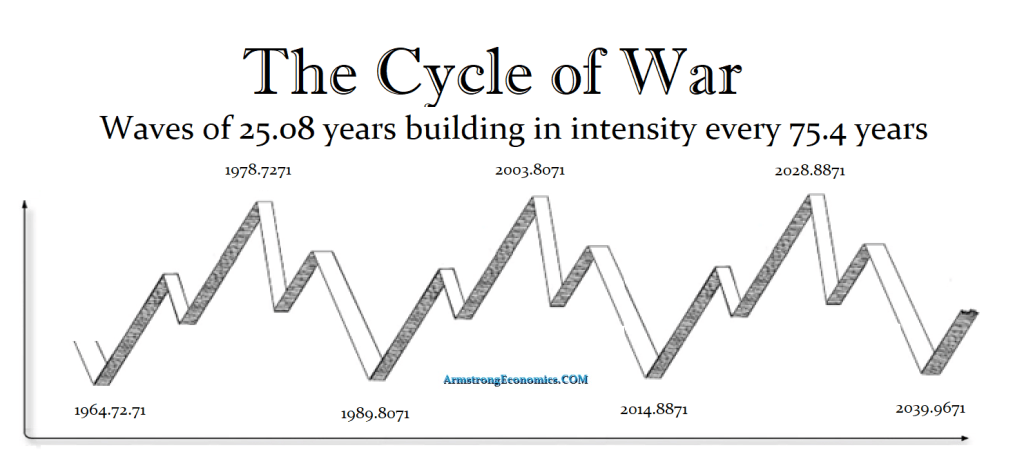
The timing should not be ignored. The computer’s international War Cycle identified 2026 as a Panic Cycle, with the cycle building into 2027 and a critical Taiwan and China period emerging around 2029. That does not mean China must invade on one predetermined day. Cycles identify the period when pressure, political miscalculation, capital movement, military preparation, and international conflict begin converging. We have already entered the expansion phase. The Ukraine conflict has spread deeper into Russia, the Middle East has erupted, Europe is militarizing, Japan is abandoning its postwar restraints, and Taiwan is transforming itself into a heavily armed island fortress. These are not isolated stories. They are symptoms of the same global turn toward war.

The 2029 target is particularly disturbing because military preparations now being announced are scheduled to mature around that same period. Taiwan wants more than 1,800 anti-ship missiles by early 2029. Drone production is being pushed toward enormous capacity by 2030. China is expanding its navy, missile forces, nuclear arsenal, amphibious capabilities, and converted drone fleet now. Governments do not spend these sums because they expect eternal peace. They see the same horizon even if they refuse to tell the public what they are preparing for.
Taiwan is also attempting to create a “non-red” drone industry that does not depend upon Chinese components. This is essential. A nation cannot claim to possess an independent defense industry when the motors, batteries, circuit boards, magnets, cameras, communications equipment, and navigation systems inside its weapons come from the country it expects to fight. Ukraine discovered that supply chains are weapons. Taiwan understands that Beijing could restrict critical components before firing a single missile, crippling production while Chinese factories continue operating at full capacity.
Taiwanese companies have reportedly sent more than 100,000 drones to Ukraine through intermediaries since 2025. Some Taiwanese systems have been submitted to Ukrainian forces for battlefield testing, where they face electronic jamming, GPS denial, broken communications, extreme weather, and an enemy that adapts within days.
Taiwan has even begun teaching civilians how to fly drones manually without depending on GPS or automated navigation. Civil-defense organizations are training ordinary people in reconnaissance, communications, first aid, emergency response, and drone operation. This is gritty preparation because Taiwan understands that if China attacks, there will be no safe rear area. Ports will be hit, power may disappear, cellular networks could fail, hospitals could be overwhelmed, and civilian infrastructure will become part of the battlefield almost immediately. There will be no time to learn these skills after the bombs begin falling.

The difference between Ukraine and Taiwan remains enormous. NATO can move artillery shells, fuel, vehicles, medical supplies, and replacement weapons into Ukraine across a long land border with Poland and other European states. Taiwan has no Poland. It is an island surrounded by water, sitting barely 100 miles from mainland China. Once Beijing imposes a naval and air blockade, the weapons Taiwan failed to stockpile beforehand may never arrive. Every missile, drone, spare part, generator, medical kit, and barrel of fuel needed to survive must already be on the island, protected and dispersed before the first strike.
This is why all the talk about treating Taiwan like Ukraine is dangerous nonsense. The United States cannot wait until an invasion begins and then debate arms packages for six months. A Chinese blockade could prevent those weapons from ever reaching Taiwanese forces. CSIS concluded that there is no real “Ukraine model” for Taiwan because Taiwan must begin the war with nearly everything it expects to use. If the stockpiles are insufficient on the first day, Congress cannot repair that failure by holding another press conference.
A war with China would be the most dangerous conflict the United States has encountered since World War II, and Washington is not remotely prepared for the scale of destruction. China is not Iraq, Afghanistan, Libya, or Serbia. It is a nuclear power with the world’s largest navy by hull count, a massive missile inventory, extensive cyber and space capabilities, and an industrial base that can manufacture ships, drones, electronics, and munitions on a scale the United States abandoned years ago. America outsourced manufacturing to China, enriched its future adversary, depleted its weapons in peripheral wars, and now talks as though victory in the Pacific would be quick and painless.

CSIS ran 24 simulations of a Chinese invasion. The United States and its allies usually prevented China from occupying Taiwan, but the supposed victory was horrific. The United States lost dozens of ships, hundreds of aircraft, thousands of troops, and normally two aircraft carriers within a few weeks. Taiwan’s navy was destroyed and its economy was devastated. Japan lost ships and aircraft as its bases became targets. China also suffered enormous losses, but that does not make the destruction disappear. A victory that leaves carriers at the bottom of the Pacific, thousands dead, and Taiwan reduced to rubble is not the clean triumph politicians will sell to the public.
Another CSIS assessment found that the United States could exhaust some critical long-range precision-guided munitions within the first week of a Taiwan conflict. One week. Washington has spent years handing weapons to allies while pretending inventories are infinite and production lines can be restarted with the stroke of a pen. Ships take years to build. Missile factories cannot multiply output overnight. Skilled workers, machine tools, microelectronics, propellants, and specialized components cannot be summoned because Congress approves another trillion dollars.
China could also strike American bases in Japan, Guam, and elsewhere across the Pacific. Supply networks, satellites, ports, fuel storage facilities, communications cables, and power systems would all become targets. Americans have not experienced a major-power war in the modern age and have been conditioned to believe conflict is something watched on television from a safe distance. That illusion would disappear the moment ships were sunk, bases destroyed, communications disrupted, and thousands of casualty notifications began reaching American homes.
The War Cycle is not moving toward stability. It is moving toward greater confrontation as we approach 2027 and the critical 2029 period for Taiwan and China. Taiwan is preparing because it sees what happened to Ukraine when diplomacy failed and politicians assumed war could be controlled. Washington continues pretending it can fight Russia indirectly, wage war in the Middle East, defend Europe, confront China, and finance the entire operation with endless debt.