For years, politicians have been obsessed with tanks, artillery, missiles, and troop counts while the real battlefield has quietly moved into space. The latest reports suggesting that Russian satellites may be capable of disrupting GPS signals on a continental scale should be sending shockwaves through military circles. If these findings prove accurate, then we are looking at a capability that extends far beyond simply making a driver’s navigation system malfunction. GPS is embedded in aviation, shipping, banking, telecommunications, emergency services, power grids, financial transactions, military operations, and virtually every aspect of modern infrastructure.
According to researchers, dozens of GPS interference events detected across Europe since 2019 may have originated from Russia’s EKS satellite constellation. These satellites were originally designed as part of Russia’s missile early-warning system, but testing suggests they may also possess the ability to transmit powerful signals capable of disrupting GPS reception across vast regions. The significance is not whether a disruption lasts a few seconds or a few minutes. The significance is proving the concept works. Once a nation demonstrates it can interfere with navigation systems from orbit, the entire strategic equation changes.
What many fail to appreciate is how dependent modern warfare has become on satellite navigation. Precision-guided weapons rely on GPS. Drones rely on GPS. Aircraft, ships, logistics networks, battlefield communications, and intelligence systems all depend on accurate positioning data. Remove that capability and armies suddenly find themselves operating under conditions that resemble an entirely different century. During the Ukraine conflict, both sides have aggressively pursued electronic warfare, jamming systems, and signal disruption technologies. What appears to be emerging now is the possibility of extending those capabilities far beyond localized battlefields and into continental-scale operations.
Financial markets depend on precise timing synchronization. Cellular networks require timing signals to coordinate traffic. Shipping companies use satellite navigation to move trillions of dollars worth of goods annually. Airlines depend on navigation systems to safely manage thousands of flights every day. Even modern agriculture relies heavily on GPS-guided equipment. The public views GPS as a convenience. Governments and corporations know it has become a critical piece of economic infrastructure.
This development also highlights something I have warned about repeatedly. The next major conflict will not resemble the wars of the twentieth century. Future wars will target infrastructure before populations even realize an attack has occurred. A cyberattack can disable communications. A satellite disruption can interfere with transportation networks. Financial systems can be disrupted electronically. Power grids can be targeted remotely. The battlefield increasingly consists of networks, satellites, data centers, and communications systems rather than simply soldiers crossing borders.
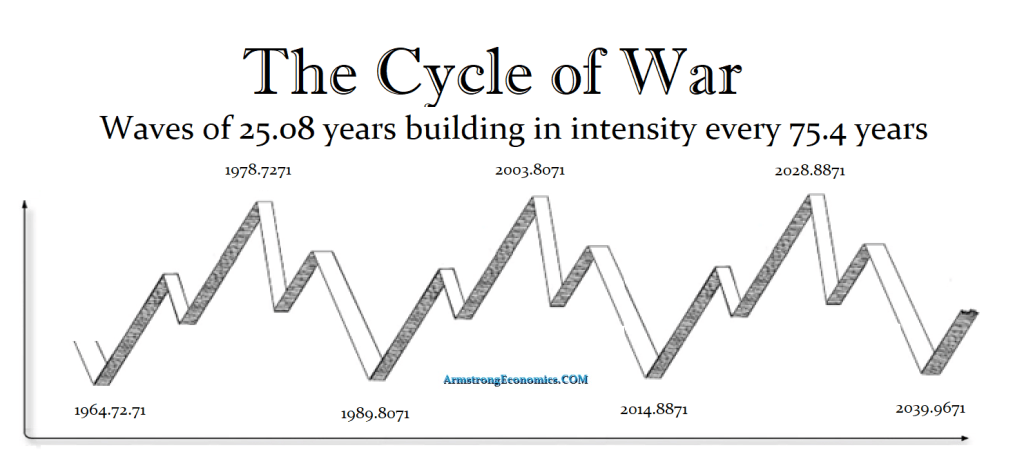
The timing is noteworthy. We are entering the most dangerous phase of the geopolitical cycle. The 2026 Panic Cycle year has already begun exposing vulnerabilities across the global system. Relations between Russia and NATO remain strained. The United States and China are engaged in a rapidly escalating technological competition. Military spending is rising globally. Governments everywhere are preparing for contingencies that most citizens never consider. Space is no longer a peaceful frontier. It has become a strategic domain where the major powers are competing for dominance.
What should concern policymakers is not merely that Russia may possess this capability. The real question is how many nations are developing similar systems. The United States, China, Russia, and other powers have invested heavily in electronic warfare, anti-satellite technology, cyberwarfare, and space-based military assets. Every major power understands that controlling information, communications, and navigation systems may prove more decisive than controlling territory itself.