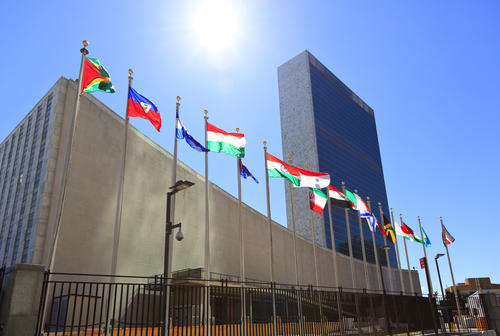
Argentina’s Javier Milei walked into the United Nations and told the bureaucrats sitting before him exactly what he thought of them. He said the organization had become “useless” and existed to support what he called a caste of “fatally arrogant parasites” masquerading as well-intentioned bureaucrats. Whether one agrees with Milei’s rhetoric or not, this was not the normal diplomatic garbage where politicians congratulate one another, read speeches written by committees, and then fly home while accomplishing absolutely nothing. He attacked the fundamental question nobody inside these institutions ever wants to discuss: who gave unelected international bureaucracies the authority to dictate how people should live?
Milei went directly after the COVID lockdowns, and this is where his speech will certainly infuriate the establishment. He accused organizations operating under the UN system of placing themselves above scientific evidence and national sovereignty while promoting forced lockdowns around the world. His description was brutal: “a global experiment in social control disguised as science.” He pointed to the destruction of employment, children’s education, access to medical care, and the ability of families even to say goodbye to dying relatives. Milei went further and characterized the resulting avoidable deaths as “genocide.”
The lockdown era demonstrated just how quickly governments will surrender individual liberty when bureaucrats declare an emergency. Businesses that people spent their entire lives building were ordered closed. Children were removed from classrooms. People were prevented from visiting dying parents and grandparents. Governments decided which businesses were “essential,” which jobs mattered, where people could travel, whether they could leave their homes, and in some countries even how far they could walk. Politicians who had never created a business in their lives suddenly possessed the authority to destroy one with the stroke of a pen.
Governments shut down productive capacity and then tried to replace lost income by creating money and borrowing on a scale previously reserved for war. They disrupted supply chains while simultaneously flooding economies with liquidity and then acted astonished when inflation exploded afterward. You cannot order people not to produce, manufacture, travel, or work normally while creating trillions in new purchasing power and expect the economic system to remain unchanged. The bill was merely postponed, and the public paid it through inflation, higher government debt, lost education, damaged businesses, and years of economic distortion.
This is the part Milei understands because Argentina knows better than almost any nation what happens when government believes there is no limit to its authority over the economy. Bureaucrats always insist that this time is different. They never surrender authority voluntarily when the emergency ends because bureaucracy behaves exactly like every other organism where the first objective becomes its own survival.
Milei broadened that criticism beyond COVID. He attacked Agenda 2030, environmental extremism, migration policy, economic regulation, and international institutions attempting to impose political objectives upon sovereign nations. His argument was that when these policies fail, the bureaucracy does not disappear or apologize. It expands. Another conference is organized, another commission is created, another target is established twenty years into the future so that nobody currently responsible will ever be held accountable when it fails.
That is the fundamental problem with supranational government. You can throw your mayor out of office. You can vote against a governor, president, parliament, or congressman. Who exactly do you vote against at the United Nations? Who elected the bureaucrats designing global regulatory frameworks? They influence national governments while remaining several layers removed from the people who must actually live under the policies they promote. Accountability becomes so diluted that nobody is ever responsible for anything.
Milei also attacked efforts to impose global regulation on artificial intelligence, and this may ultimately prove more important than his remarks about COVID. AI represents one of the greatest productivity revolutions of our lifetime. Every government bureaucrat already sees something entirely different. They see something to license, regulate, tax, restrict, and control. Milei pledged that Argentina would instead attempt to place itself at the forefront of AI development. Whether his government succeeds remains to be seen, but the competition itself is unavoidable. Nations that strangle AI development because bureaucrats fear technological change risk watching investment, engineers, companies, and intellectual capital migrate elsewhere.
Milei walked into the United Nations and said out loud what plenty have wanted to say directly to its face. He did not bow or pretend that another room full of bureaucrats somehow possesses the wisdom to manage eight billion human beings. He called them “fatally arrogant parasites” and accused the institution of becoming absolutely useless. Stop trying to regulate how people work, travel, produce energy, use technology, run their businesses, and live their lives from glass castles where nobody ever seems personally accountable when the grand experiment fails. COVID demonstrated how quickly emergency powers can swallow individual liberty, and Milei’s warning is that the same mentality is now migrating into climate policy, economic regulation, migration, and artificial intelligence.
Whatever one thinks of his language or politics, there was something unmistakably different about watching a head of state stand inside the institution itself and tell its leadership that the world does not belong to them. Nations are not laboratory experiments, citizens are not livestock to be managed, and freedom does not exist at the pleasure of some international bureaucracy. Milei did not go there asking these institutions to control the world a little more efficiently. He went there telling them to get their hands off it.