QUESTION: Mr. Armstrong, You previously predicted that gold would decline due to forced selling to raise cash, partly triggered by the energy crisis involving Iran, and I believe that assessment was correct. Turkey, for instance, has reportedly sold 60 tons of gold while also dumping U.S. Treasuries. Now, with tensions escalating between Turkey and Israel—and given Netanyahu’s recent rejection of negotiated peace with Iran, stating that “savages cannot be trusted”—I am concerned about the broader implications. Given that U.S. Treasury yields are rising as you anticipated due to geopolitical conflict, do you foresee this escalating into a major Middle Eastern war?
HL
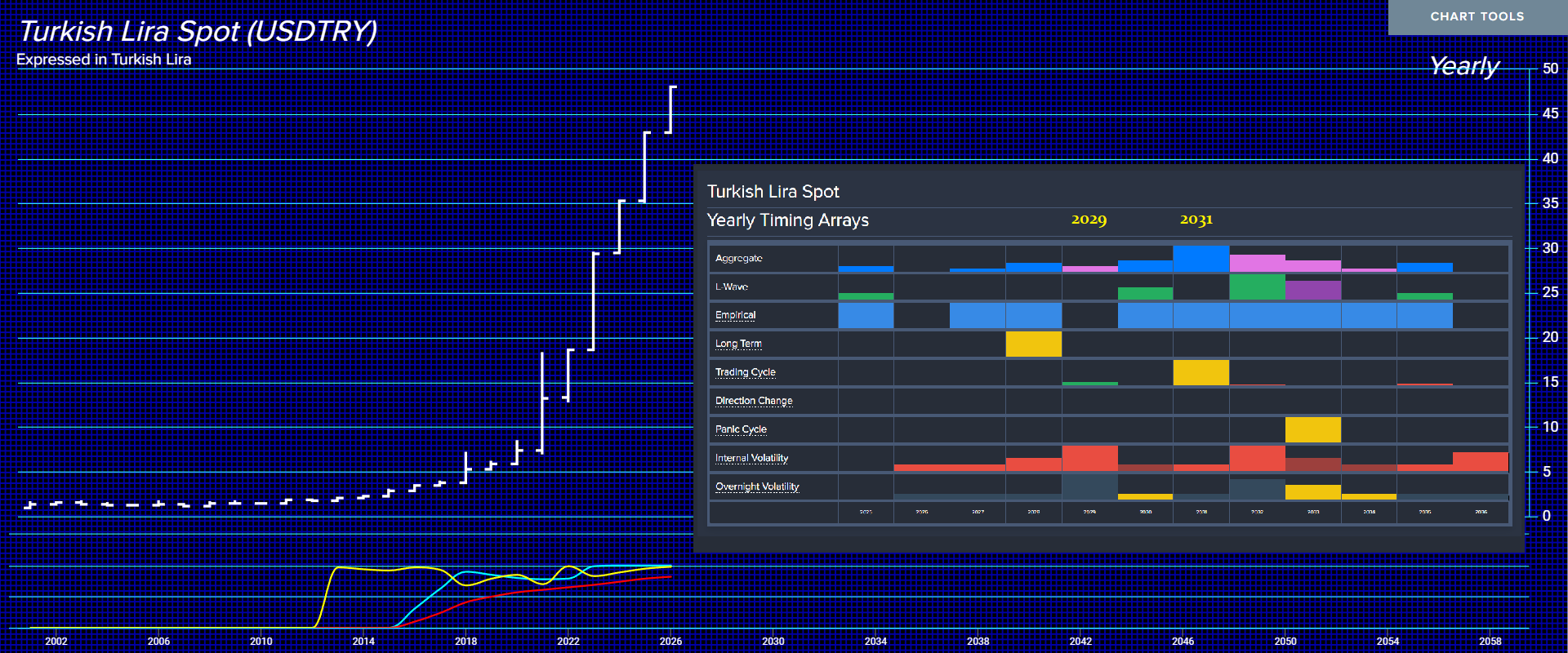
ANSWER: In the case of Turkey, it is a significant net importer of oil. The country relies heavily on foreign sources to meet its energy needs, with domestic production covering only a small fraction of its consumption. To meet that cost in the face of their perpetual currency decline, they dumped US treasuries and sold 60 tons of gold to buy energy. The currency is in a virtual religious bear market.
Consequently, I have said many times, when domestic tension rises, government look for an external enemy. This is what you are witnessing. There is significant tension between Turkey and Israel right now. Relations have severely deteriorated, reaching one of their most strained points in years, driven by the faltering economics using a combination of the ongoing war in Gaza and a new, direct rivalry in Syria to justify the tension.
The Main Sources of Conflict used to Divert Domestic Tension
Turkey has been one of the most vocal critics of Israel’s military actions in Gaza, accusing it of committing “genocide.” Turkey has suspended all trade with Israel, closed its airspace to Israeli aircraft, and joined a genocide case against Israel at the International Court of Justice . In a striking escalation, a Turkish court has even issued an arrest warrant for Israeli Prime Minister Benjamin Netanyahu on these charges, and Turkey has requested Interpol to issue a “red notice” for his arrest. None of this alters the domestic economic deterioration. Yet, it makes a great diversion tactic.
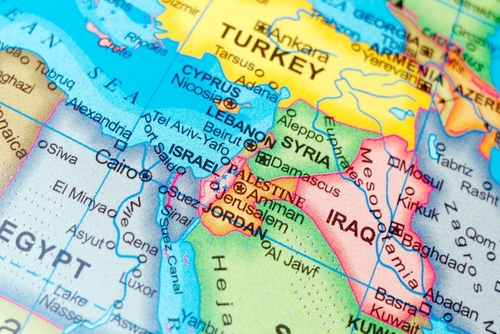
The most immediate flashpoint is Syria. Following the fall of the Assad regime, Turkey has deepened its ties with Syria’s new government and is seen as trying to expand its military influence there. This is a major concern for Israel. On August 18, 2026, Israel launched an airstrike on the Abu al-Duhur airbase in Syria, claiming it was a preemptive strike to prevent Turkey from deploying air defense systems that could threaten Israeli aircraft. This event brought the two countries dangerously close to a direct military confrontation.
Historical Disputes:
Mutual accusations have also spiked around historical issues as they always do. In July 2026, Israel officially recognized the Armenian Genocide, a move that deeply angered Turkey. The accusation is that the Ottoman Empire systematically killed 1.5 million Armenians during World War I, and it is recognized as genocide by over 30 countries and numerous international organizations. In response, Turkish officials made strong statements against Israel, which Israel’s Foreign Minister called “textbook incitement to genocide.” Turkey accuses Israel of Genocide in Gaza.
Could This Lead to a Direct War?
Despite the intense hostility, most analysts do not believe a direct war likely. Both sides have stated they do not seek a direct conflict. They are continuing to use back channels that I know of off the headlines. This is standard in an effort to prevent any miscalculation.
I can confirm that the US is acting as a mediator right now since it is a key ally to both countries. It is trying to de-escalate tensions in Syria, to prevent an accidental clash.
There is no question that this is a Middle East “cold war.” The conflict is playing out in the political, diplomatic, and legal arenas, as well as through competition for influence in places like Syria and the Eastern Mediterranean, rather than on a direct military battlefield. The red flag is the triumvirate of Turkey, Saudi Arabia, and Pakistan.
In short, while the relationship has hit a new low and the risk of a direct incident is rather high. There are efforts underway behind the curtain trying to manage the tensions to keep them from escalating into a full-blown war.
We have an important Directional Change in Israel in 2027 and the critical turning point aligns with the ECM in 2028.Our models have shown rising volatility was to begin here in August and escalate into November.