Spain has demonstrated precisely why government is so often the source of the crisis rather than the solution. The Sánchez government issued a sweeping royal decree to legalize hundreds of thousands of undocumented migrants, bypassed Parliament, and then acted astonished when people outside Spain interpreted the message exactly as any rational person would: enter the country illegally today and the politicians may legalize you tomorrow.
The decree did not explicitly state that every migrant arriving by boat would automatically receive legal status. It applied to undocumented migrants who could prove that they had lived in Spain for at least five months before January 1, 2026, but leave it to government to hide the fine print. Then Spain’s Supreme Court restricted the immediate expulsion of migrants arriving by sea. Smugglers and social-media accounts distorted that ruling into a promise that anyone who entered Spanish territory through the water could not be sent back, and Madrid failed miserably to contain or correct the message before people began moving. The outcome was entirely predictable.
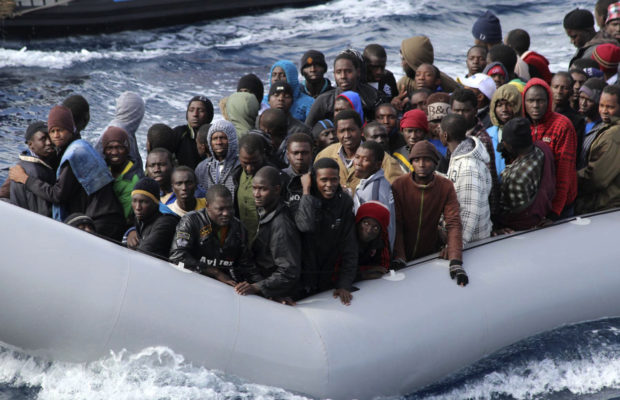
Approximately 60,000 migrants reportedly entered Ceuta in roughly 24 hours. Ceuta normally has around 85,000 residents, so the government allowed a sudden influx equal to about 70% of the city’s entire population, temporarily pushing the number of people in this small Spanish enclave toward 145,000 almost overnight. This was not a normal migration flow. It was the sudden transformation of an entire city caused by politicians who played with human incentives and never prepared for the consequences.
People swam around the Tarajal breakwater, breached barriers, and poured across sections of the border where Moroccan enforcement had weakened. At least 57 people reportedly died from drowning or in stampedes, although the early numbers varied, and those deaths belong on the conscience of every politician who sent the signal that reaching Spain would provide a new life.
Ceuta’s facilities were already collapsing before this mass influx. The city was caring for 472 unaccompanied minors by July 28 after receiving more than 250 in only two weeks, and officials admitted that the child-protection system was operating at 1,600% of its intended capacity.
Residents reported theft, break-ins, assaults, public defecation, and migrants bathing in fountains. Some businesses closed, local people barricaded streets, and frightened residents remained inside their homes because the government had abandoned its first responsibility, which is to protect the people it supposedly represents. Only a fool would believe that social order will survive when 60,000 desperate people arrive without the basic necessities of life.
Pedro Sánchez suddenly denounced the crossing as an attack on Spain’s territorial integrity. The same government that issued a mass regularization decree and promoted itself as Europe’s humanitarian alternative suddenly discovered that a nation must have a border.
Madrid deployed the military, sent additional police and Guardia Civil officers, closed crossing points, erected barriers, and began returning migrants at an astonishing rate. Estimates indicate that more than 48,000 returned rapidly, with later figures approaching 70,000, while only 3,000 to 5,000 reportedly remained in Ceuta by August 3.
Spain reversed its course because its policy finally landed on the doorstep of Spanish citizens. Compassion ended the moment the numbers became politically visible, the shops closed, the streets filled, and voters began demanding to know who was in charge. This exposes the absolute hypocrisy of modern government. Politicians condemn strict border enforcement as inhumane when someone else proposes it, but they deploy soldiers and accelerate removals the moment their own careers are threatened. Spain reportedly expelled or induced the return of tens of thousands of migrants within days. Therefore, the government clearly possessed the ability to defend the border and return illegal entrants; it merely refused to exercise that authority until the crisis became impossible to hide.

The government then complained that the migrants had misunderstood the rules. This is like placing a sign reading “FREE MONEY” outside a bank and then blaming the crowd for failing to read the conditions printed in microscopic letters beneath it.
Spain had already regularized migrants in the past, and the opposition warned that another broad decree would encourage further irregular entry. Sánchez ignored those concerns because European politicians have convinced themselves that repeating the word “humanitarian” exempts them from reality. Morocco also bears responsibility for allowing border enforcement to weaken. Rabat denied deliberately organizing the influx and blamed misinformation and trafficking networks, but European governments have made themselves dependent on North African states to contain migration before it reaches Europe.
That dependency has turned migrants into a geopolitical weapon. Morocco, Turkey, Belarus, Libya, and other transit states understand that they can pressure Europe simply by relaxing enforcement and allowing desperate people to move toward the border. Europe surrendered control of its perimeter and then became shocked when foreign governments discovered the leverage. No country possessing a functioning sense of sovereignty would outsource its border to a neighbor and assume that arrangement would never be manipulated.
The European Union is useless in a genuine crisis because Brussels specializes in bureaucracy rather than reality. It will convene committees, demand solidarity, design another quota, and distribute funds after the local population has already absorbed the damage. The EU wants every nation to surrender border control while Brussels refuses to accept responsibility for the consequences. It demands uniform humanitarian language but leaves local governments and citizens to confront the crowds, shortages, crime, and anger.
France and Italy moved to protect themselves because they understood that Spain’s failure would not remain confined to Ceuta if migrants reached the mainland and traveled through the Schengen zone. Open internal borders cannot survive when external borders are treated as optional.
Migration cannot be managed through moral slogans. A government must decide how many people it can accept, where they will live, how they will support themselves, what happens when facilities are full, and how those without valid claims will be removed. Without enforcement, asylum becomes immigration by incantation. Anyone who reaches the territory says the required words, the bureaucracy begins a process that may last years, and the government loses the political will to remove anyone once that person has established a life.
The people of Ceuta did not vote to increase their population by 70% in a day. They were not consulted, and the officials who created the policy were nowhere near the streets when residents began barricading their neighborhoods. The migrants were also used as pawns. They were encouraged by rumors, smugglers, court rulings, and Spain’s own political signals to risk drowning, only to be pushed back after Madrid realized that it could never accommodate them.
That is not compassion. It is government playing with human lives to maintain a political image and then using force when reality destroys the performance. The politicians responsible will never admit fault because government has perfected the art of blaming the consequences of policy on everyone except those who wrote it. They will blame Morocco, social media, smugglers, the courts, the opposition, and even the migrants themselves before acknowledging that their broad decree helped create an expectation of eventual legalization.
Government cannot repeal human nature by decree. Desperate people move toward perceived opportunity, frightened communities defend themselves when the state fails, criminals exploit confusion, and politicians reverse policy when their survival is threatened. This crisis was not caused by compassion. It was caused by cowardly politicians who wanted credit for being compassionate without accepting the limits, costs, and responsibilities that accompany their promises.