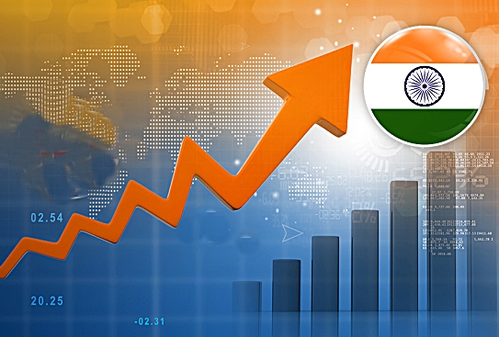
India is giving the world something worth paying attention to through its expanding economy and domestic market. The IMF’s October World Economic Outlook puts growth at 7% for India’s 2026–27 fiscal year, up from 6.4% in July. The following year is also projected at 7%, up from 6.7%. These are forecasts, but the direction of the revisions matters. Higher energy costs and international turmoil have not prevented India from performing better than the IMF previously expected.
The IMF projects global growth of 3.1% in 2026, advanced-economy growth of 2.1%, and Chinese growth of 4.5%. India’s fiscal-year figure is not an identical calendar-year comparison, but the momentum difference is substantial. The IMF attributes India’s stronger outlook to domestic demand and services activity, with demographics, structural reforms, and a growing internal market supporting its potential. This is an economy where the opportunity to expand remains considerable.
Seven percent growth compounds into something powerful. If sustained for ten years, it would almost double real economic output. That shows why a sustained growth advantage changes the position of a country. Businesses gain customers, investment can support additional capacity, and a larger economy creates possibilities that did not exist a decade earlier.
What interests me is the domestic market. A country that develops a larger base of consumers and businesses has more than one source of demand. Export opportunities remain important, but the economy is less dependent on waiting for a foreign customer to place the next order. An entrepreneur can see opportunities in his own country. That changes incentives. People become willing to establish businesses, improve skills, and commit money when they believe tomorrow offers something beyond merely paying yesterday’s bills.
Demographics give India an opportunity, but a population does not become prosperous simply because it is large or young. People need productive employment, infrastructure, and the freedom to build businesses. The encouraging part of the IMF’s assessment is that it identifies actual demand and services activity alongside demographic potential. There is movement behind the promise. India still has considerable work to do, but it has a reason to do it: an economy growing fast enough to reward improvements in its productive capacity.
The energy problem has not disappeared. The IMF reportedly projects Indian inflation at 5% this fiscal year and a current-account deficit of 1.5% of GDP, compared with 0.7% previously. Those figures underline the cost of imported energy and the need to preserve stability while expanding. Growth is not permission to ignore the balance sheet. India’s achievement is that the outlook has improved despite those pressures, not that it has somehow escaped them.
India also gained from the trade routes disrupted by the Ukraine war and Western sanctions. As Europe turned away from Russian energy, Indian refiners bought discounted Russian crude and expanded sales of finished fuels abroad. Reuters reports that India exported 4.1 million metric tons of jet fuel to Europe in 2025, nearly three times its 2021 volume, and supplied almost 15% of Europe’s aviation-fuel imports over 2022–2025. India maintained commercial relationships across opposing geopolitical camps and captured business others had abandoned. Europe still needed fuel, Russia still needed buyers, and Indian refiners earned their place between them. That opportunity has since narrowed after the EU prohibited imports of products made from Russian crude from January 21, 2026. But the lesson remains. Sanctions can redirect commerce toward countries willing and able to act as intermediaries. India pursued its own economic interests, and its businesses benefited from the gap between political declarations and the world’s continuing need for energy.
Capital moves toward opportunity. Investment means people can build businesses, acquire skills, and earn a living that their parents could scarcely have imagined. That gives a population a reason to believe it has a future, and that confidence encourages further investment. The established powers seem to believe their position is permanent, as though capital owes them loyalty while they make it more expensive to operate. It owes them nothing. India still has serious problems to overcome, but a country opening opportunities for its people has something that a country taxing and regulating those opportunities away cannot manufacture by decree.