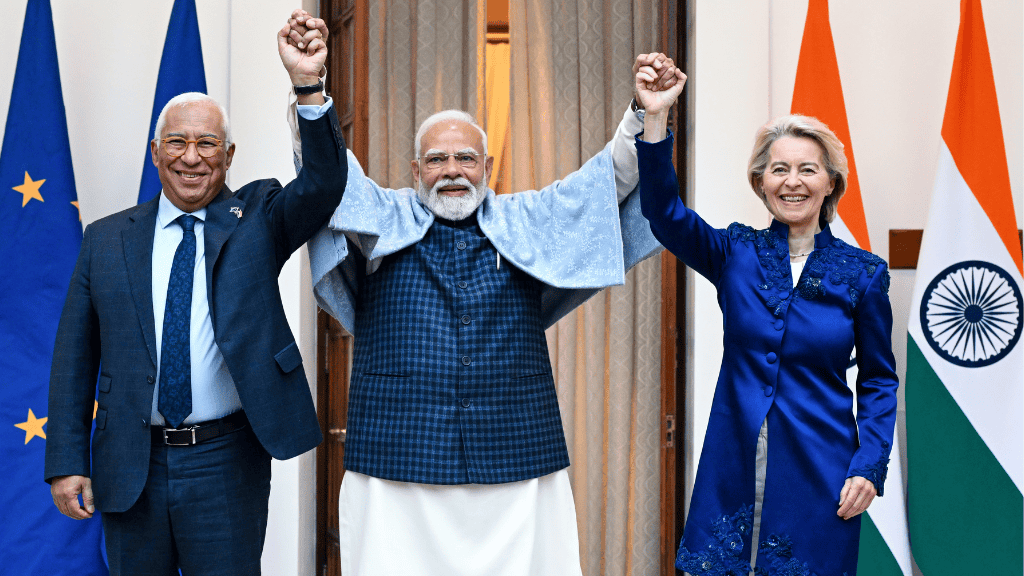
Deemed the “mother of all deals” by Commission President Ursula von der Leyen, India and the European Union signed a historic trade agreement that will permit near free trade between the two economies. The EU plans to phase out tariffs on Indian goods by up to 95% over a multi-year period. India will begin phasing out tariffs on EU-dominated imports. The proposed India–EU trade agreement is being promoted as a strategic breakthrough, but in reality it reflects Europe’s growing isolation rather than strength.
Total services between the two economies have been rapidly increasing from the €26 billion spent in 2023 to the estimated €120 billion today. Reduced restrictions will permit services to continue expanding. The EU primarily imports machinery and electrical equipment, chemicals, and transport equipment to India.
The EU has angered its top trading partner in the process. “The U.S. has made much bigger sacrifices than Europeans have. We have put 25% tariffs on India for buying Russian oil. Guess what happened last week? The Europeans signed a trade deal with India,” US Treasury Secretary Bessent told ABC News Sunday.
China came out earlier in the week to publicly praise its relations with India. India’s neutrality politically has caused it to become indispensable in the global marketplace. Most nations turned to India to bypass Russian energy sanctions, and now, they are turning to India to bypass tariffs and political uncertainty.
From India’s perspective, this deal is about leverage, not partnership. India gains access where it wants it, while carefully protecting its domestic industries. Europe, meanwhile, is trying to replace what it lost with Russia and China by pivoting to India without changing the policies that caused the damage in the first place. Europe’s problem is not a lack of trade agreements. The problem is that confidence in government is collapsing, and capital follows confidence.
Non-tariff barriers, regulatory obstacles, carbon taxes, ESG compliance, and digital rules are all designed to protect Europe’s internal market while demanding open access abroad. India noted that these areas have made preliminary discussions extremely difficult. You cannot tax, regulate, sanction, and militarize your economy and then expect trade deals to reverse capital flight.
The Economic Confidence Model has consistently warned that Europe would fracture economically before it ever unified politically. The EU can now sell in India, but so can other economies that may have a competitive advantage due to a lack of regulatory and political pressures from a centralized control powerhouse. India has come out on top yet again.