I wrote on September 9, 2014, just days before Scotland’s independence referendum, that we had been taking the prospect of Scottish separation seriously since the Berlin Conference in 2012. At that conference, I showed the chart illustrating the rise of separatist movements throughout Europe as part of our Cycle of War model. By 2014, when the polls suddenly showed Scotland could actually vote YES and break apart a union dating back to 1707, the political establishment was shocked. I wrote then that “such trends are driven by economics” and that what we were witnessing was the rise in civil unrest as confidence in government declined. Scotland ultimately voted 55% to 45% to remain, and the establishment assumed the threat had passed.
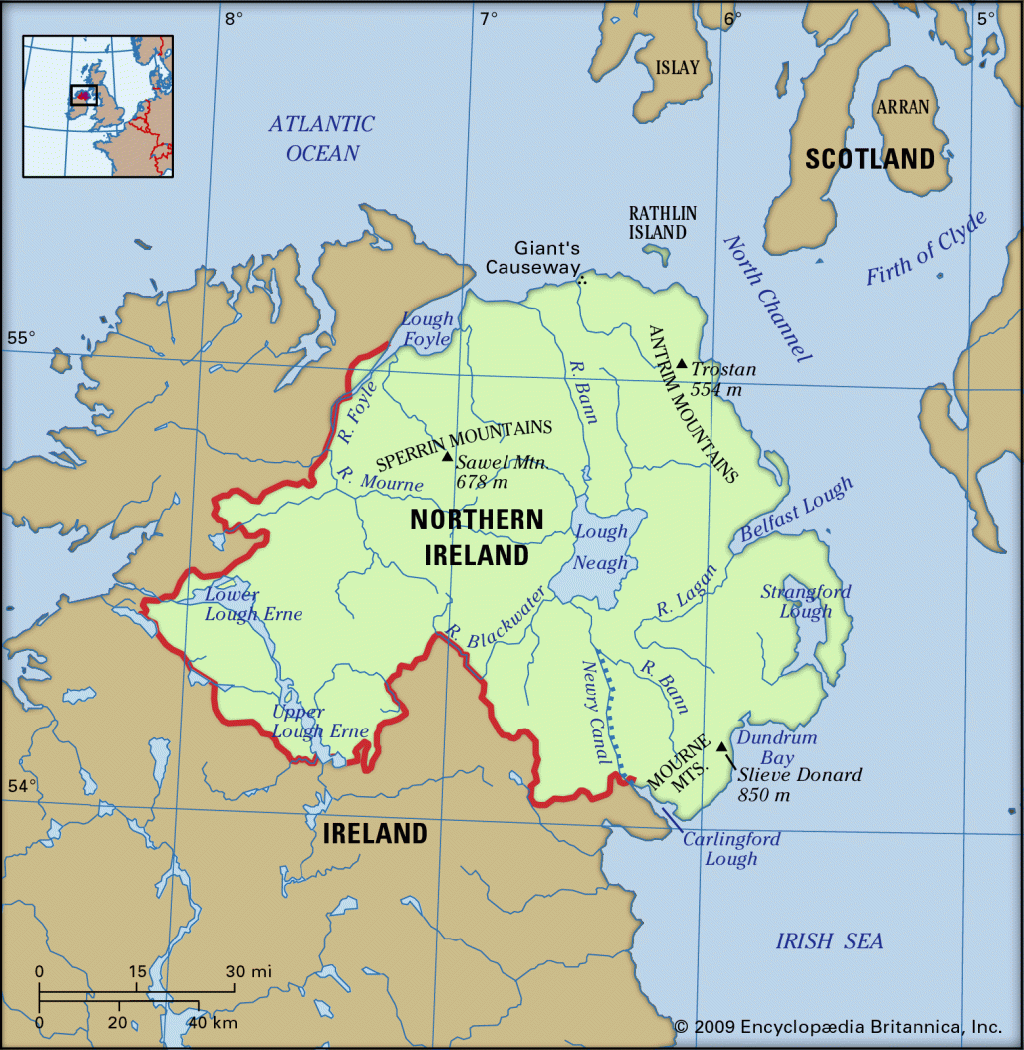
Twelve years later, Scotland’s independence movement remains alive, Wales is showing a rising generational appetite for separation, Northern Ireland has a legal path toward reunification, and now the leaders of all three devolved nations have sat at the same table and declared that “Westminster’s time is coming to an end.” What was appearing on the model as a rising separatist trend more than a decade ago is no longer sitting on the political fringe.
Scotland’s John Swinney and Northern Ireland’s Michelle O’Neill are openly calling for referendums, while Welsh First Minister Rhun ap Iorwerth has joined them in asserting Wales’ right to determine its own future. The SNP, Plaid Cymru, and Sinn Féin declared that “no Westminster government has the right to block democracy” and called upon the British government to “prepare for, plan and facilitate constitutional change.” The agreement itself has no legal power to dissolve the United Kingdom, but dismissing it as symbolism misses what is actually taking place. Political structures begin to break when the consent holding them together begins to disappear.
When everything is prosperous, people tolerate central government because there is little incentive to upset the system. When taxes rise, living standards decline, debt expands, migration creates political tensions, and government becomes increasingly authoritarian or unresponsive, people begin asking a very different question: why are we paying these people to rule us?
The numbers in Scotland are particularly important. Scotland held its independence referendum in 2014 and voted 55% to 45% to remain inside the United Kingdom. That was supposed to settle the issue for a generation. There have now been nearly 300 Scottish independence polls conducted since the Brexit referendum, and support has repeatedly hovered around the dividing line. Recent polling continues to place the country essentially around 50-50 once undecided voters are removed. An independence movement that captured 45% twelve years ago did not disappear; it became a permanent political force capable of splitting the country almost directly down the middle.
Among voters aged 18 to 24, support for independence reached 59% in Wales. Among those aged 25 to 34 it was 54%, and among those aged 35 to 44 it reached 57%. Support collapsed among older voters, falling to just 15% among those 65 and older. That is a generational divide, and political trends driven by younger populations do not simply disappear with time.
Northern Ireland presents an entirely different constitutional problem because the Good Friday Agreement already contains a legal mechanism for a referendum on reunification when the British government believes a majority would likely support it. Current polling does not establish that threshold. Recent estimates place support for Irish unity well below an outright majority, and a University of Liverpool study found that many voters supporting reunification could actually be persuaded to remain in the UK if public services improved and the cost of living declined. That is incredibly revealing because it demonstrates what I have said all along: these constitutional movements are not driven purely by nationalism. ECONOMICS MATTERS.
More than 61% of pro-unity respondents in that Northern Ireland survey said improved public services could persuade them to remain, while 58.5% said a lower cost of living could change their position. In other words, loyalty to political structures is not unconditional. People tolerate government while they believe the arrangement works. Once they conclude that the existing system is failing them economically, the political structure itself becomes negotiable.
Westminster continues to treat independence as something that can simply be denied until the problem disappears. Prime Minister Andy Burnham recently suggested Scotland could receive another referendum if there were a “clear consensus,” only to subsequently tell Swinney that another vote was effectively off limits. That is precisely how separatist movements become stronger. If the United Kingdom truly exists through the consent of its nations, then eventually Westminster must confront the uncomfortable question of what happens when that consent is withdrawn.

The irony in this latest agreement is that Scotland, Wales, and Northern Ireland say their future lies back inside the European Union. Escaping Westminster merely to surrender sovereignty to Brussels is not independence. I have criticized the SNP for precisely this contradiction for years. If Scotland wants sovereignty, then Scotland should have sovereignty. Trading London bureaucrats for Brussels bureaucrats accomplishes very little.
But that does not change the larger trend. The centralized political structures are beginning to fracture. Look across Europe and you can see the same pressure appearing in different forms. Nationalist parties are rising in Germany. Giorgia Meloni is calling for a confederal Europe where sovereignty remains with the nation-states rather than Brussels. Regional identity remains politically potent throughout the globe. Government always believes centralization creates stability. It eventually produces the opposite.
The United Kingdom itself is an excellent example. The union between England and Scotland dates to 1707. For centuries, economic interests, empire, trade, military power, and political institutions bound these nations together. But political unions are not immortal simply because they appear permanent to the generation currently governing them. The Soviet Union looked permanent until suddenly it was not. Yugoslavia looked like a nation on a map until the internal divisions became stronger than the political structure holding it together. Czechoslovakia disappeared peacefully. Political borders change whenever confidence in the central authority collapses sufficiently.
That does not mean Britain will break apart tomorrow. Scotland remains divided.. The significance is not that dissolution is imminent. The significance is that all three separatist movements are now politically aligned at precisely the same moment that confidence in Westminster is under enormous strain. This is how political change develops. It begins on the fringe, moves into opinion polls, enters parliament, captures political parties, and eventually reaches government. By the time the establishment acknowledges the trend, it has usually been developing beneath the surface for years.