QUESTION: Marty, Bessent is plainly no trader. As you’ve pointed out, he’s spent far too long in the company of market manipulators. I remember your warning that rolling debt into shorter maturities only deepens future fragility. And as you put it, it’s Groundhog Day on repeat. So the question is: does this bring us closer to Socrates’ prophecy of even higher rates?
SK
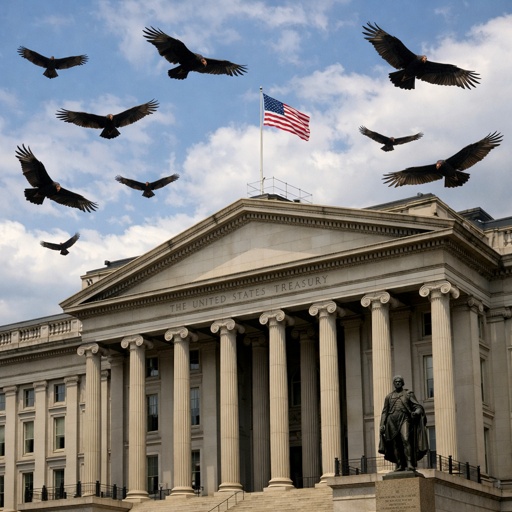
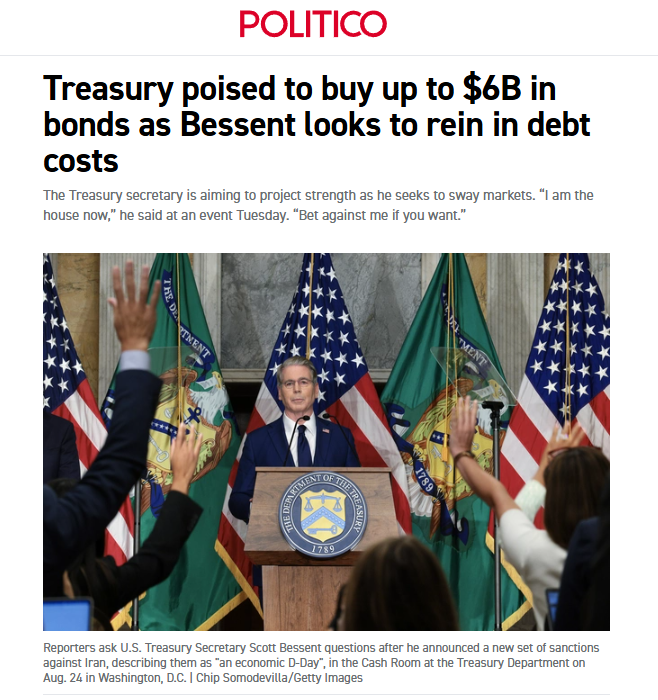
ANSWER: This is a dumb move. With war circling around like vultures waiting for the carcas to die for a free meal, the Bessent announced that the federal government will buy back up to $6 billion of its bonds this week three times its normal operations, which is really stupid, in a braindead theory that it will rein in longer-term borrowing costs.

This is OpEd I wrote for the Wall Street Journal back on April 19, 1995, was about the same gimmick where President Clinton (1993-2001) was able to balance the budge was (1) the economy recovered in 1994 with capital pouring into the United States as it fled South East Asia resulting in the Asian Currency Crisis in 1997, (2) US Interest rates rose sharply in 1994 attracting huge capital inflows including those from Japan, and (3) he shortened the maturity of the debt funding it short-term to cut interest expenditure.
The National Debt rose from $4,064.6 billion in 1992 to $5,807.5 billion by 2001. The rate of growth was slowed by the shift in funding. Interest rates at the Fed dropped by 6.5% in 2000 to 1.75% in 2001. When Clinton took office the Fed Discount Rate stood at 3.5%. The rise began in 1994 that helped to attract foreign capital, especially from Japan, and it peaked in 2000 with the Dot Com Bubble on the heels of the 1998 Long Term Capital Management debacle that followed the collapse of Russian debt.
Based on the most recent data available, the amount of long-term U.S. Treasury debt (20-year and 30-year bonds) outstanding was approximately $5.5 trillion as of July 31, 2026. This is little more than 13% of the total. Here is the problem. The more you shift the debt short-term, it becomes much more volatile and with war, the rates can explode and this will send the interest expenditures up dramatic crowding out other spending and when the Democrats get back in, they will demand raping anyone who earns more than the poverty level with higher taxes as if that is ever a long-term solution.
The debt instruments outstanding are:
Treasury Bills (T-Bills): Short-term securities with maturities of one year or less (e.g., 4, 8, 13, 26, and 52 weeks). They are funded by being sold at a discount to their face value; the investor’s return is the difference between the purchase price and the face value received at maturity, meaning they do not pay a periodic coupon. (outstanding $6.99 trillion).
Treasury Notes (T-Notes): Medium-term securities with maturities from 2 to 10 years (e.g., 2, 3, 5, 7, and 10 years). They are funded by paying a fixed interest rate (coupon) every six months until maturity. (T-Notes represent about 52% of all outstanding debt about $30.2 trillion).
Treasury Bonds (T-Bonds): Long-term securities with maturities of more than 10 years, currently issued as 20-year and 30-year bonds. They are funded by paying a fixed interest rate (coupon) every six months. (outstanding $5.5 trillion).
Treasury Inflation-Protected Securities (TIPS): These are medium to long-term securities (5, 10, and 30 years). They are funded differently, as their principal is adjusted based on inflation (CPI-U). They pay a fixed interest rate twice a year, but the payment amount changes with the inflation-adjusted principal. (outstanding $39.8 billion).
Floating Rate Notes (FRNs): These are 2-year notes whose interest rate is not fixed. Their funding mechanism involves a variable interest rate that is reset weekly, based on the most recent 13-week Treasury bill auction rate plus a fixed spread. (outstanding $600 billion).
The Buy Back
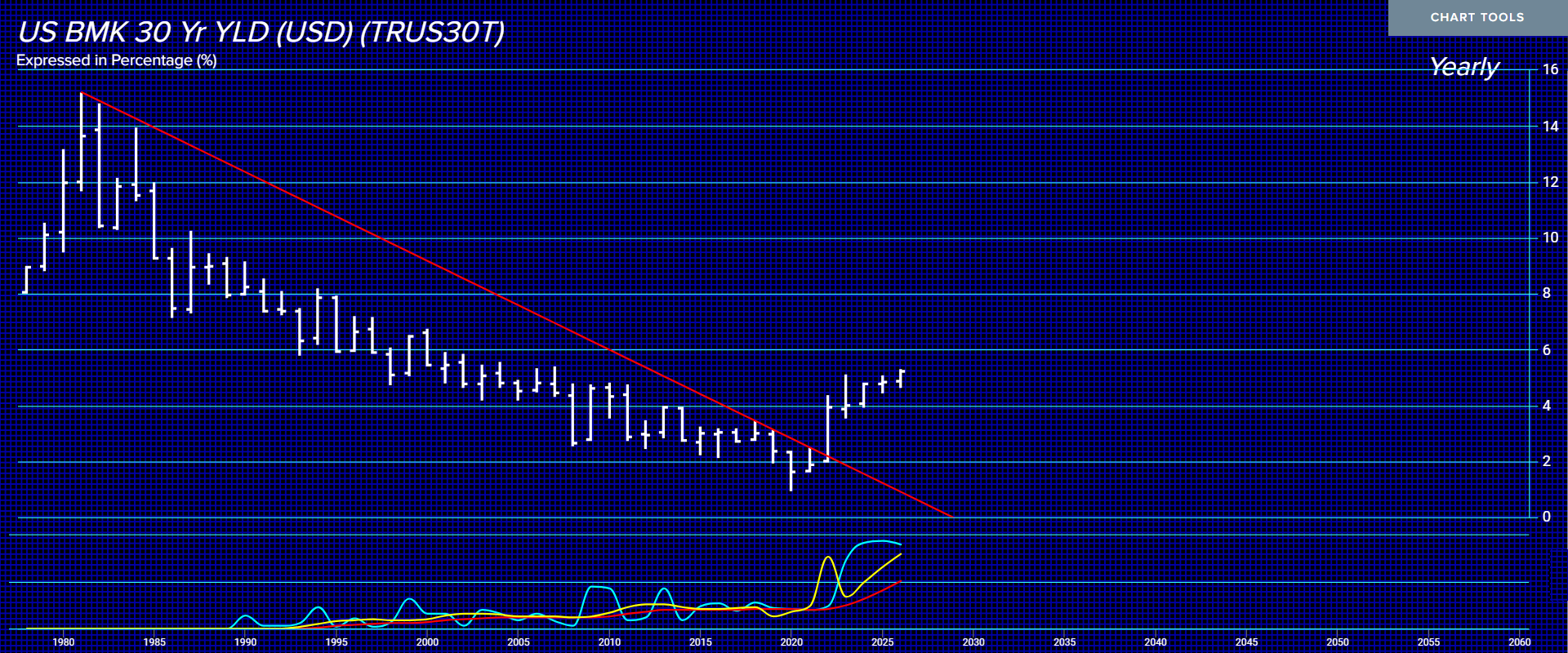
Look, the buy back of $6 billion amounts to .001%. This is again a CONFIDENCE game attempting to manipulate the market with a lot of hot air. As I have said, the 30-year has formidable resistance at 5.5%. A failure to close about that level warns we can have a knee-jerk reaction to the down side, but this will be caused by a rush of capital inflows because of war as capital flees the geopolitical epic-centers. However, that will not last beyond 2027. Inflation will rise because the real crisis is not in crude oil but in the refined products thanks to the madman of Ukraine, Zelensky attacking Russian refineries. As debts become exponential post 2027, rate will rise and the prospect of war becomes a reality and governments NEVER have any intention of ever paying off what they borrow. Shifting debts short-term make the roll costs exceptionally higher. We do we borrow with no intention of paying anything back? This is the way ALL governments function with no rational reasoning behind this stupidity. The press loves to bash the US and ignore the sovereign crisis which has reach about $350+ trillion worldwide. This is what 2032 is all about.