QUESTION: Marty, you have said that every religion has undergone some schism. That implies that governments have also seen splits and even civil wars. Is this what Socrates has uncovered that unity cannot exit in ant group setting?
Greg
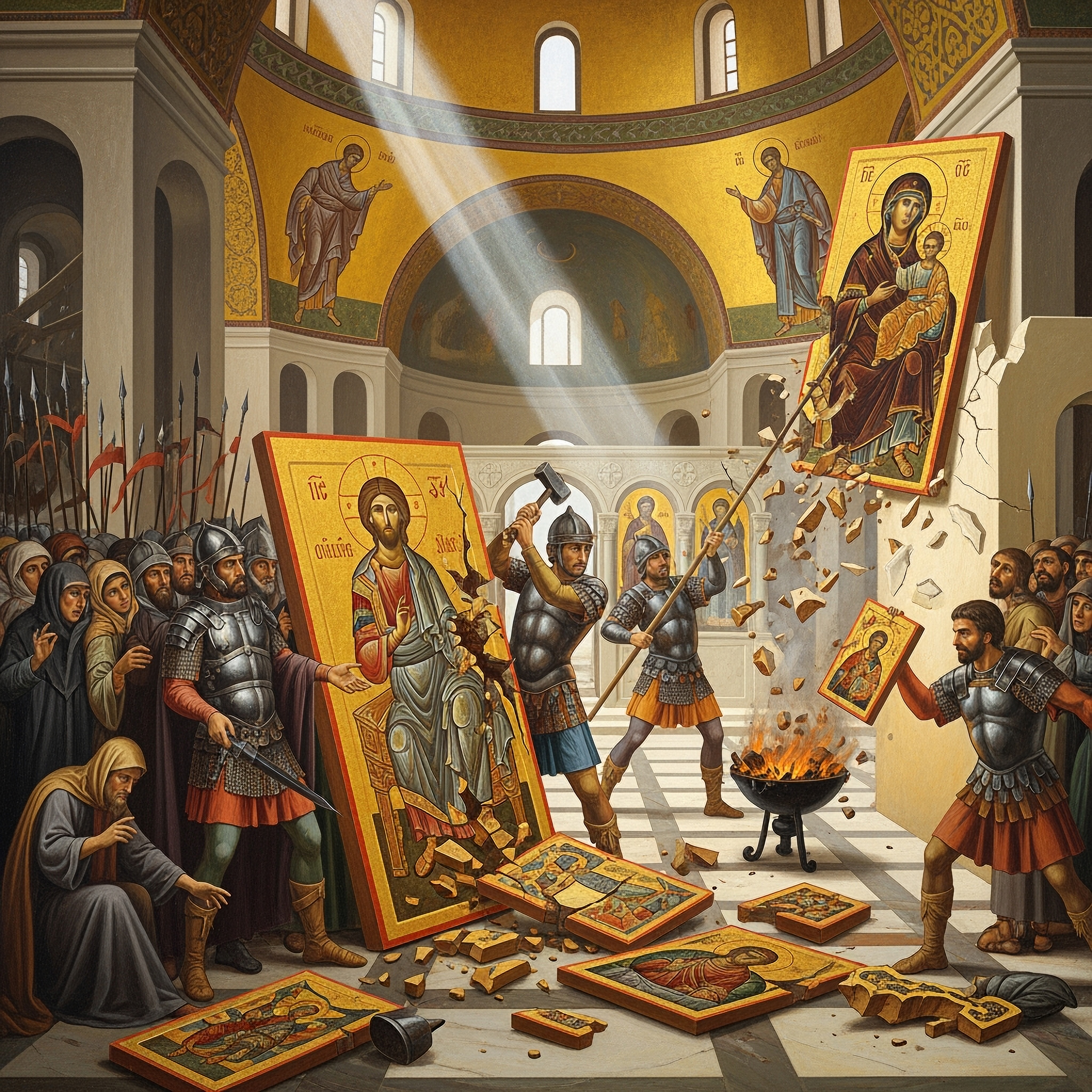
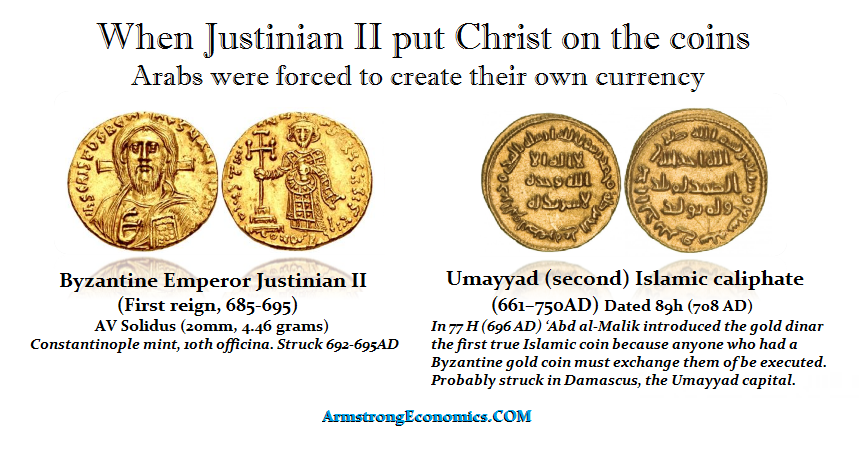
ANSWER: There have been major upheavals in religion, such as the Byzantine Iconoclasm, a profound religious and political crisis that rocked the Byzantine Empire for over a century (with two main phases: 726–787 and 814–842 AD). While the act of putting Christ’s image on coinage by Emperor Justinian II (c. 692 AD) was a highly significant and a controversial event that intensified theological debate and foreshadowed the coming conflict, it is not considered the beginning of Byzantine Iconoclasm. However, the Muslims were using the Byzantine coinage until this event. That is what caused Islam to begin to issue their own coinage.
Then there was the Great Schism of 1054 in Christianity between the East (Orthodox) and the West (Rome). Sunni-Shi’a divide, which originated in a succession crisis after the death of the Prophet Muhammad in 632AD. Martin Luther (1483–1546) was the Catalyst for the Protestant Reformation when he nailed his “95 Theses” to the door in 1517AD. Judaism has experienced major ideological fractures and the gradual emergence of distinct movements, particularly in the modern era. Buddhism has a clear history of major schisms, often formalized by councils. Hinduism is inherently pluralistic, so “schism” is less applicable. Daoism in China split primarily along liturgical and lineage lines. The major schism in Shinto is a modern, politically engineered one. Sikhism experienced a major, definitive schism after its 10th Guru. We find that religions have split as we see politically in nation-states.
To me, this demonstrates that there will ALWAYS be a division among nations for politics is even more divisive. If religions split, the division of a nation into groups of political views is much more possible than religion.