THE GREAT MONETARY COLLAPSE OF BYZANTIUM IN 1092
A Study in Sovereign Failure and the Destruction of Confidence
The Byzantine Empire was no more successful in its currency management than the Western Roman Empire? In fact, it may have been worse. Rome reduced weight of the gold but debased the silver. Byzantium debased the gold as well. There was the Great Monetary Crisis of 1092 AD that effectively marked the peak from which it never really recovered.
Introduction: The Same Story, Different Century
There is nothing new in monetary history. The forces that destroyed the Byzantine monetary system in 1092 are the same forces that threaten every fiat currency regime throughout history. This assumption that fiat simply means paper currency is seriously wrong. Fiat means the value of a currency is dictated by the state. If they took one ounce of platinum and called it $1 trillion as some proposed, that would be fiat despite the fact it is platinum rather than paper. All money is fiat for it is the product of the state. What actually makes its value is a combination of CONFIDENCE in the state and the fact that it is LEGAL TENDER meaning that the state will accept its own money in payment of taxes.
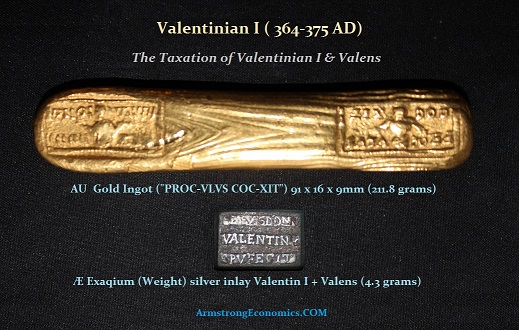
During the 4th century, the number of debased and counterfeit coins became so prominent that under the emperors Valentinian I and Valens, the coinage was not accepted as LEGAL TENDER. The tax had to be paid in terms of raw gold. Here is an official weight to measure the coin and here is a gold bar stamped by the tax collector who simply melted down the coins to product ingots in the tax collection.
When political corruption erodes CONFIDENCE in the future, people hoard their wealth. When people hoard their wealth, governments debase the coinage. When governments debase the coinage, the system collapses. This is not complicated. It is a cycle that has repeated itself since the dawn of civilization. Those who refuse to learn from history are condemned to repeat it. The Byzantine Empire of the 11th century is a perfect case study in this eternal truth.
The Prelude: The Slow Poison of Debasement
The Byzantine monetary system, which had remained remarkably stable since the 3rd century AD, began its final decline in the decades preceding 1092. The two principal gold coins—the histamenon nomisma and the tetarteron nomisma—had suffered a series of progressive debasements that would render them barely recognizable as gold. By the time Alexius I Komnenos ascended to the throne in 1081, the gold content of these once-prestigious coins had become so low that they could scarcely justify their names. This is where the crisis of confidence begins.
I have argued many times that when confidence in government collapses, you see a flight to real value. The Byzantine people understood this intuitively. They began hoarding their gold because they understood that the government’s promises were worth less every day. The standard economic models of supply and demand fail to explain what happens in such circumstances. When people do not trust the future, they will hoard their wealth. No amount of additional supply can satisfy demand when the underlying asset is perceived to be worthless. Nothing is ever permanent. The silver-to-gold ratio fluctuates precisely because it reflects shifting confidence in monetary regimes. The Byzantine people were witnessing their government’s slow-motion collapse.
The Collapse of 1092: When a System Dies
By 1092, the situation had become untenable. The monetary crisis reached its breaking point. The old coinage system was completely abolished. Not reformed. Not adjusted. Abolished. The old histamenon and tetarteron were declared worthless, and a new system was instituted from scratch. This is the ultimate sign of sovereign failure. When you must completely scrap your monetary system and start over, you are admitting that the previous regime was built on a lie.
The reform of 1092 introduced the hyperpyron as the new gold standard. It also introduced new denominations: the aspron trachy in electrum and the billon aspron trachy. I use the word “reform” cautiously. In reality, this was a sovereign default by another name. The government that had spent decades debasing its currency was simply replacing the old fictions with new ones. The hyperpyron enjoyed a brief period of relative stability, but even this new system would eventually succumb to the same forces. By the end of the 12th century, the billon aspron trachy had been debased to 1/184 of the value of the hyperpyron. The pattern is always the same.
The fact that the new coins were made scyphate, or cup-shaped, is itself revealing. Governments love to create the illusion of value. When you cannot deliver real value, you create a physical gimmick. The cupped shape of the trachy was aesthetic; it was designed to suggest substance where none existed. This is precisely the same phenomenon we see today with modern currency design. Governments create elaborate paper money, sophisticated anti-counterfeiting measures, and complex monetary policies—all in a desperate attempt to maintain confidence in paper promises. The underlying reality remains the same.
The Core Cause: Political Corruption and the Destruction of Capital Formation
I have stated countless times that the collapse of a monetary system is never about economics alone. At the core is always the collapse in debt, for therein is the destruction of capital formation. Crash the stock market and you get a recession. Crash the debt market and you get a depression. The Byzantine collapse of 1092 was driven by the same political corruption that has characterized every major economic collapse in history.
What was the Byzantine government doing in the decades before 1092? It was spending beyond its means. It was debasing its currency to fund its excesses. It was destroying the very capital formation that had sustained the empire for centuries. The cause is always political corruption. It was true in ancient Rome, it was true in Byzantium, and it is true today.
When investors and citizens lose faith in a government’s ability to manage its fiscal affairs, they withdraw their capital from the system. They hoard gold. They move assets offshore. They find ways to protect their wealth from the inevitable collapse. This capital flight destroys the productive capacity of the economy. Businesses cannot secure loans. Trade falters. Manufacturing declines. The real economy contracts, and the government responds with even more debasement. This is the death spiral of every monetary system.
The Aftermath and the Lessons for Today
The reformed Byzantine monetary system limped on through the 12th century, but the damage had been done. By the reign of Isaac II (1185-1195), the electrum aspron trachy had been debased to the point of extinction. The hyperpyron itself would eventually be debased. The Byzantine Empire never fully recovered its monetary stability, and its decline was accelerated by the very corruption that had caused the crisis in the first place.
There is a direct parallel to what we see in the world today. Sovereign debt levels are at historic highs. Central banks continue to debase their currencies through quantitative easing and negative interest rates. Political corruption and dysfunction are rampant. The global monetary system is built on the same foundation of fiat currency and government promises that failed the Byzantine Empire.
I have warned about the coming crisis of 2032, which will push humanity into a new Dark Age. The parallels with the Byzantine collapse of 1092 are undeniable. When governments destroy confidence in their monetary systems, they destroy the foundation of civilization itself. There is no way to solve this problem through more government spending, more debt, or more monetary intervention. The only solution is to restore confidence in the rule of law, fiscal discipline, and real value. But I fear that the political corruption that caused the Byzantine collapse is now so deeply embedded in our system that no such restoration is possible.
Conclusion: The Unchanging Pattern
The great monetary collapse of Byzantium in 1092 is not an isolated historical event. It is a demonstration of a universal principle. I have documented this pattern through the economic cycles from the Sumerian city of Ur to the 13th century Venetians. The Byzantine collapse is simply one point on the chart. The evidence is clear: when governments debase their currency, when they destroy capital formation, and when political corruption becomes systemic, economic collapse is inevitable.
Those who look to history for guidance should study the Byzantine monetary crisis of 1092 very carefully. It tells us that the forces of economic destruction are constant. It tells us that confidence is the foundation of all value. And it tells us that once confidence is destroyed, no reform, no new coinage, and no policy can restore it. The collapse of the Byzantine monetary system was a wound that never fully healed. The lesson for today is the same: destroy confidence, and you destroy everything.