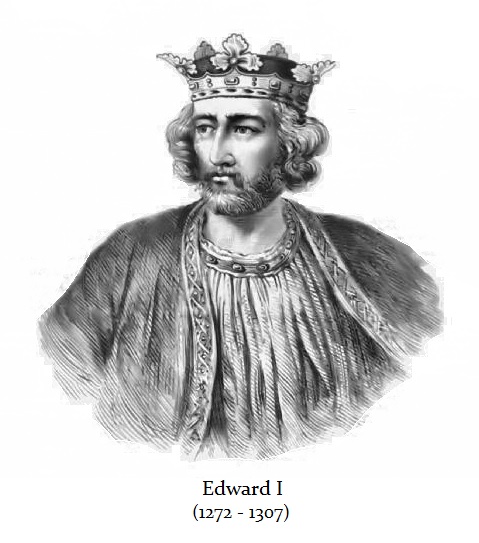
Edward I

Longshanks
1272-1307
Edward I (Longshanks) was the eldest son of Henry III and his queen, Eleanor of Provence. Edward was born in 1239 and at the age of only ten he was named governor of Gascony. In 1254, Edward was married to the Princess Eleanor of Castile.
Edward began to take a prominent role in matters of state during the latter part of his father’s reign. There is no doubt that he displayed great ability to make quick decisions and he was not beyond treachery when needed to serve his purpose.
In the barons’ war, which began in 1261, he had generally the conduct of the royal forces; was defeated and taken prisoner by De Montfort at Lewes, in 1264; escaped the next year, and defeated De Montfort at Evesham, thus securing the liberty of his father, and ended the war by the reduction of the Isle of Ely in 1267. He soon after took the cross, and set out to join St. Louis in the crusade, but did not arrive in the Holy Land till 1271. After various successes and a narrow escape from assassination, his wife, it is said, sucking the poison from his arm –he set out on his return, arriving in England in August, 1274. He had been proclaimed king on the death of his father nearly two years previously, and was crowned, with his queen, soon after his arrival.
War filled up the greater part of his reign. The principal events are the conquest of Wales and the wars with Scotland. Llewellyn, prince of Wales, refusing to attend the English parliament and do homage, was defeated by Edward in 1277 ; and having again revolted, was again defeated, and at last slain in 1282. Edward built many castles in Wales, and settled the government by the statute of Rhuddlan.
Edward I is also remembered for his persecution of the Jews and ultimate banishment from England, He treated the Jews with great cruelty and injustice, hung hundreds of them on a charge of clipping the coin, and in 1290 banished them. However, Edward I had borrowed from the Jews extensively at a time when there were no government bond issues or debt market.
Edward also borrowed extensively from the Italian bankers known as the Riccardi family who had the ability to lend vast sums of money to the English Crown because they were a medieval quasi-primary dealer raising money for the king among the other banking houses of merchants in Italy. As Edward I began to engage in war with the Welsh, First War 1276-1277 followed by the Second War 1282-1283, he relied upon the Riccardi to provide the funding secured by the right to collect customs taxes in Ireland and England.
The Riccardi raised funds on the continent among the Italian merchant-banking houses. The Welsh campaigns were fully funded by this banking arrangement. Kaeuper reported that in 1277, funds had been raised “from fifteen companies, totaling 13,150 marks.” (p202). which was 8,766 pounds. Then there was in Wales the event known as the Rhys ap Mardudd Rebellion, which took place in 1287. Again, the English Crown turned to the Riccardi of Lucca to provide the funding. However, Edward I had also started to borrow from the Jews in England.
In order to provide this funding, the Riccardi were given the right to collect taxes controlling the English and Irish customs tax on exports. Nevertheless, there was clearly a distinction that funding the war with the Welsh was one thing. However, in 1294, war broke out with the French. That created a serious problem for the Riccardi. Just on the surface, war with France interrupted the line of communication between England and Italy and disrupted the merchant-banking interbank market as a whole.
When Edward I returned to England in 1289, he was confronted by corrupt judges and dismissed them summarily. Then in 1290, Edward I seized all the property of the Jews and expelled them from England. It was one thing to assert the Jews were not Christian, and another to use that as the pretense claiming they had violated his previous ban on usury, when in fact he was an excessive borrower himself. Edward I not only banished the Jews, he then decreed that all their assets were now his and those who they had lent money to now owed the crown. This seems to be a profitable decree disguised as law. The Jews were not allowed in England until Oliver Cromwell permitted them to return to England in 1655 by refusing to extend Expulsion Laws imposed roughly 300 years earlier by Edward I in 1290.
In 1291 the numerous competitors for the crown of Scotland submitted their claims to Edward’s decision, which was in favor of John de Baliol. Baliol paid homage to Edward, and was made to feel his dependence too keenly; so that war soon broke out between the two kingdoms. Then came the terrible devastation of Scotland, temporary submission, insurrection of William Wallace (? – 1305), his victory of Stirling, his defeat at Falkirk, numerous invasions and truces, capture and execution of the great patriot leader, fresh revolt, and coronation of Robert Bruce in 1306, and a final expedition against the Scots in the following year, which was cut short by the death of Edward at Burgh-on-the-Sands, near Carlisle, 7th July, 1307.
Very great and important legislative changes took place in this reign. Edward left by his first wife, four sons and nine daughters; and by his second, Margaret of France, whom he married in 1299, two sons and one daughter. Margaret survived him.
Taxation
The earliest printed version of “Baa, Baa, Black Sheep” dates back to 1744, but the rhyme is likely much older than that. The words, which have barely changed over the centuries, appear to tell a simple story of wool being delivered to three different people: the master, the dame, and a little boy. Historians believe, however, that the nursery rhyme actually alludes to a medieval wool tax that existed in England from 1275 up to the 1500s. The tax demanded that wool producers deliver a third of their product to the king (the master), and a third to the church (the dame), leaving only a third for the farmer — a tax seen as entirely unfair at the time. The specific mention of a black sheep possibly adds another layer, as black wool was less valuable than white because it couldn’t be dyed.
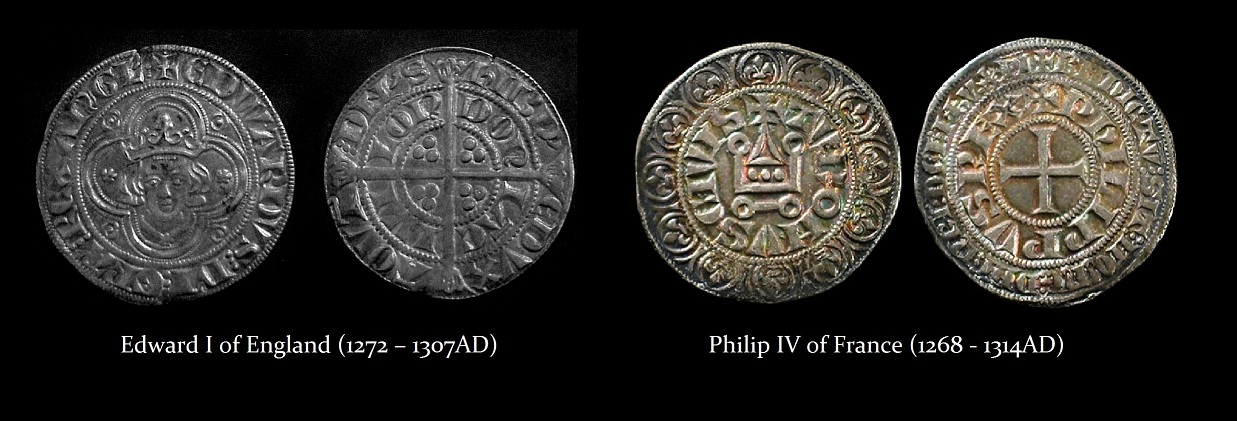
 As the 13th century unfolded, the cost of endless Crusades burdened both the crowns of England and France. Throughout the remainder of the 13th century, a variety of Crusades were aimed not so much at toppling Muslim forces in the Holy Land but to combat any and all groups seen as enemies of the Christian faith. Edward I of England began his reign in 1275 with heavy debts incurred from the Crusades.
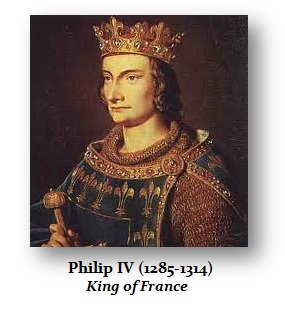 These endless wars resulted in the time of major sovereign defaults by Edward I of England and Philip IV of France. In 1275, Edward secured a financial monopoly and negotiated a grant of export duties on wool, woolfells, and hides that brought in an average of £10,000 a year. He then used this as collateral to borrow substantially from Italian bankers granting them the security of these customs revenues to fund his endless wars of aggression.
Edward imposed heavy taxes on the value of movable goods. At the beginning of this Wave 850, Edward defaulted on his loans from the English Jewish bankers, and then as 1290 began, to cover that default he expelled all of the Jews from England and confiscated all their property.
Moreover, this was the Edward Langshakes of the movie “Brave Heart” when in 1291 he attacked Scotland all for money. As this 8.6-year Wave 850 peaked, Edward launched his very costly war against Philip IV (1295-1314) of France which lasted until the end of this 8.6-year wave when it came to an end in 1297.
Edward I enacted significant taxes on wool. The kings before him had levied some duties, but Edward I established a major, permanent tax on wool exports with the consent of Parliament. Edward I’s principal tax on wool was established in 1275. He instituted a permanent export duty of 6s. 8d. (six shillings and eight pence) on every sack of wool exported.
the tax on wool was directly connected to Edward I’s use of Italian bankers. The new customs duty on wool was not just a source of revenue but was specifically designed to serve as security for loans from Italian merchant-bankers.
The “Ancient Custom” of 1275, a tax of 6s. 8d. on every sack of wool exported, was a key part of Edward I’s financial strategy to fund his war against Philip IV of France. While it provided the king with a steady income, its true value was its predictability. This reliable revenue stream was perfect to offer as collateral for loans, allowing Edward to secure a continuous flow of cash from Italian banking houses.
The Partnership with the Riccardi of Lucca
The primary beneficiaries of this system were the Riccardi of Lucca, a powerful Italian merchant-banking society. Edward I had partnered with the Riccardi on his crusade and continued the relationship after becoming king. From 1275, they were appointed to collect the new wool custom in England and Ireland.
In return for collecting this customs revenue, the Riccardi acted as the king’s bankers, advancing him cash for his major military campaigns, including the conquest of Wales. This system allowed Edward to borrow against future tax income, smoothing out the seasonal gaps in his revenue and funding expensive wars without having to maintain a large cash reserve.
This relationship was risky for the Italian bankers. For example, in 1294, when war broke out with France, Edward demanded more money, but the Riccardi could not raise the funds due to a “credit crunch.” Edward responded by seizing their assets, effectively bankrupting them.
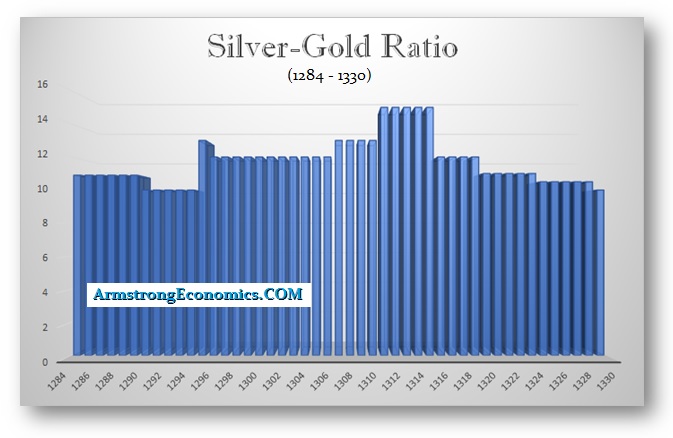
The Riccardi of Lucca was perhaps one of the major international merchant banking houses to emerge during the 13th century. The Riccardi established branches in Rome, Bordeaux, Paris, Flanders, London, York, and Dublin, Ireland. They engaged in trade with Edward I of England. Prior to 1272, the English kings were customers of the Italian merchant who had exotic imports as they were purchasing luxury goods and would use them to transfer money to Rome. With the outbreak of war against Philip IV in 1294, a major credit crunch and inflation erupted which impacted the entire international money markets throughout Europe at the time. The value of gold rose against silver from 10:1 to virtually 15:1, which was a monumental distortion of the European monetary system as a consequence of these endless wars.
Cash-strapped, Edward sought financial support from the Riccardi establishment but they refused to lend him any funds. In response, Edward seized all of Riccardi’s assets in England, effectively bankrupting them. The Riccardi had derived significant benefits in dealing with the English monarchy. They held contracts with special access to the English wool market. The Riccardi banking establishment was involved in about 50% of all the forward contracts with English wool producers, which were in effect futures contracts in the cash market. When Edward confiscated all the assets of the Riccardi, his action backfired. Nobody else would then deal with England in international money markets. This led Edward I to impose heavy levels of domestic taxation, which led to civil unrest. This led to a constitutional crisis in 1297.
Monetary System

DENOMINATIONS
AR Groat
AR Penny
AR Half-Penny
AR Farthing