
Join Us at the World Economic Conference in Orlando, Florida! Nov. 17-19, 2023

Join Us at the 2023 World Economic Conference in Orlando, Florida!
? Dates: November 17, 18, and 19 ? Location: Orlando, Florida, USA (or tune in from home with our virtual ticket options)
Are you ready to unlock the future of economics and finance? Prepare for an unforgettable World Economic Conference experience in sunny Orlando, Florida! This premier event is your gateway to insights, networking, and valuable resources that will supercharge your understanding of the global economy.
?️ What’s Included for In-Person Attendees:
- Event Admission: Enjoy reserved seating assigned based on the order of ticket sales, ensuring you have a prime view of every presentation.
- Presentation Slides: Gain access to the presentation slides from all speakers, allowing you to delve deeper into the topics discussed.
- Video Recording: Can’t make it to a session? No worries! You’ll receive access to video recordings of all conference presentations, so you can catch up at your convenience.
- WEC Event App: Connect with the conference on a whole new level. Access presentation slides, bonus reports, recordings, and more via the official WEC Event App.
- Bonus Conference Materials: Get a package of bonus conference-related materials, including exclusive bonus reports and videos (as provided by Martin Armstrong).
- Morning Information Sessions: Don’t miss out on important morning information sessions, screened on-site in the meeting room on Saturday and Sunday.
- Networking Opportunities: Exclusive access to the Event App Networking Feature allows you to connect with fellow attendees, both in-person and virtual, fostering valuable professional relationships.
- Culinary Delights: Savor delicious breakfast and lunch on Saturday and Sunday, prepared to keep you energized throughout the day.
- Cocktail Reception: Kick off the conference in style at our Friday evening cocktail reception. Meet and mingle with fellow attendees while enjoying refreshing drinks.
- Swag Bag: As a token of our appreciation, each in-person attendee will receive a swag bag filled with goodies, including an Armstrong Economics notebook, pen, and an event collector’s mug!
Unable to travel? We also have two different ticket options for those wishing to attend virtually!
Don’t miss this opportunity to be part of a global gathering of economic and financial minds. Secure your spot at the World Economic Conference in Orlando, Florida, and gain the knowledge, connections, and resources you need to thrive in the world of finance and economics.
Space is limited, so act now and reserve your seat! Visit our Events page to register and join us in sunny Orlando this November.



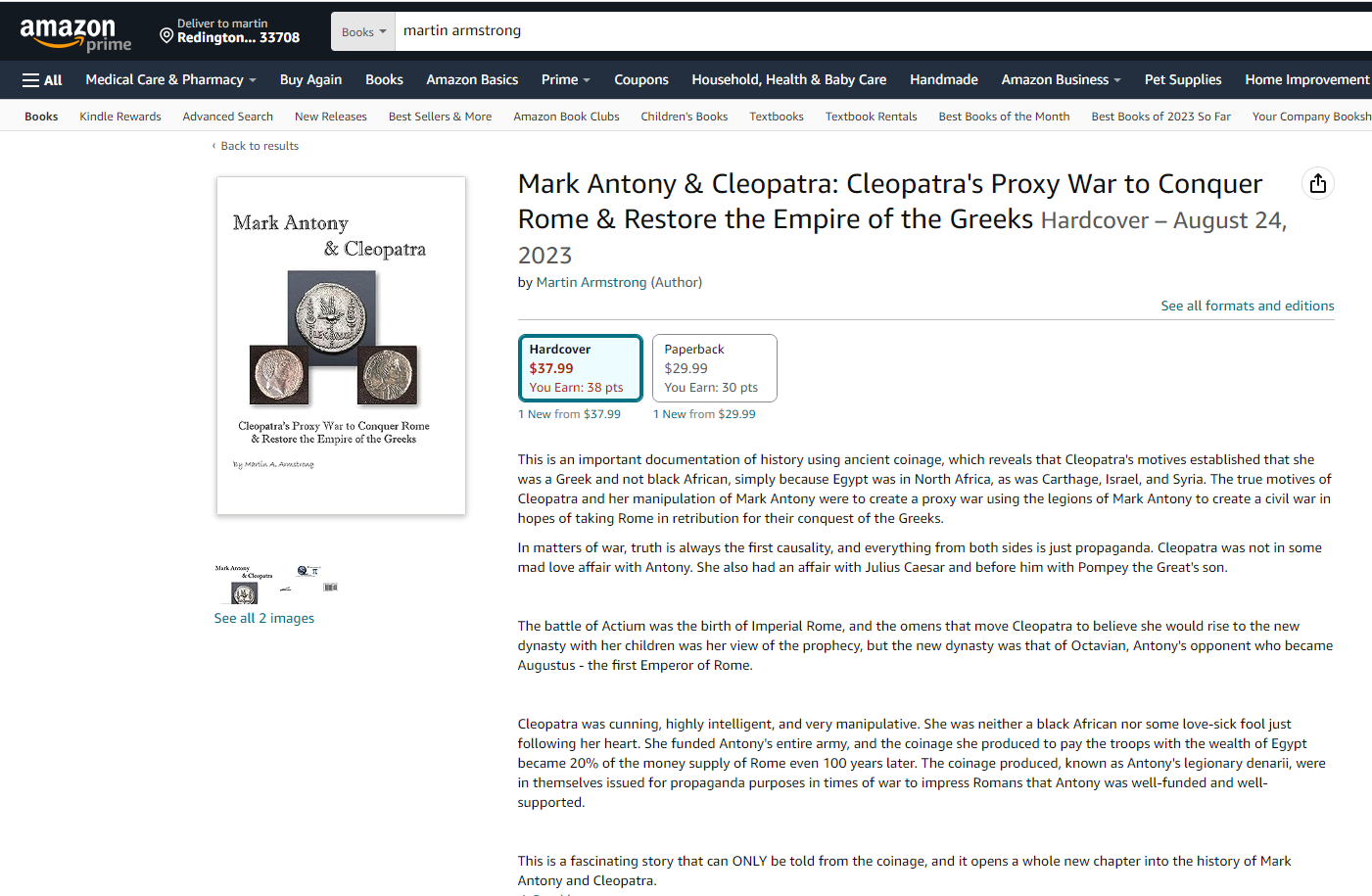
NEW BOOK Now Available : "Mark Antony & Cleopatra"
"THE PLOT TO SEIZE RUSSIA - THE UNTOLD HISTORY"

The second edition of “The Plot to Seize Russia – The Untold History” is now available for purchase in paperback and hardcover on Amazon and Barnes and Noble. The ebook will be available shortly.
Book description:
“Take care of Russia,” Boris Yeltsin said as he departed his presidency in August 1999. These words were directed at current Russian president, Vladimir Putin. Yeltsin specifically picked Putin as his predecessor to prevent the takeover of Russia.
So, who was Yeltsin warning against? Newly declassified documents from the Clinton Administration prove that there was a plot to rig the Russian election of 2000. These never-before-seen documents confirm numerous attempts to implement pro-Western policies using the Russian oligarchy headed by Boris Berezovsky.
On the other side were the communists who desired a return to the glory days of the Soviet Union. As one of the largest international hedge fund managers, author Martin Armstrong found himself in the middle of perhaps the greatest espionage, or attempt at a regime change for Russia, in modern history.
The Plot to Seize Russia pulls back the curtain to expose the most extraordinary attempt to seize power in modern history, but with the pen rather than armies. These declassified documents reveal a plot that has altered our thinking about the relations between the United States and Russia. The thirst for power comes seething through every line of these papers that alter our perception of reality, change the course of history, and now threaten us with World War III.
Netanyahu Has Turned Israel Into a Country Its Own People Are Fleeing

Israel was supposed to be the one place in the world where Jews could live without fear of persecution, war, or being driven from their homes. That was the entire argument behind the creation of the Jewish state following the Holocaust. Yet under Benjamin Netanyahu, Israel has become a country where growing numbers of its own citizens are questioning whether they have any future at all.
The October 27 election is now approaching, and Netanyahu is facing a population exhausted by years of war, political division, military mobilization, and the constant threat of another attack. What is particularly revealing is that Israelis are not simply complaining about the government. They are leaving, and the numbers have reached levels that should alarm anyone concerned about the country’s long-term survival.
Researchers at Tel Aviv University found that 268,509 Israeli citizens left the country for at least three consecutive months between 2023 and 2025. That compares with 183,219 during the corresponding three-year period a decade earlier, an increase of approximately 47%. The annual figures were 86,509 in 2023, 91,499 in 2024, and 90,922 in 2025. These are not all permanent emigrants, and the distinction matters. Nevertheless, researchers estimate that between 45,000 and 50,000 Israelis emigrated for at least one year during 2025 alone. The trend has continued through three years of conflict, and the researchers themselves are concerned that continued departures could eventually threaten Israel’s economic and national security.
Israel’s own Central Bureau of Statistics reported that approximately 69,500 Israelis were classified as emigrants in 2025, while only 18,800 were classified as returning. That represents a negative balance of approximately 50,700 among those two categories. The official figures use a different methodology from the Tel Aviv University study and classify emigration after a qualifying period abroad, so they should not be confused with the number who physically departed during that calendar year. The Taub Center calculated that Israel’s overall international migration balance, including new immigrants, had turned negative in 2024 and was expected to remain negative in 2025. This is a remarkable reversal for a country that spent generations encouraging Jews from around the world to relocate there.
The Bank of Israel has acknowledged the deterioration. Its 2025 annual report found that the migration balance had shifted from an average annual gain of roughly 20,000 people during 2016–2019 to an average annual loss of approximately 20,000 during 2024–2025. Some of that change reflects people who had recently arrived from Russia and Ukraine and subsequently moved elsewhere. It would be misleading to portray every departure as a lifelong Israeli fleeing Netanyahu. But the central bank also identified a meaningful increase in emigration among native-born Israelis. The problem cannot simply be dismissed as temporary immigrants returning home.
What is perhaps even more troubling is the number of people considering leaving. A survey conducted by the Israel Democracy Institute in April 2025 found that approximately one-quarter of Jewish Israelis and one-third of Arab Israelis were considering living abroad, either temporarily or permanently. Among secular Jews, the figure reached 39%. These are people who have grown up in Israel, established careers, raised families, and contributed to the economy. They are now questioning whether remaining is worth the financial, political, and physical risks. Considering emigration is not the same as actually leaving, but when such a substantial portion of the population begins looking toward the exits, the government should be asking what has gone wrong.
The economic consequences are particularly serious because Israel depends heavily upon a relatively small segment of highly educated and productive workers. Reuters recently reported that high technology generates approximately 18% of Israel’s GDP, while the top 20% of workers account for 93% of income-tax revenue. Defense spending has doubled to approximately 8% of GDP, placing enormous pressure on public finances. Israel can withstand the loss of some residents, but the departure of engineers, scientists, physicians, entrepreneurs, and skilled professionals has consequences far beyond the number of people boarding airplanes. These are the taxpayers and innovators who sustain the economy and help finance the country’s enormous security establishment.
The Taub Center has also observed that Israeli-born emigrants are increasingly choosing destinations beyond the traditional United States, Britain, and Australia. Germany, Cyprus, and parts of East Asia are becoming more prominent. Germany is especially revealing given the history of the Jewish people in Europe. For generations, Israel encouraged Jews to leave Europe and establish a secure future in the Jewish homeland. Now some Israelis are looking toward Germany and other European countries for economic opportunity, political stability, and a different quality of life. The reversal is extraordinary, even though Germany’s inclusion among emigration destinations does not establish that all those moving there are Jewish or that every move is motivated by security.
Descendants of European Jews who fled persecution may qualify for citizenship in countries their parents, grandparents, or great-grandparents once called home. Germany allows eligible victims of Nazi persecution and their descendants to reclaim or acquire German citizenship through constitutional and statutory restitution provisions. Austria provides citizenship to qualifying descendants of people persecuted by the Nazi regime, generally without requiring them to surrender their existing nationality. Lithuania permits eligible descendants of former Lithuanian citizens to restore citizenship, including many families whose ancestors departed before March 1990. Poland provides a process for confirming citizenship inherited through Polish parents or grandparents, provided the legal chain of citizenship remained intact. Hungary also has ancestry-based citizenship procedures, including simplified naturalization for qualifying descendants who meet the applicable requirements, such as demonstrating knowledge of Hungarian. These arrangements are not blanket offers of citizenship to anyone who is Jewish.
Israel is not experiencing a collapse of its population. Births still exceed deaths, and its total population has continued growing. Nor does the available evidence establish that most Jewish Israelis intend to leave permanently. But a country does not have to experience mass depopulation before emigration becomes an economic and political problem. The loss of confidence begins long before the demographic consequences become irreversible. The fact that Israel’s central bank, universities, and demographic researchers are now examining these trends should be enough to demonstrate that this is a serious national concern.
Britain Tells Citizens to Stockpile Supplies as the War Cycle Escalates
The British government is now telling its citizens to stockpile food, water, cash, and emergency supplies in preparation for a potential cyberattack or disruption to critical infrastructure. The new “Be Ready” campaign advises households to maintain at least 72 hours of essential supplies, warning that electricity, communications, transportation, and even supermarket payment systems could suddenly become unavailable. This is coming from the same political establishment that has spent years promoting a society increasingly dependent upon electricity, digital banking, and centralized infrastructure. I have been discussing these vulnerabilities for years. Now the government is finally admitting that ordinary people need to prepare for the possibility that the systems they depend upon every day may stop functioning.
Britain is advising citizens to store nine liters of drinking water per person, three days of nonperishable food, essential medications, batteries, flashlights, a radio, and physical cash. Security Minister Dan Jarvis has described these as sensible precautions, while Defence Secretary Wes Streeting has raised the possibility of cyberattacks and disruptions caused by hostile states or terrorists. Government research found that only 13% of Britons feel prepared for an emergency that could interrupt essential services. That is an astonishing admission about how dependent modern society has become upon systems that most people assume will always function.
I have repeatedly explained that the power grid will become one of the most important strategic targets during a major war. You do not need to destroy every building or occupy every city to bring a modern economy to its knees. Interrupt the electricity supply and you can cripple banking, telecommunications, fuel distribution, transportation, refrigeration, and large portions of the water system. Hospitals have backup generators, but those systems depend upon fuel and maintenance. Supermarkets cannot operate indefinitely without electricity, and their electronic payment terminals are useless when the networks go down. The public has become so accustomed to immediate access to everything that many people cannot imagine what happens when the infrastructure supporting their daily lives is suddenly unavailable.
Governments have been pushing society toward digital transactions while ignoring the obvious vulnerability that every electronic payment depends upon functioning infrastructure. What happens when you have money in the bank but cannot access it? Your account balance may be perfectly healthy, yet the supermarket cannot process your card, the ATM is offline, and your banking application cannot connect. The European Central Bank’s own advice is to keep physical cash available during emergencies. Even central bankers recognize that cash provides a backup when digital systems fail. Yet politicians continue promoting the elimination of cash as though technological dependency were somehow an improvement in national security.
The same problem applies to the supply chain. Most supermarkets are not warehouses containing months of food for the surrounding population. They depend upon regular deliveries, functioning distribution centers, available fuel, and transportation networks. A major cyberattack against logistics systems could interrupt deliveries even if the farms and factories producing the food remain untouched. Refrigerated products would be particularly vulnerable during prolonged electricity outages. Trucks cannot move without fuel, and fuel stations themselves often require electricity to operate their pumps. A disruption that begins in one sector can rapidly spread into several others. We witnessed during the COVID lockdowns how quickly supply chains can become strained when transportation, production, and distribution are interrupted.
I have also discussed the agricultural cycle and the risks associated with food shortages, particularly when war disrupts energy supplies and international trade. Fertilizer production depends heavily upon natural gas, while agriculture requires diesel, transportation, machinery, and reliable access to international markets. The conflict involving Iran has demonstrated how quickly the interruption of a major shipping route can affect energy supplies and the cost of moving goods. The Strait of Hormuz is not merely an oil issue. Disruptions to energy exports raise costs throughout the global economy, including food production and distribution. A prolonged war can create shortages thousands of miles from the battlefield without a single bomb falling on the country experiencing them.
Physical cash is another essential precaution. I have repeatedly argued against the idea that society should become entirely dependent upon digital currency. During a serious cyber incident, banking systems may remain operational in one region while payment networks fail in another. Even a localized communications outage can prevent merchants from processing transactions. Keeping a reasonable amount of cash in small denominations provides an alternative for essential purchases, although cash will not solve every problem if shops are closed or goods are unavailable. If the government collapses and cash becomes worthless, I highly suggest having items for barter like silver coins that people will accept as a storage of wealth.
The grid itself is becoming more vulnerable as governments increase the number of essential services dependent upon electricity. Europe has spent years pursuing Net Zero policies while reducing certain forms of conventional energy capacity and expanding dependence upon interconnected systems. Renewable generation is not inherently the problem, but an energy transition that fails to provide adequate backup capacity, grid protection, and reliable dispatchable power creates serious risks. Electric vehicles, digital payments, internet-connected infrastructure, and automated logistics all increase the consequences of a prolonged outage. The more dependent society becomes upon a single interconnected system, the more important it is to maintain redundancy.
Cyberattacks are particularly concerning because they can target infrastructure without requiring a conventional military invasion. Governments and private companies face constant attempts to penetrate their networks, and some attacks can compromise systems before vulnerabilities are discovered or repaired. Electricity operators, water utilities, ports, rail networks, hospitals, and financial institutions all present potential targets. A cyberattack does not automatically mean an entire national grid will collapse, and well-designed systems contain protections intended to prevent such failures. Nevertheless, the consequences of a successful attack against critical infrastructure can be enormous. In wartime, the incentive to disrupt an opponent’s economy becomes even greater.
The broader War Cycle is what concerns me. We are witnessing escalating geopolitical tensions, enormous sovereign debt burdens, military rearmament, and growing civil unrest throughout Europe. Governments are preparing for scenarios they would have dismissed as alarmist only a few years ago. The British campaign follows similar preparedness advice issued in several European countries, particularly those closer to Russia. This does not establish that a wider war is inevitable, but it demonstrates that governments are taking the possibility of serious disruption more seriously. Ordinary citizens should do the same without allowing fear to dictate their decisions.
What bothers me most is that governments spent decades encouraging the public to surrender practical independence in exchange for convenience. Everything is becoming digital, interconnected, and dependent upon a functioning power grid. Now those same governments are admitting that the systems they promoted may not be available during a serious emergency. Britain is telling its citizens to prepare for three days without essential services. I would suggest that everyone, regardless of where they live, consider how they would manage if the electricity, banking network, water supply, or local supermarket were unavailable for longer than expected.
The world is entering a period of increasing geopolitical instability, and preparation should not be confused with panic. Nobody knows precisely where the next disruption will occur or how long it will last. It could be a cyberattack, a storm, a transportation failure, a regional war, or a combination of events that overwhelms already strained infrastructure. The point is to reduce dependence upon the assumption that everything will always be available tomorrow. When governments themselves begin advising citizens to stockpile necessities, perhaps people should finally recognize that maintaining a reasonable supply of food, water, medicine, and cash is simply common sense.
Rioters Storm Rome’s Colosseum
Europe is descending into civil unrest, and now the violence has reached the heart of Rome. Protesters carrying Palestinian flags forced their way through the gates of the Colosseum, one of the most recognizable monuments of Western civilization. Security personnel attempted to close the gates as demonstrators pushed forward, and some managed to enter the ancient amphitheater before being removed. The Italian government confirmed the intrusion on October 24 and reported no injuries or damage to the monument. Nevertheless, the spectacle of security guards struggling to protect a 2,000-year-old landmark while crowds attempted to force their way inside should tell you something about the growing disorder across Europe.
Italy is now confronting the same unrest that has swept through France and spread into other European nations. Thousands marched through Rome, Milan, Turin, and other cities over…student rights? It is unclear how the media is still attempting to twist these violent gatherings at student protests. In Rome, confrontations erupted near Piazza della Repubblica, where police deployed water cannons and tear gas to disperse groups attempting to push through security lines. In Bologna, demonstrators hurled bottles and other objects at police. The authorities reported nine arrests across Italy on Saturday, while hundreds were taken in for identification or security checks. The whole nation is putting out fires as the left descends further into violence.
The situation in Milan has become particularly disturbing. After rioters looted businesses and smashed storefronts during the previous weekend, merchants were forced to board up their shops ahead of another round of demonstrations. Luxury retailers, including Gucci, Tiffany, and Omega, protected their windows while the Apple store closed as a precaution. Prime Minister Giorgia Meloni deployed an additional 500 soldiers to Milan, reinforcing hundreds already stationed there and approximately 5,000 police and other security personnel. Think about that. One of Europe’s wealthiest commercial centers is deploying military personnel and barricading businesses because the authorities fear another outbreak of looting. The shopkeeper who has invested his savings into a business is now expected to absorb the financial consequences of political disorder he had nothing to do with creating.
Defense Minister Guido Crosetto acknowledged that the soldiers have limited enforcement powers. They may carry plastic restraint ties in designated areas, but they are not authorized to carry pepper spray or tasers. Italy is deploying military personnel to help maintain order in civilian streets, yet even their authority is tightly restricted. The police must deal with the violence, the businesses must bear the losses, and ordinary citizens are left wondering whether they can safely enter their own city centers.
Italy has long maintained armed security around sensitive religious and historic sites because of the threat of terrorism. Soldiers have guarded locations in Rome, including the capital’s synagogue and Jewish schools, while security has also been heightened around the Vatican and other prominent landmarks.
This is the birthplace of Roman civilization, a country whose architecture, law, language, and institutions helped shape the development of Europe. The Colosseum survived the collapse of the Western Roman Empire, centuries of political turmoil, and countless wars. Now unarmed security personnel are being forced to protect it from people who should never have been allowed in the nation in the first place. The Barbarians have passed the gates, but the people are utterly helpless thanks to ineffective governments that abandoned sovereignty to unelected globalist organizations long ago.
Britain Telling Its People Prepare for Riots & War
The Elections & Diesel
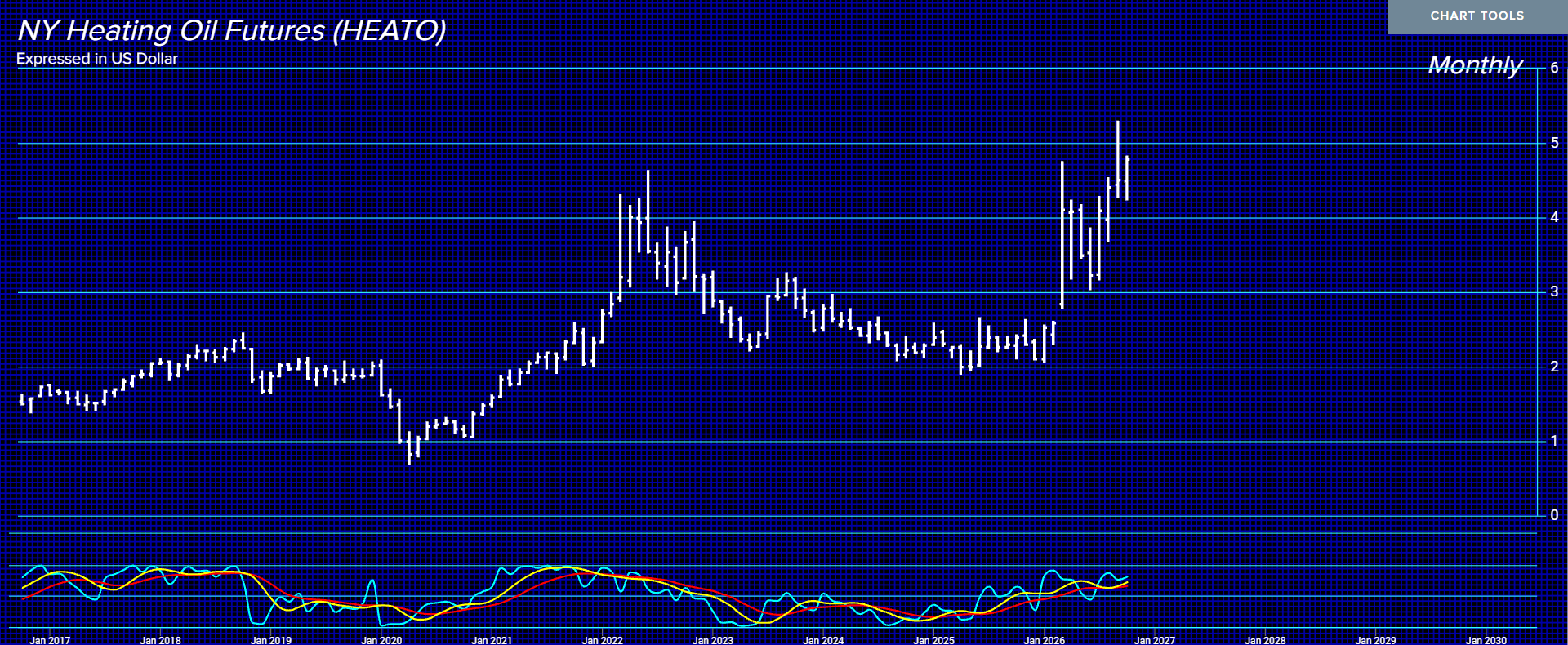
COMMENT: Well, it looks like Socrates is forecasting a Democratic win for the House and a witch-hunt on Trump and Putin.
P
ANSWER: Looks that way. Sources are saying that the Democrats have already informed banks to save all documents relative to diesel and Russia. As I have said, this is going to be just political war. It has nothing to do with what is good for the country. The Democrats will be anti-Iran War, but want war with Russia for their pet dictator Zelensky. He knows he can count of the Democrats to fill his pockets more. No elections for the Ukrainian people.
Diesel will rise. I do not see this reaching a conclusion until next March. So Europe will be in an energy crisis, the Democrats will cheer Zelensky destroying all the Russian refineries. Even if we have a very strong El Niño that is expected to dominate, and its typical impact is to bring warmer-than-average temperatures to many regions, particularly across the northern United States, rather than colder conditions, either that forecast is wrong or Zelensky takes out more refineries.

The Democrats will be their own worst enemy between their Progressive policies to increase taxes on the Middle Class and rich and increases in Social Security Taxes to pay for their cronies, and their desire to launch WWIII with Russia that China will join. This is all necessary to reach that light at the end of the tunnel where we can reform government at last.
They will go after Kushner and try to show corruption between Putin and Trump. Hillary is spinning this nonsense that Putin has something on Trump completely ignoring trying to avoid WWIII.
Nobody cares about the country. They are so stupid that they think taking down Trump means they will ride the white horse is insane. Over 85% of the country views Washington as corrupt. We are looking at the complete collapse in the CONFIDENCE in government and this will have a major impact on all financial markets.
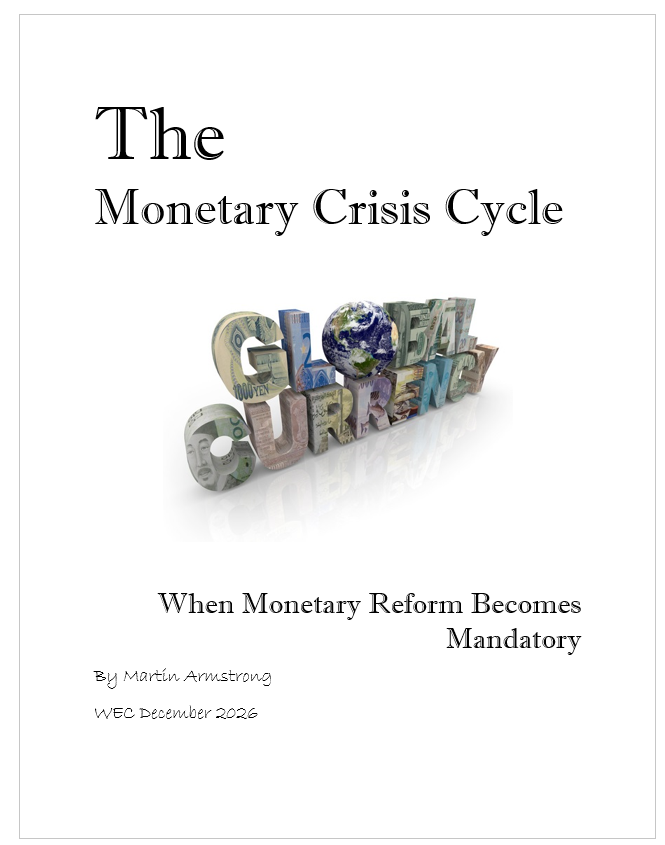
Yes, we will be updating the Monetary Crisis Cycle from the 2019 WEC. We will have some very interesting markets into 2028.
UK Politics Explained
Market Talk – October 26, 2026

US Markets:
- DJIA advanced by 146.42 points (0.28%) to 52,361.58
- S&P 500 advanced by 53.09 points (0.7%) to 7,676.77
- NASDAQ advanced by 214.04 points (0.83%) to 26,169.381
- Russell 2000 advanced by 10.53 points (0.38%) to 2,786.424
Canada:
- TSX Composite advanced by 155.98 points (0.44%) to 35,944.16
- TSX 60 advanced by 8.66 points (0.41%) to 2,139.48
Brazil:
- Bovespa declined by 28,474.33 points (13.88%) to 176,608.23
The Political Chaos – End of Republicans?
QUESTION: Mr. Armstrong, I appreciate that you are nonpartisan. You called out Kushner and his sidekick and explained that since they were not actual government employees but volunteers, they did not have to comply with the Freedom of Information Act like Hillary and her private server. I can see how you have forecast that, going into 2032, confidence in government on both sides will collapse.
Do you think Kushner will be investigated for treason?
DP
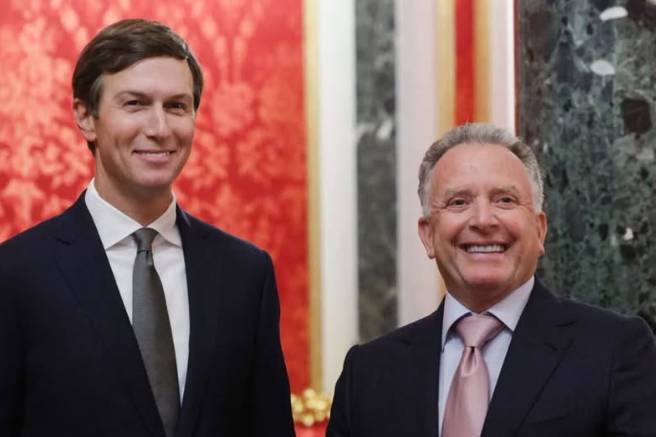
ANSWER: My red flag was raised when Jared Kushner played a key role in bringing former Goldman Sachs President Gary Cohn into the Trump administration during the first term. Kushner’s Role was critical. After Trump won the 2016 election, Kushner arranged a meeting between Cohn and Trump to provide a general briefing on the economy. Reports indicate that Cohn entered Trump’s circle through Kushner and Ivanka Trump, who were both critical advisors. Cohn ultimately left Goldman Sachs to serve as the Director of the National Economic Council. That was against everything people voted for Trump to end the inside deals with the Neocons & bankers.
The during the second term, Jared Kushner probably convinced Trump to listen to Netanyahu to start this war. The record indicates Kushner was present at the meeting. I believe even Rubio advised against it. Then to send Kushner and his sidekick as INFORMAL negotiators in the Middle East and Russia/Ukraine, I think was the worst possible decision and I believe they will not merely undermine the Republican Party, they will destroy Trump’s legacy and destroy the critical CONFIDENCE in government from both sides that will be why we end up in 2032. The Democrats will no doubt target them. They cannot help themselves. They will burn down the barn to get a mouse. This will only expose the distrust in government demanding political change as we head into 2032. Gallup Poll already has found:
Democrats: 91% hold this view, a sharp increase from 57% in 2024.
Independents: 90% hold this view.
Republicans: 83% hold this view, relatively stable compared to previous years.
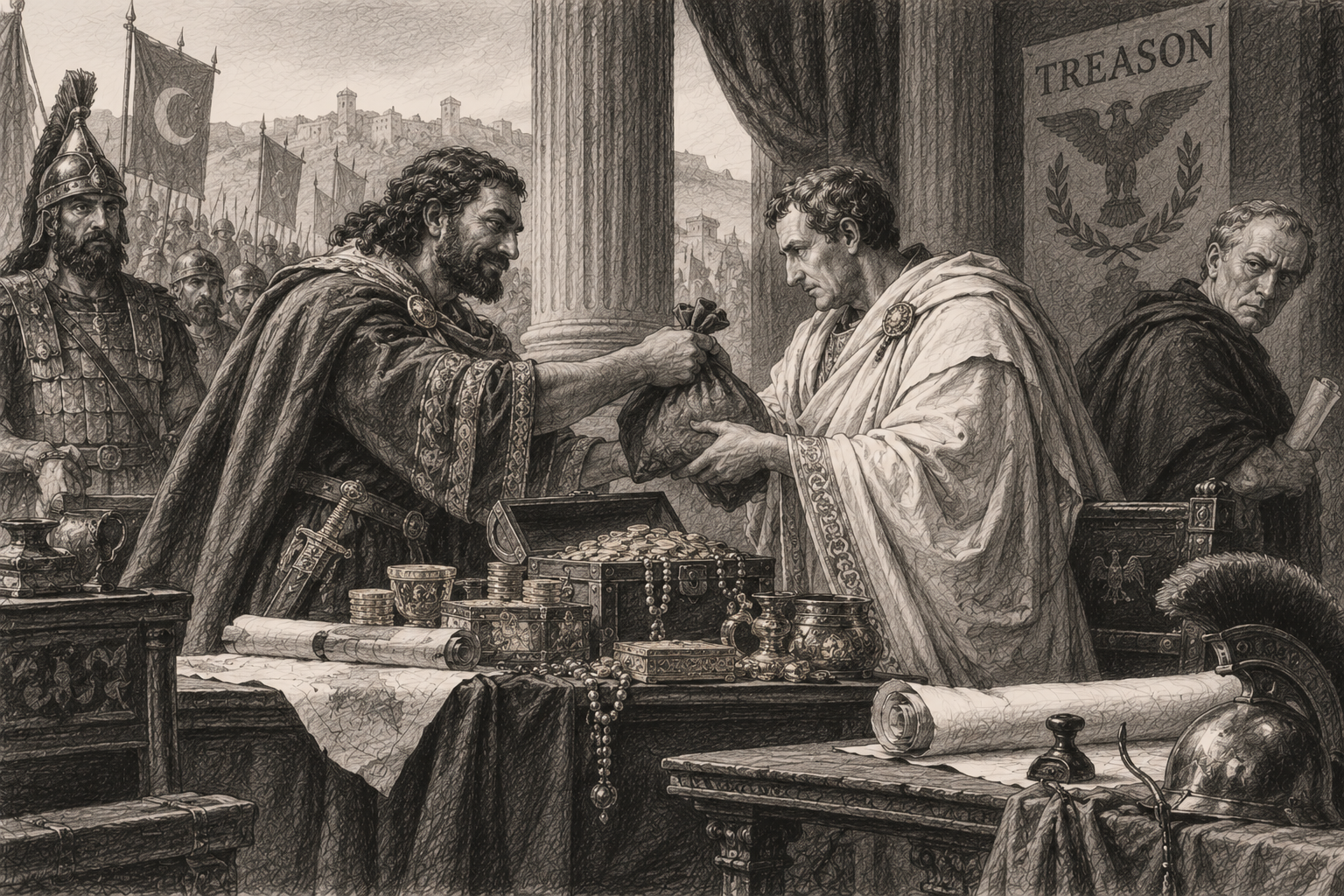

The question of TREASON is a curious one. In the Roman Republic, the legal concept closest to “treason” was perduellio (roughly meaning “acting as an enemy of the state“), and its core prohibited acts included aiding the enemy, surrendering to the enemy, or colluding with the enemy. Regarding the specific scenario of “accepting money from the enemy,” history does record such events. As I have said, human nature never changes throughout the centuries.
However, according to the historian Livy, during the early Republic, the Vitellii brothers conspired with the exiled king Tarquinius Superbus, proposing to betray the Roman state in exchange for payment, and were ultimately punished as proditores (traitors). This case directly demonstrates that “betraying the state for money” constituted treason.
During Gaius Licinius Verres’ tenure as governor of Sicily (73–70BC), he was accused by Cicero of secretly colluding with pirates (Rome’s enemies) for personal financial gain, including releasing pirates and even hosting them in his home, conduct that Cicero characterized as treason (maiestas). Although Verres primarily faced charges of extortion, this case illustrates the legal and public opinion stance on officials who colluded with the enemy for profit. As they say, there is NOTHING NEW under the Sun.
The treason law in ancient Athens (known as prodolia) included in its scope of punishment “accepting gifts from enemies” (taking gifts from them). This meant that receiving money from an enemy and engaging in corresponding actions could potentially constitute betrayal of the city-state.
However, the historical cases actually recorded often involved military commanders, and the charges frequently intertwined military failure, corruption, and betrayal. For example, the famous case of Timotheus. He was prosecuted through a “treason indictment” (graphē prodosias) and ultimately sentenced to a massive fine of 100 talents. According to records, the reason he was accused was “taking bribes from allies” in order to seek reduction of tribute payments for them, this was more like corruption involving foreign interests, but the charge was categorized under treason.
The Athenian generals, Pythodorus and Sophocles, lost the battle in the Sicilian expedition. They fled fearing being charged. They were tried in absentia and sentenced to death. The charges often involved both corruption and betrayal; the generals feared being prosecuted for “corruption or betrayal” upon returning home.
During Medeval times, the core of the famous English 1351 Treason Act was “compassing the death of the king,” “levying war,” or “adhering to the king’s enemies and giving them aid and comfort.” Receiving foreign money to influence policy, unless it directly constituted aiding enemies in wartime, was generally difficult to fit within this narrow definition.
However, cases involving “foreign money” are mostly tied to espionage or wartime treason. For example, during World War I, Frenchman Bolo Pasha was prosecuted for treason for receiving German funds, and the prosecutor argued that “receiving German money itself was sufficient for the death penalty,” though the money was not actually used against France.
Then there was the Irishman Roger Casement who was convicted of TREASON under the 1351 Treason Act for seeking German support for Irish independence, but this was “aiding the enemy,” not merely “influencing policy.”
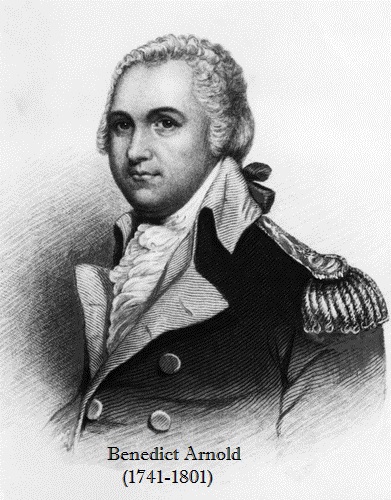
Benedict Arnold (1741-1801) was never formally tried and convicted by a court for “treason” in the modern legal sense. He was declared a traitor through a legislative resolution after his plot to surrender the vital American fortress at West Point to the British in exchange for MONEY and a military commission was exposed. He had previously been court-martialed only for other misconduct charges (unrelated to treason) while serving in the Continental Army. After learning that Major John André had been captured with the incriminating documents, Benedict Arnold fled to the British.
US LAW ON TREASON
Under U.S. law, a person acting for the U.S. government accepting payments from a foreign government would generally not be considered treason. Treason is defined very narrowly by the U.S. Constitution, and such an act would more likely fall under other federal criminal statutes, ethics regulations, or specific prohibitions regarding foreign gifts. The Strict Constitutional Definition of Treason legally is defined exceptionally narrow and is explicitly outlined in Article III, Section 3, Clause 1 of the U.S. Constitution. According to this clause, treason against the United States consists only in:
Levying War against the United States; or
Adhering to their Enemies, giving them Aid and Comfort
Crucially, for an act to constitute treason, the foreign government in question must qualify as an “Enemy” of the United States. This generally requires a state of open hostilities or war. The U.S. Supreme Court has interpreted this to require a formal declaration of war or actual armed conflict; merely accepting money from a foreign government that is not an active enemy in a war does not meet the constitutional threshold for treason . The Framers intentionally made the definition strict to prevent the charge of treason from being used as a political weapon against dissent as historically it was abused for just speaking out against the King.
Legal and Ethical Issues Besides Treason
While accepting foreign payments might not be treason, it is still subject to strict regulation and can be illegal under other laws.
Federal Gift Regulations:
Under the Foreign Gifts and Decorations Act, U.S. government employees generally cannot accept gifts or payments from foreign governments valued over a minimal threshold (often cited as $100 or a similar limit depending on the specific regulation and context). If a foreign government offers a gift exceeding this limit, the employee must generally turn it over to the government or seek specific approval .
Bribery and Ethics Rules:
If the payment is made with the intent to influence an official act, it could constitute bribery under federal criminal law (such as 18 U.S.C. § 201). Additionally, government ethics principles strictly prohibit employees from soliciting or accepting gifts from entities that might seek official action or do business with their agency .
Just for the record, I cannot accept a gift from a foreign government and under securities law, I cannot even buy tickets to Disneyland to give to a CEO of a company for that is considered to be paying a bribe. I question if Kushner and his sidekick could be charged with Treason unless they accepted anything from Iran, when we are in an active wartime that could be construed as providing aid and comfort to Iran’s war effort, the act does not legally qualify as treason. However, it would almost certainly violate federal gift acceptance rules, ethics regulations, or anti-bribery laws.
I would suspect that that Kushner is blinded by the money, and assumes he can get a pardon on Trump’s last day, or he will flee to Israel. The chaos this has introduced is mind-boggling. Based on current legal understanding, the president likely cannot validly pardon himself, but the Constitution does permit pardoning family members—even those who carried out a bribery scheme on his behalf. The legality of a self-pardon remains untested and highly contested. This maybe Kushner’s ace-in-the-hole.
However, a person cannot rely on a future presidential pardon to deliberately break the law with impunity. While the President’s pardon power is broad for past offenses, it cannot be used to authorize or license future crimes, and a pardon granted as part of a corrupt bargain (like a bribe or to obstruct justice) can itself be illegal. The fact that Kushner is a family member, if it could be shown that Trump benefited at all, then any pardon maybe null and void.
As I said, this is going to be sheer chaos and we are likely to see this completely bring down the two-party system and raise the specter that government is just too corrupt and that may be what 2032 ultimately resolves.
The Inevitable Pardon
Core Legal Principle: Pardons Only Cover Criminal Liability
The U.S. Constitution grants the President pardon power that extends ONLY to federal criminal offenses. It does NOT extend to civil lawsuits, NOR does it extend to state-level criminal charges. Even if Trump tries to pardon him as Biden did, the Democrats could (1) use a state to pursue him that could gather evidence, and (2) go after him civilly. This will all undermine the CONFIDENCE in government overall. The Democrats may assume they will score a victory, but they are burning down the barn to get the mouse.
I have often been asked why I would not join the “club” to become a multi-billionaire. The answer is simple. I was a TRADER not a market-manipulator just to make money. I enjoyed the challenge of figuring out the markets and how they function. You cannot possibly spend that kind of money anyway so all you can do with it is bribe other people to do things you want done. Sorry, I have never been interested in such schemes. Trying to make billions this way is for POWER – not accomplishment. But there are people who think the more zeros they have means they are better than everyone else. You can’t take it with you on the way to the sky. I was more interested in solving mysteries and accomplishment than making money as if that is somehow magnanimous. Many think accomplishment is to add zeros. That does not make you more important than someone else at the end of your time.

The richest man in Rome was Marcus Crassus. That was not enough. He wanted glory. He led a military campaign against the Persians, lost, and they poured melted gold down his throat to kill him to symbolize his wealth.
India’s Rise Is Becoming Harder to Ignore

India is giving the world something worth paying attention to through its expanding economy and domestic market. The IMF’s October World Economic Outlook puts growth at 7% for India’s 2026–27 fiscal year, up from 6.4% in July. The following year is also projected at 7%, up from 6.7%. These are forecasts, but the direction of the revisions matters. Higher energy costs and international turmoil have not prevented India from performing better than the IMF previously expected.
The IMF projects global growth of 3.1% in 2026, advanced-economy growth of 2.1%, and Chinese growth of 4.5%. India’s fiscal-year figure is not an identical calendar-year comparison, but the momentum difference is substantial. The IMF attributes India’s stronger outlook to domestic demand and services activity, with demographics, structural reforms, and a growing internal market supporting its potential. This is an economy where the opportunity to expand remains considerable.
Seven percent growth compounds into something powerful. If sustained for ten years, it would almost double real economic output. That shows why a sustained growth advantage changes the position of a country. Businesses gain customers, investment can support additional capacity, and a larger economy creates possibilities that did not exist a decade earlier.
What interests me is the domestic market. A country that develops a larger base of consumers and businesses has more than one source of demand. Export opportunities remain important, but the economy is less dependent on waiting for a foreign customer to place the next order. An entrepreneur can see opportunities in his own country. That changes incentives. People become willing to establish businesses, improve skills, and commit money when they believe tomorrow offers something beyond merely paying yesterday’s bills.
Demographics give India an opportunity, but a population does not become prosperous simply because it is large or young. People need productive employment, infrastructure, and the freedom to build businesses. The encouraging part of the IMF’s assessment is that it identifies actual demand and services activity alongside demographic potential. There is movement behind the promise. India still has considerable work to do, but it has a reason to do it: an economy growing fast enough to reward improvements in its productive capacity.
The energy problem has not disappeared. The IMF reportedly projects Indian inflation at 5% this fiscal year and a current-account deficit of 1.5% of GDP, compared with 0.7% previously. Those figures underline the cost of imported energy and the need to preserve stability while expanding. Growth is not permission to ignore the balance sheet. India’s achievement is that the outlook has improved despite those pressures, not that it has somehow escaped them.
India also gained from the trade routes disrupted by the Ukraine war and Western sanctions. As Europe turned away from Russian energy, Indian refiners bought discounted Russian crude and expanded sales of finished fuels abroad. Reuters reports that India exported 4.1 million metric tons of jet fuel to Europe in 2025, nearly three times its 2021 volume, and supplied almost 15% of Europe’s aviation-fuel imports over 2022–2025. India maintained commercial relationships across opposing geopolitical camps and captured business others had abandoned. Europe still needed fuel, Russia still needed buyers, and Indian refiners earned their place between them. That opportunity has since narrowed after the EU prohibited imports of products made from Russian crude from January 21, 2026. But the lesson remains. Sanctions can redirect commerce toward countries willing and able to act as intermediaries. India pursued its own economic interests, and its businesses benefited from the gap between political declarations and the world’s continuing need for energy.
Capital moves toward opportunity. Investment means people can build businesses, acquire skills, and earn a living that their parents could scarcely have imagined. That gives a population a reason to believe it has a future, and that confidence encourages further investment. The established powers seem to believe their position is permanent, as though capital owes them loyalty while they make it more expensive to operate. It owes them nothing. India still has serious problems to overcome, but a country opening opportunities for its people has something that a country taxing and regulating those opportunities away cannot manufacture by decree.
India’s Economic Rise Has Left Millions Behind
I have written extensively about India’s economic rise and how the people are witnessing their economy expand in real time. Manufacturing is growing, foreign investment is pouring into technology and infrastructure, and an emerging middle class is finally experiencing opportunities that previous generations could only dream of. Yet there is another side to India that cannot be ignored. The 2026 Global Hunger Index ranked India 100th out of 122 countries, placing one of the world’s fastest-growing major economies in the category of serious hunger.
The numbers are disturbing. According to the Global Hunger Index, 9.8% of India’s population remains undernourished. Nearly three out of every ten children under five, or 29.3%, suffer from stunted growth, while an astonishing 19% experience wasting, meaning their weight is dangerously low relative to their height. The under-five mortality rate stands at 2.7%. These are children who are being deprived of the nutrition necessary for proper physical and cognitive development during the most critical years of their lives. This is not simply a matter of families being unable to afford certain luxuries. We are talking about basic food security in a country that has become an increasingly important player in the world economy.


India’s population exceeds 1.4 billion people. Even a relatively small percentage represents an enormous number of human beings. A 9.8% undernourishment rate translates into roughly 140 million people when applied to that population. That is an entire nation of people living without sufficient nutrition. Meanwhile, India is attracting multinational corporations, expanding its manufacturing base, and competing with China for international investment. Generations of the caste systems still prevail despite it being dismantled.
There has certainly been progress. India’s child stunting rate has fallen from approximately 50% in 2000 to 29.3%, and its overall hunger score has improved considerably over the past two decades. Now India received a hunger score of 24.1 in 2026, still within the serious category, and its child wasting rate remains exceptionally high.
The expansion of technology centers in Bengaluru, Hyderabad, and other major cities has created opportunities for skilled workers and attracted substantial foreign capital. But a farmer in a remote village does not automatically benefit because an American corporation establishes another technology operation in India. Growth in national GDP does not mean every household experiences an equivalent improvement in living standards.
Capital is moving toward the country because businesses recognize its enormous domestic market, young population, and expanding industrial capacity. India does not need to become another China to succeed, nor should its progress be dismissed because it has not yet eliminated poverty.
Nevertheless, there is a considerable difference between becoming a major economic power and achieving widespread prosperity. India can report impressive GDP growth while millions of families continue living in conditions that should be unacceptable for a nation with such extraordinary resources and capabilities. A nation cannot measure its success solely by stock market performance, manufacturing output, or the number of multinational corporations establishing operations within its borders. The real achievement will come when economic expansion reaches the families who have been excluded from prosperity for generations